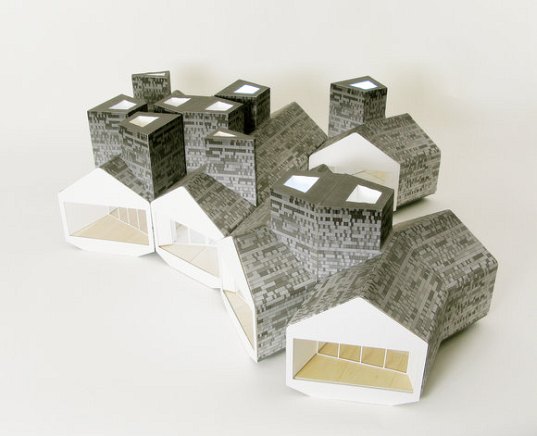
MOS Architects’ prefab strategy is based around a stereotypical housing unit, the Element, which has a simple cross section. This housing unit can the be combined in an infinite number of ways, but for the home to make sense, MOS uses the Fibonacci sequence to create the layout. In theory this results in a more natural, more organic home, which is hopefully more pleasing to the those living inside. MOS also proposes that this prefab housing concept could be expanded past single family homes, to multi-family homes or even a whole village. Elemental units can be added or subtracted as needed to accommodate for new families or changing needs.
One distinct characteristic of the dwellings are the chimneys seen popping up from some of the modular units. These are actually not chimneys, but light wells, which bring natural light into the interior of the homes and also act to increase natural ventilation. MOS’s inclusion of these stacks was also an exploration of the hearth, and by removing it, they comment on the changing times, and how technology has removed the need for the traditional fireplace.
The Element House would follow strict LEED design criteria and will also be off the grid, functioning independently of utilities. With the light wells and large windows on the end, natural daylight would provide light for the interior, and natural ventilation helps with cooling. The prefab modules would be limited to to a max size of 1,500 sq feet each, encouraging smaller living.
In case you’re in Denver this weekend, Principals Michael Meredith and Hilary Sample of MOS Architects will be giving a lecture on their new prefab housing strategy at the Museum of Outdoor Arts. The lecture takes place on Saturday, April 10th at 4:30 pm with an opening reception from 5-9pm. The exhibition continues through August 14th, 2010.
Via Core77
[1]
Prefab housing is as much about efficiency of construction as it is about building homes that make sense for the end user. The Element House, by MOS Architects, is a modular housing prototype designed for a “new ecology” — one that can grow and change depending on the family’s needs. Based around a modular element, with strong environmental design criteria, the Element House expands according to the Fibonacci sequence, “a describer of developmental patterns in living organism.”
[2]
Each elemental unit has a simple layout consisting of a rectangular box and a triangular roof.
[3]
Chimneys poke out of some of the modular units, but in reality they are not fireplaces, but light wells that bring natural light to the interior of the home.
[4]
The modules come in a few different basic shapes, but can all be attached together, allowing for multiple configurations.
[5]
MOS’s aim was to create a prefab strategy that could accommodate everyone, but still be easy to manufacture.
[6]
The modules could even be formed together in order to create larger multi-family homes or maybe even large complexes or even a village.
[7]
Inspiration for the formation of the modular houses came from the Fibonacci Sequence.
[8]
The homes come together and grow based on organic forms found in nature. Here the Fibonacci Outgrowth is represented.
[9]
With nature driving the pattern for construction, the building would appear natural and organic.
[10]
“This mathematical series was applied in order to explore the idea of recombinatory growth in building forms and the economics of spatial compartmentalization.”
[11]
Light wells, which appear to be chimneys from the exterior draw in light into the inner spaces of the home.
[12]
With changing technology the traditional fireplace is less important and the fireplace and chimney are intentionally transformed to make the home more naturally lit and ventilated.
[13]
This diagram shows how the light reaches into the home from the exterior windows as well as the light wells.
[14]
An exhibition and a lecture about the Element House will take place on April 10th, 2010 at the Denver Museum of Outdoor Arts.

 [1]
[1]
 [2]
[2]
 [3]
[3]
 [4]
[4]
 [5]
[5]
 [6]
[6]
 [7]
[7]
 [8]
[8]
 [9]
[9]
 [10]
[10]
 [11]
[11]
 [12]
[12]
 [13]
[13]
 [14]
[14]