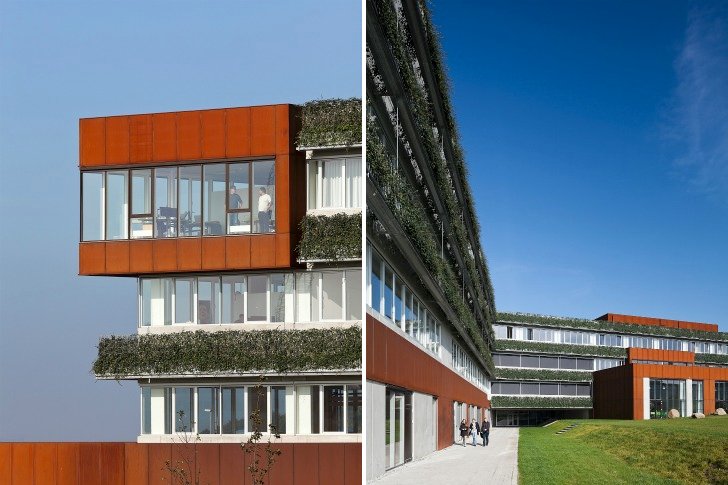
The aim of Campus Aarhus N is to consolidate the activities of one of Denmark’s largest educational institutions. Shaped like a plus sign, the 27,000 sq meter building has four wings shooting out from a central atrium. The school’s vision was to have a building with flexible, dynamic, cross-disciplinary study environment where students can meet, study, and learn. Inside there are auditoriums, a multimedia centre, a canteen, intimate meeting rooms, social meeting spots and lounge areas.
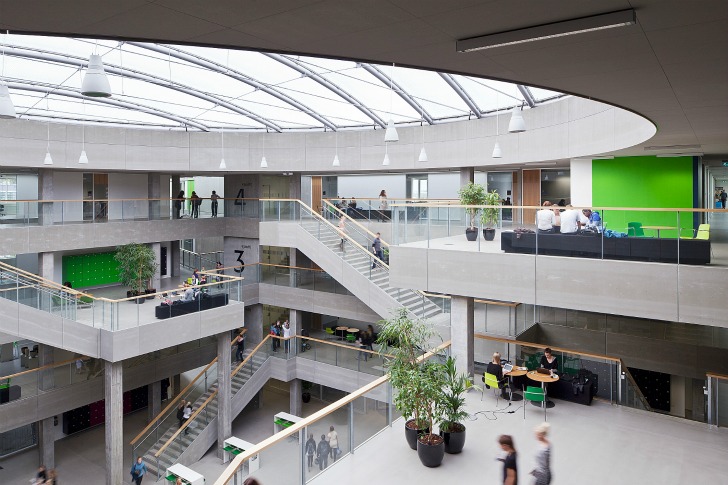
Daylighting plays an integral role in the new campus building, most prominently featured in the central atrium. A large domed skylight pulls natural light down into the multi-story open space that acts as a giant plaza and crossroads. Daylight slits and skylights are also integrated into the rest of the building to create more optimum lighting conditions for study. Artificial lighting is controlled by sensors to minimize energy use when not needed.
[1]
October 11th marked the opening of the new, ivy-trimmed Campus Aarhus N at the VIA University College in Denmark. Attended by Her Royal Highness Crown Princess Mary, the new university building unifies VIA’s healthcare facilities which were previously located in separate locations. The four-winged campus building provides space for six fields of study and encourages knowledge sharing and synergy between the disciplines. Schmidt Hammer Lassen took the reigns on designing the facility, and as expected…
[2]
The aim of Campus Aarhus N is to consolidate the activities of one of Denmark’s largest educational institutions.
[3]
The school’s vision was to have a building with flexible, dynamic, cross-disciplinary study environment where students, lecturers and visitors can meet, study, teach and learn.
[4]
Inside there are auditoriums, a multimedia centre, a canteen, intimate meeting rooms, social meeting spots and lounge areas.
[5]
Daylighting plays an integral role in the new campus building, most prominently featured in the central atrium.
[6]
A large domed skylight pulls natural light down into the multi-story open space that acts as a giant plaza and cross roads.
[7]
Daylight slits and skylights are also integrated into the rest of the building to create more optimum lighting conditions for study.
[8]
Artificial lighting is controlled by sensors to minimize energy use when not needed.
[9]
A specialty Variable Air Volume (VAV) technology manages the movement of natural ventilation and automatically adjusts depending on the number of people in the room and the desired temperature.
[10]
With all the energy efficient measures the building will operate with an annual energy consumption of 75 kWh per square meter, which is 20 percent below the level required by the Danish building regulations.
[11]
Campus Arhus N, Schmidt Hammer Lassen, via university, sustainable campus, green building, eco university, daylighting, living facade
[12]
Water use will be minimized with water efficient fixtures throughout the building. Green roofs will act to insulate the roof and collect rainwater, which is used for irrigation of the building’s green facade.
[13]
The ivy-trimmed living facade provides solar protection for the structure and creates a pleasant microclimate around the building.
[14]
Then surrounding the building, landscaping is used to enrich the campus experience and a variety of activity and sensory gardens have been planted.
A specialty Variable Air Volume (VAV) technology manages the movement of natural ventilation and automatically adjusts depending on the number of people in the room and the desired temperature. With all the energy efficient measures the building will operate with an annual energy consumption of 75 kWh per square meter, which is 20 percent below the level required by the Danish building regulations. A rooftop solar system will supplement some of the energy use.
Water use will be minimized with water efficient fixtures throughout the building. Green roofs will act to insulate the roof and collect rainwater, which is used for irrigation of the building’s green facade. The ivy-trimmed living facade provides solar protection for the structure and creates a pleasant microclimate around the building. Landscaping, which surrounds the building, is used to enrich the campus experience and a variety of activity and sensory gardens have been planted. Parking areas have been paved with grass and the remaining areas on the rural campus will become flowery meadows.
October 11th marked the opening of the new, ivy-trimmed Campus Aarhus N at the VIA University College in Denmark. Attended by Her Royal Highness Crown Princess Mary, the new university building unifies VIA’s healthcare facilities which were previously located in separate locations. The four-winged campus building provides space for six fields of study and encourages knowledge sharing and synergy between the disciplines. Schmidt Hammer Lassen took the reigns on designing the facility, and as expected…
[2]
The aim of Campus Aarhus N is to consolidate the activities of one of Denmark’s largest educational institutions.
[3]
The school’s vision was to have a building with flexible, dynamic, cross-disciplinary study environment where students, lecturers and visitors can meet, study, teach and learn.
[4]
Inside there are auditoriums, a multimedia centre, a canteen, intimate meeting rooms, social meeting spots and lounge areas.
[5]
Daylighting plays an integral role in the new campus building, most prominently featured in the central atrium.
[6]
A large domed skylight pulls natural light down into the multi-story open space that acts as a giant plaza and cross roads.
[7]
Daylight slits and skylights are also integrated into the rest of the building to create more optimum lighting conditions for study.
[8]
Artificial lighting is controlled by sensors to minimize energy use when not needed.
[9]
A specialty Variable Air Volume (VAV) technology manages the movement of natural ventilation and automatically adjusts depending on the number of people in the room and the desired temperature.
[10]
With all the energy efficient measures the building will operate with an annual energy consumption of 75 kWh per square meter, which is 20 percent below the level required by the Danish building regulations.
[11]
Campus Arhus N, Schmidt Hammer Lassen, via university, sustainable campus, green building, eco university, daylighting, living facade
[12]
Water use will be minimized with water efficient fixtures throughout the building. Green roofs will act to insulate the roof and collect rainwater, which is used for irrigation of the building’s green facade.
[13]
The ivy-trimmed living facade provides solar protection for the structure and creates a pleasant microclimate around the building.
[14]
Then surrounding the building, landscaping is used to enrich the campus experience and a variety of activity and sensory gardens have been planted.
 [1]
[1]
 [2]
[2]
 [3]
[3]
 [4]
[4]
 [5]
[5]
 [6]
[6]
 [7]
[7]
 [8]
[8]
 [9]
[9]
 [10]
[10]
 [11]
[11]
 [12]
[12]
 [13]
[13]
 [14]
[14]