One Cool Habitat is built out of a 20′ shipping container, using the chasis of the container as a basis for the space. They cut out space for windows and doors, efficiently reusing the cut parts or sending them off to shipping container rebuilders. Windows are bonded to the frame of the structure similar to how a car windshield is attached — this provides extra support for the frame. Rather than traditional insulation and wall facing, a composite panel is used that provides efficient insulation, strength, and a wall. This composite is also fire-retardant, vermin proof and fully recyclable.
The space within this standard 20′ shipping container can be set up however the buyer wants — whether you need an extra room, an office, or even a place to hang out. One Cool Habitat builds out the space and installs the interior walls, but then the owner has the opportunity to build out the interior however they want. As Paul Bartlett, a designer for the firm told us, “Instead of designing a prefab to be all things to all people, it was felt that a broader appeal would derive from a client having greater options to customize it to suit their tastes, and most importantly – on their budget. And this would be carried out in house by the client once receiving the unit, within their own timeframe.“
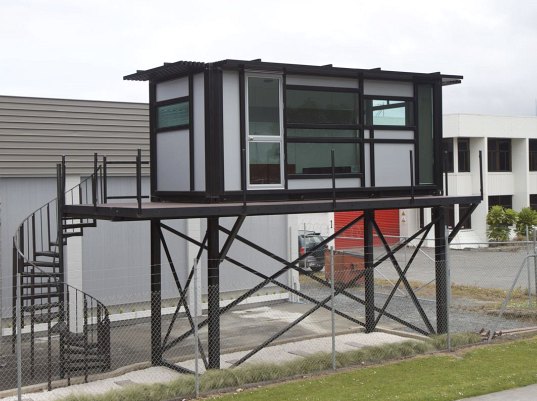
One Cool Habitat’s prefabs can be shipped anywhere around the world and are considered temporary structures, so there shouldn’t be issues with zoning or codes. The prefab can be easily transported on the back of a truck and placed anywhere with a level floor. They can even be placed up on a platform, like the unit at their office (the platform was previously used to hold the America’s Cup yachting trophy from when the race was held in New Zealand). They expect to build and ship their base model, which is about 160 sq feet, starting at US $29,500.
[1]
One Cool Habitat, a prefab maker out of New Zealand, has a different take on prefabs than most other manufacturers do. Typically with prefab homes, you get the design they’re selling and changes could cost you a pretty penny. One Cool Habitat believes a
[2]
One Cool Habitat wants you have the exact space you need and want, not some cookie cutter house.
[3]
Built from a 20′ shipping container, the windows and doors are cut out and then reinforced with other elements like windows and walls to add strength.
[4]
One Cool Habitat’s can be placed anywhere, even high up like this one at their factory. The platform was previously used to hold the trophy for the America’s Cup Yachting Tournament when it was in New Zealand.
[5]
The metal cut out for windows and doors is saved and either reused or sent off to companies that rebuild shipping containers.
[6]
The steel window frames are jig welded, and subsequently welded into the openings. Glass is then bonded directly onto the frame, similar to how windscreens are bonded onto a car. This bonding method reduces the use of traditional aluminum extrusions and
[7]
A new sliding door system allows for larger doors to be manufactured, and this reduces the footprint by not requiring a clear-way for a swing out door in confined spaces.
[8]
The traditional three-stage process of battening, insulating, and wall facing the internal linings proved time-consuming and relatively uneconomical.
[9]
A composite panel is now used that offers a high strength, fire retardant, vermin proof, non-sagging insulative alternative that is completely recyclable. Because these panels are able to span their length unsupported from edge to edge, these ‘floating
[10]
The interior can be outfitted and finished however the owner wants according to their needs, timeframe and budget.
[11]
The accessory space can become an extra office, bedroom, studio or even just a place to hang out.
[12]
There are many choices available as to what lies underfoot; flooring options will be offered in the form of recycled timber, or a choice of soft linings. Acrylic paint finishes are currently used, and new alternatives are being assessed for extended durability in harsh environments.
[13]
The turnkey prefab base model will start at $29,500. One model is inspired by the design of early fifties diners that incorporated elongated panoramic windows, with the functionality of a solid ‘skirt’ that allows furniture placement at lower levels. The other design is still top secret.
[14]
One Cool Habitat can easily be transported on the back of a truck and lifted off with a harness.

 [1]
[1]
 [2]
[2]
 [3]
[3]
 [4]
[4]
 [5]
[5]
 [6]
[6]
 [7]
[7]
 [8]
[8]
 [9]
[9]
 [10]
[10]
 [11]
[11]
 [12]
[12]
 [13]
[13]
 [14]
[14]