


Start Slideshow


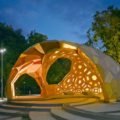 ICD/ITKE Research Pavilion 2011The humble little sand dollar served as the inspiration for this amazing new pavilion in Stuttgart, Germany. Designed through a collaboration between the <a href="http://icd.uni-stuttgart.de/" target="_blank">Institute for Computational Design</a> (ICD), the <a href="http://www.itke.uni-stuttgart.de/" target="_blank">Institute of Building Structures and Structural Design (ITKE)</a>, and students from the University of Stuttgart, the wooden research pavilion is an exploration of biological principles translated into architecture. Thin sheets of plywood were laser cut and pieced together into the polygonal plywood structure. Finger joints, which are seen as the technical equivalent of a sand dollar's morphology, are used to connect the parts together, resulting in an incredible temporary pavilion located in a public square at the university.1
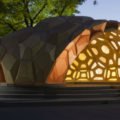 ICD/ITKE Research Pavilion 2011For the second year in a row, the <a href="http://icd.uni-stuttgart.de/?p=6553" target="_blank">ICD/ITKE Research Pavilion</a> is a chance to explore architecture through computational design.2
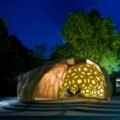 ICD/ITKE Research Pavilion 2011This year inspiration for the temporary pavilion came from sea urchins and more specifically, the sand dollar.3
 ICD/ITKE Research Pavilion 2011The plate skeleton morphology of the <a href="http://en.wikipedia.org/wiki/Sand_dollar" target="_blank">sand dollar</a> is composed of a modular system of polygonal plates that are linked together at the edges by finger-like calcite protrusions.4
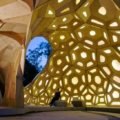 ICD/ITKE Research Pavilion 2011This system of joints and plates allows the sand dollar to bear a high load bearing capacity.5
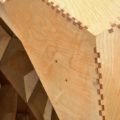 ICD/ITKE Research Pavilion 2011It is because of this understanding of the sand dollar, the researchers decided to use it as the basis for its most recent design.6
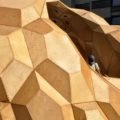 ICD/ITKE Research Pavilion 2011In collaboration with students from the university, the <a href="http://icd.uni-stuttgart.de/?p=6553" target="_blank">ICD/ITKE</a> developed a computational model of polygonal modular elements joined together.7
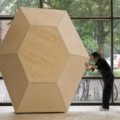
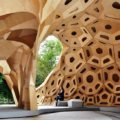 ICD/ITKE Research Pavilion 2011Three plate edges always meet together at just one point, which allows for normal and shear forces but no bending moments.8
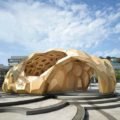 ICD/ITKE Research Pavilion 2011This geometry allows for large lightweight structures to be built from simple plywood.9
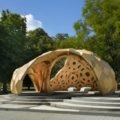 ICD/ITKE Research Pavilion 2011In fact the entire pavilion is constructed out of 6.5 mm plywood sheets and is so light it had to be fastened down to the ground to avoid being blown away.10
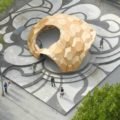 ICD/ITKE Research Pavilion 2011The pavilion was assembled in a public square between the <a href="http://www.uni-stuttgart.de/home/" target="_blank">University of Stuttgart's</a> buildings and consists of two distinct spatial entities.11
 ICD/ITKE Research Pavilion 2011ne large opening exposes a large interior space with a porous inner layer, while a smaller interstitial space enveloped between the two layers that exhibits the constructive logic of the double layer shell.12
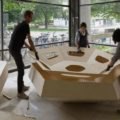 ICD/ITKE Research Pavilion 2011The modular bionic pavilion is at the forefront and intersection of architectural research and teaching.13
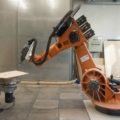 ICD/ITKE Research Pavilion 2011The university's robotic fabrication system was used to cut out the plates and their finger joints for a total of 850 geometrically different components.14














