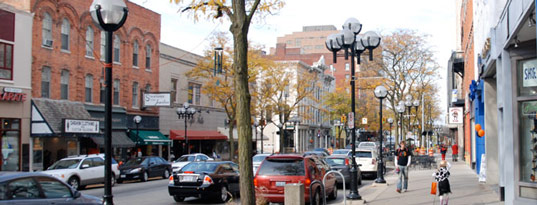
We haven’t been giving Ann Arbor, Michigan enough attention and the city deserves it! Last year Ann Arbor joined forces with LED manufacturer Cree, Inc, on an ever-expanding citywide LED initiative to save energy and reduce greenhouse gas emissions. With a recent retrofit contract signed with Lumecon, Ann Arbor is on its way to being the first U.S. city to light up its downtown with 100% LED technology!
Related Posts
-
Building a new stadium is always a massive undertaking that requires millions of dollars, substantial physical labor, and a vast amount of electricity to keep
-
Rizhao 日照 means “sunshine” in Chinese, which is quite an appropriate moniker… Since 2001, Rizhao City (Shandong Province, China) officials have been educating the
-
The US Department of Energy recently announced a five-year, $122 million grant to establish a new research facility in California with the goal of developing
20 Responses to “Ann Arbor Lighting Up With 100% LEDs!”
-
Featured Author
-
Read Inhabitat
-
Search Categories
-
Recent Posts
-
Recent Comments
-
Browse by Keyword
follow inhabitat on:
popular today
all time
most commented
more popular stories >
© Inhabitat.com 2012 | About Inhabitat | Contact Us | Advertising with Inhabitat | Terms Of Use | Privacy Policy | Inhabitat, LLC


About time!
I’m using Cree LED lights in a lot of my rooms for lighting and they work pretty well. They’re expensive, but lighting a room with less than 10watts is impressive
http://www.spymac.com/details/?2334927
Wow, the LIGHT POLLUTION they emit is absolutely HORRIBLE. Not only do they emit bright multispectral light that you can’t FILTER OUT, they direct it not into the STREET, but into THE SKY.
Will I ever be able to see the stars again?
I love to visit this place within my lifetime
Nice, can’t wait until we can buy leds for our homes.
Damn hippies!
Ann Arbor is a great city, I got to University of Michigan and I love it here
go*
Cool. Anyone know what happens to the bulbs that are removed? Where do they go?
madison wi has some LED traffic lights and they suck in winter because they dont produce heat and therefore don’t melt any snow that covers them up in winter. Tha’ts bad. bad.
LED is not a very efficient way to convert power into energy, although it lasts longer and creates less heat, the efficancy is only at maybe 40%, pretty bad actually, it takes so many more LEDs to light the same area as an incandescent or an HMI or an arc lamp. flourescents are still the best however they contain large amounts of mercury, on of the most deadly substances we can come up with.
Lots of luck!
They are wasting at least half the light by shooting it into the sky. It also has a serious impact on astronomy and people who just like to see, you know, stars and stuff. Check out the International Dark-Sky Association here: http://www.darksky.org/ They have a list of IDA-approved fixtures that reduce light pollution.
Love the power savings Ann Arbor, let’s see if we can save another 40% by shooting the light downwards.
Ted
@ Ted
Good point, except for the part about mercury. Compared with thermometers, and watch batteries, fluorescent lamps have tiny amounts of mercury. LEDs are great for exit signs and x-mas tree lighting, but for illumination, only some can compare with CFLs–linear fluorescents are still the most efficient way of providing ambient lighting.
Ah, People need to do some research before bench-discussing(I can’t use benchracing) LED technology, and don’t just judge by the pictures in this thread. One of the key benefits of LED technology is that it is directional (light path) therefore reducing to eliminating light pollution in the future. Looking at the street globes in the pic and not knowing how Peter engineered and what the city/town engineers, requested in the design, I will have to check them out when I get back to MI. in March. I can only assume why the light path was designed to escape vertically.
As far as disposing LED lights, there is no mercury or any caustic materials (solid state technology).
Basically, when you buy led replacement bulbs for your household, when you sell your house, take them with you to your next residence. Many have a service life baseline of 50,000 hrs, which is like keeping on for 7 years without ever turning them off, many will last much longer!
Yes, the first generations of LEDs(a while ago) used many many individual leds which looks like a cluster (30 and more for one bulb). This stuff is still sold today and there is A LOT of LED JUNK out in the market, so buyer BeWare! Though, not all multi diodes or Led’s are bad bulbs or considered junk. You have to be careful what and where you buy because there is A LOT OF BAD LED stuff out there. I have seen bad batches of different types.
The new technology, some 1 watt high power 1 LED (not high consumption) diodes are insane how powerful they are. I have 1 watt #194 auto bulbs(meaning they consume 1 watt, they emit much more than 1 watt) in my parking lights in my car that are brighter than my fog lights which are 55W. For instance, if you have track lighting in your house and know how hot they get and how much heat they generate(usually a MR16), you can replace these halogen MR16 bulbs with a 1 watt/ 1 LED bulb or even a 3 watt/ 3 LED MR16 which also comes in different colors like, cool white or warm white. These can be taken out with your hands even if they have been on all day(they do get warm though nothing like halogen),
It will be pointless to get into all the dynamics and am not here to convice, make, force people to listen to my words.
All I ask is do some accurate research and try and test them yourself then make your own decision. I think you will find the proof is clear.
Virtually everything will be replaced with LED technology in the near future, until a new technolgy is discovered or invented which will replace LED.
fluorescent ligths are evil. if you need it explained to you you’ll never get it
LED is the way to go. If we as a country continue to waste energy and pollute our environment with CO2 because of our use of inefficient, wasteful lighting, we will not be here to gaze at the stars. Ann Arbor should be commended for taking steps to reduce their carbon footprint. We as a whole should strive to be more like Ann Arbor in our own lives.
[...] A2 isn’t just switching a few of its streetlights; according to Inhabitant.com, the home of the University of Michigan is “on its way to becoming the first U.S. city to [...]
Its really worth to have a visit there… i wish i could do it soon.
Relume Technologies of Oxford, MI is the manufacturer.
RE: Patrick Wambold and other people who don’t know much about LEDs:
Incandescent lamps are rated at 15-20 lumens per watt (lm/W) and halogens are rated at 17 lm/W, which is pretty atrocious (about 2% efficient). High-pressure sodium and HID are the best, with 100 lm/W. Fluorescent bulbs are also really good, at 60-100 lm/w.
LEDs are at approx. 60-90 lm/W, but are steadily improving in efficiency and have bulb lifetimes over twice the length of other technologies. This results in less maintenance to repair the bulbs, which means less bulb purchases and production costs, less gas for the trucks to replace them, etc. They’re also the only directional light on the list, so we can use LEDs with less power because they only need to light the area we want them to.
I’ve switched my home lights from fluorescent to led and have seen a reduction in my electric bill of 40%. Electric comsumption reduced by 30%. The bulbs last much longer and are dimmable.