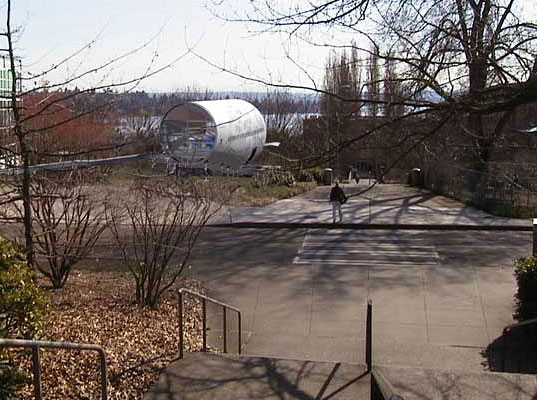
Last year we wrote about Lot-ek’s recycled airplane fuselage library and got a ton of interest from people who appreciated the architects’ creative reuse of old planes. Well, it turns out that Lot-ek has another recycled airplane project for an education facility- check out this reclaimed aeronautical stunner. Using a 60-foot-long section of a Boeing 747 plane, Lot-Ek’s Student Pavilion at the University of Washington in Seattle turns fuselage into function.

Related Posts
-
Move out of the way shipping containers… there’s a new kid on the block: airplane fuselages. New York’s urban architect recyclers, LOT-EK, have recently designed a
-
Here at Inhabitat we’re huge fans of recycled airplane architecture, and it turns out that if you’re building a house on a sprawling property deep
-
The eco-farm consists of four small-scale public buildings: a club house, a harvest pavilion, a botanical showroom, and an information center. Completed in 2012, the
10 Responses to “RECYCLED AIRPLANE PAVILION by Lot-ek”
-
Featured Author
-
Read Inhabitat
-
Search Categories
-
Recent Posts
-
Recent Comments
-
Browse by Keyword
follow inhabitat on:
popular today
all time
most commented
more popular stories >
© Inhabitat.com 2012 | About Inhabitat | Contact Us | Advertising with Inhabitat | Terms Of Use | Privacy Policy | Inhabitat, LLC


This is most excellent. Reduce, reuse and recycle!
As a former flight attendant who spent at least 25 years on the 747 and now as an interior designer I can really appreciate how this fuselage was recycled into a functional lounge. Excellent idea.
…heating and cooling an UN-insulated aluminum tube will cost an arm and a leg…but of course, the designer will not have to pay for any of that…
Another unique ‘GREEN” idea, Incredible! Love it!
Please tell me this is a joke! I mean really – do they need the building at all? How much energy will be expended in getting this hulk supported and retrofitted?
We need to start taking this stuff seriously, and silly stunts like this just help us to fool ourselves. We need to legislate change and alter our consuming and importing habits before it is too late!
maybe it would have been more efficient to do this project at the site of the airplane graveyard, so there wouldnt be wasted energy in moving the fuselage. but maybe all of us living in caves and drawing our ideas with the bones of elephants and sheeps blood on the walls would also be a step in the right direction since passing ideas along via the internet wastes electricity also.
i think its refreshing to have a firm who sees opportunity in recyclables.especially when the recyclable materials dont need to be totally reprocessed to be reused. once the building returns itself to being junk at the bottom of the ocean, it will have been the worlds most versatile space. starting as a fortress in the sky, then a library on the ground, and then a reef in the gulf of idaho!
Call me a Philistine, but aren’t there any other values besides recycling — like for instance aesthetics? That thing is UGLY. And come to think of it, what kind of heat loss does an aluminum-skinned room have? Sorry, but in this case the airplane graveyard should have kept the carcass and ground it up for use in beer cans and hub caps.
Could somebody knowledgeable answer the question about insulation? A couple people have claimed it’s not insulated at all. How can that possibly be true? Planes regularly spend hours in -60 F temperatures. Here in Seattle we rarely get below freezing…
I think this is a brillant idea. I don’t think its ugly, its very modern and stylish. If there is a problem with it being energy efficent, I am sure the designers and architects could come up with something to solve that issue.
In response to Davids comment. You are absoloutely correct in stating that planes work in freezing conditions and are incredibly well insulated, the pictures above however show that the insulation has been stripped out along with the interior fittings making it a thermally conductive alluminium tube. It is possible to spray coat insulation onto these surfaces but it looks like the designer chose not to