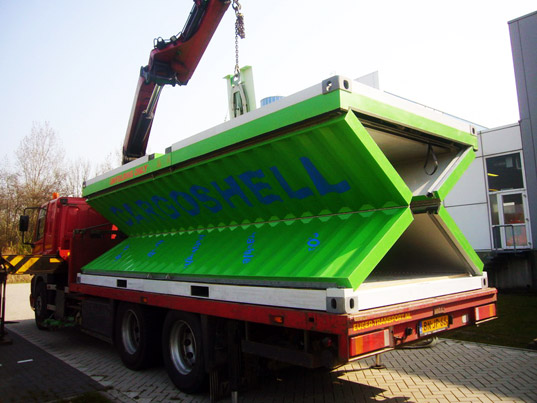
Ocean-bound shipping containers are an often-overlooked source of CO2 emissions — over 90% of all non-bulk cargo carried worldwide arrives in containers, and many of them are sent back empty. Enter the innovative Cargoshell collapsible shipping container, which can drastically cut emissions on return trips by collapsing to a quarter of its full size.

Collapsible Cargoshell Shipping Container Cuts Emissions
by Ariel Schwartz, 02/08/10
filed under: Green Transportation
Related Posts
-
The humble shipping container has truly come into its own over the last decade as architects and designers have innovated ump-teen new ways of re-purposing
-
As COP15 delegations continue in Copenhagen, Danish architects MAPT have erected a striking pavilion composed of a set of old shipping containers stacked up like
-
This beautiful sunset observatory made from recycled shipping containers was recently constructed in the harbor of Songdo New City in Incheon, South Korea. Designed and
4 Responses to “Collapsible Cargoshell Shipping Container Cuts Emissions”
-
Featured Author
-
Read Inhabitat
-
Search Categories
-
Recent Posts
-
Recent Comments
-
Browse by Keyword
follow inhabitat on:
popular today
all time
most commented
more popular stories >
© Inhabitat.com 2012 | About Inhabitat | Contact Us | Advertising with Inhabitat | Terms Of Use | Privacy Policy | Inhabitat, LLC


At a glance this seems amazing. But don’t the ships have to go back to pick up the full containers anyway? Unless we start packing ships onto ships, I don’t see how any of these 10,000 voyages can actually be cut.
Please tell me where I went wrong. I want this to be a good idea.
If a ship can only fit, say, 1000 containers normally – with these collapsible containers it could fit 4000. Likewise, trailers used to transport them across the country could more efficiently move empty containers to wherever they need to go.
But if one ship brings back 4000 empty containers, what are the other three ships that brought the original containers across going to do? They still have to go back to pick up the refilled containers, no?
andyt: I can see the problem you’re talking about, but there’s something you’re not considering. Without the containers on board the ships are considerably lighter, meaning better fuel efficiency going back across to pick up more cargo. I’m no expert on this, but basing this off land transport, a 4x the cargo does not mean 4x the fuel consumption to get it there. In other words, the ratio of fuel use to cargo is not 1:1. So I’d be willing to wager that while the one ship taking back 4000 containers might use more fuel than if it only had 1000, the increased consumption to carry those back would more than likely be less than amount saved by freeing up those three other ships.