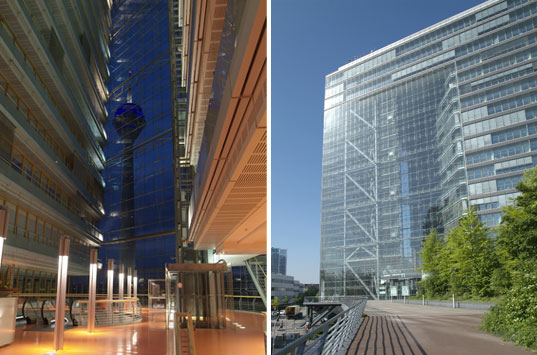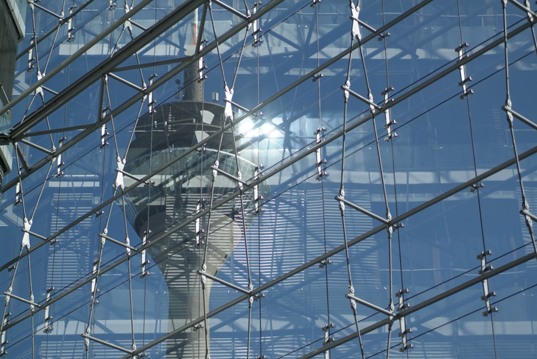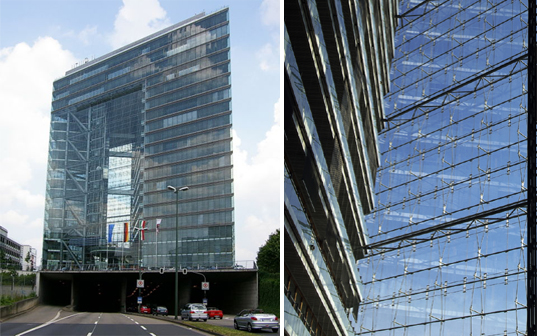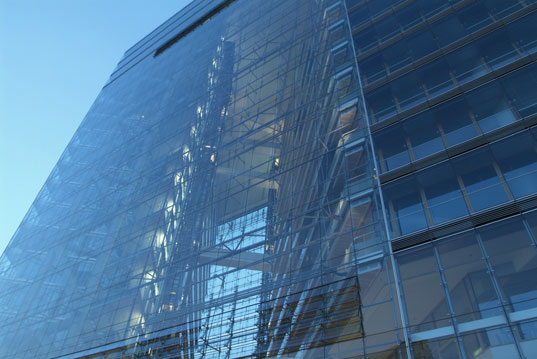

City gates in Europe have a long history of being both functional and aesthetically important, and the Stadttor in Düsseldorf, Germany, is no exception. Completed in 1998, the double-skin glass façade building is a nod to traditional design but with high tech 20th century performance capabilities. Its energy-efficiency systems are some of the most high-tech and advanced we’ve seen, from sensors to radiant heating and efficient ventilation.
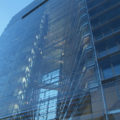
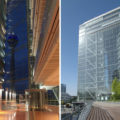
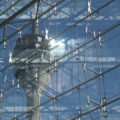
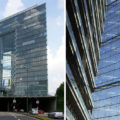
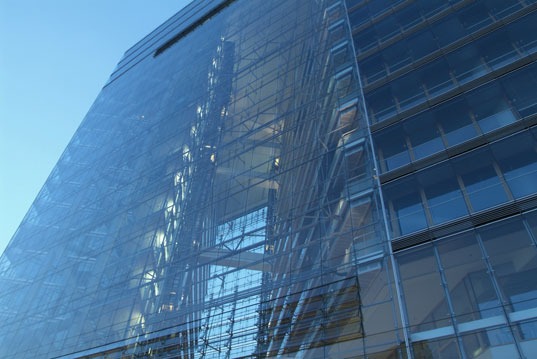
Designed by Petzinka, Pink & Partners, the Stadttor stands guard over the city’s sunken main artery. Two 16-story towers enclose a 56m high atrium designed to allow maximum natural daylighting, a citywide building ordinance. The interior glass façade features double-pane, low-E glazed doors operable at every other bay and high-reflectance Venetian blinds. At each story, a climate buffer corridor circulates fresh air between facades allowing natural ventilation for 60% of the year.
The Stadttor’s mechanical systems are fully computerized with 14,000 sensors located throughout the building to moderate and maximize energy efficiency. In winter months the structure uses on-site recaptured heat as well as excess thermal produced by Stromkraftwerks, an electrical plant upriver on the Rhine. An on-site geo-exchange system supplements heating with ceiling integrated radiant transfer that also serves the building’s cooling needs.
Cool, long-lasting lighting systems are centrally programmed but can also be controlled individually within work spaces. Natural daylighting, natural ventilation and humidity control provide optimum thermal comfort that enhances occupant experience and the building’s energy performance.
The Stadttor’s whole building design and systems allow a energy savings of 70% over a closed system, conventionally conditioned commercial space.