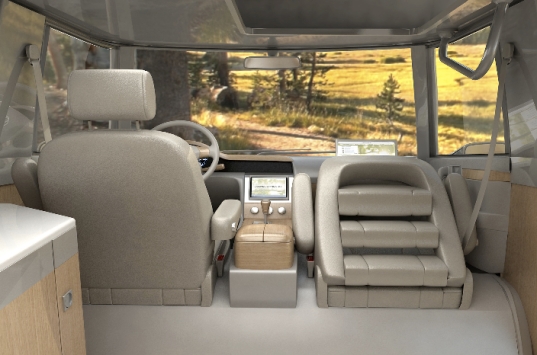
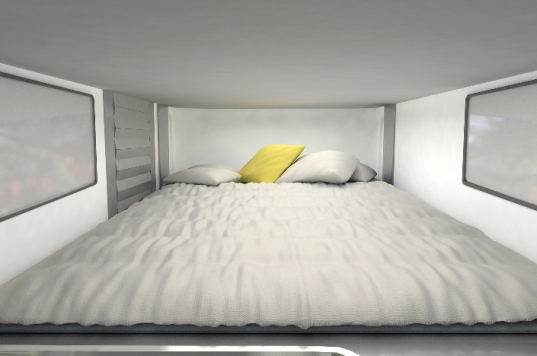
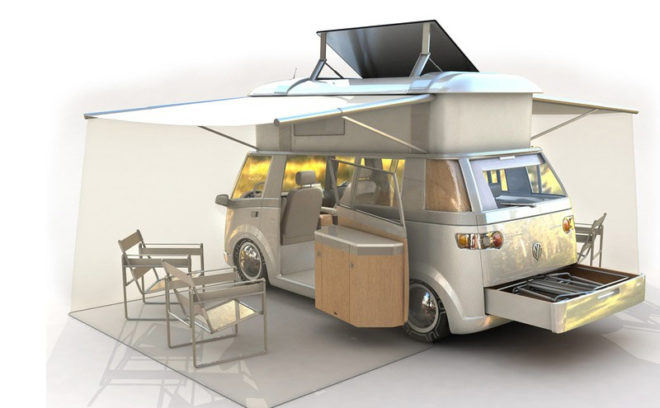
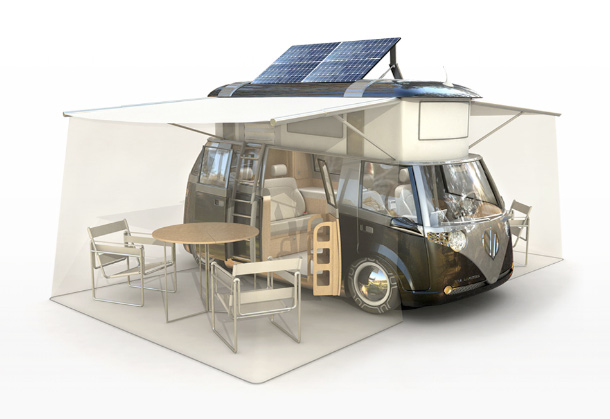
What with gas prices being as high as they were this summer, we didn’t go on as many road trips as we would have liked to. If we had a camper like the Verdier Solar Powered Camper, we definitely would have embarked upon more road trips to beautiful National Parks and done it in eco-style. Verdier’s eco-RV is based upon a classic VW Westfalia that has been upgraded with many green elements, like a hybrid engine, solar panels and a lot of high-tech systems that makes this bus a hippy’s Pimp My Ride dream come true.
Related Posts
-
Moby-1 XTR Expedition Trailer Moby1‘s XTR puts a modern spin on the classic pull-along teardrop trailer. While the look of this camper may be retro, this
-
There’s a sense of freedom to be found in loading up your RV with all you need to survive and hitting the road to explore
-
The Opera features a low profile design that makes it easy to tow behind a sedan rather than a larger SUV or truck (which is
13 Responses to “Verdier’s Stylish Solar-Powered Eco Camper”
-
Featured Author
2012 Pritzker Prize Awarded to Wang Shu – First Chinese Architect to Win the Award
Curved House is a Modern Residence with Distinctive Sustainable Strategies in Missouri
Sugarhouse Studios Pop-Up Cinema & Workshop Encourages Community Interaction in London
Luxurious Floating Home Makes the Most of Its Small Footprint on Lake Union in Seattle
This author's twitter feed is currently unavailable. Please try again later.
-
Read Inhabitat
-
Search Categories
-
Recent Posts
-
Recent Comments
-
Browse by Keyword
follow inhabitat on:
popular today
all time
most commented
more popular stories >
© Inhabitat.com 2012 | About Inhabitat | Contact Us | Advertising with Inhabitat | Terms Of Use | Privacy Policy | Inhabitat, LLC


i love it and i want one immediately!
about how realistic do you think it would be to get one of these and it be affordable?
i am definitely interested…
Love it. Send me one right away.
This is very attractive, but I wonder about the ratio of energy use to weight. Batteries are heavy, and solar power may only provide enough energy to transport the weight of the battery. I think this may be the image more than it is the practice of sustainability.
Excellent idea! I believe that solar will be able to play a big part in reducing our transport emissions. I am currently modifying a 1989 Toyota Landcruiser to drive from London to Cape Town raising money the charity Solar Aid. The power steering, cooling fan, water pump and all other electrics will run off Solar – hope raising efficiency by around 10%. I am using thin film Solar -which is light weight and flexible – and just be able to stick on the body work. Search “Overland in the Sun” to find my website.
The only green consumer is a dead consumer…
What’s the carbon footprint of making one of these things?
Is this for real? Have Verdier answer that. Please.
Great idea!
I have to finally chime in. This “product”, like so many shown in design mags/fora lately, is so completely virtual that it exists primarily as a proposal, a fantasy, a futuristic dream. CAD software and rendering technology has made it possible to image concepts to a high degree of apparent finish, but much stands between a gorgeously rendered glossy of a design concept and its proof: the final, physical product. I’m glad someone is thinking about this, and about self-sustaining prefab homes, and solar cars, and everything else. That’s why I like Inhabitat. But it really dilutes the impact of a report when we are left realizing that it has never been, and might never be, constructed in the real world.
Student projects appear every year imagining such fantastic uses of new technology, but on the ground, where we’re still dealing with existing building codes, aging infrastructure, and limited means, it’s almost insulting to discuss “green” projects that essentially sidestep any involvement in the real world. A lovely website with perfectly-rendered 3-D images does not a green product make.
Please, keep track of stories like this, and the yellow chrysalis restaurant in the trees, but identify them as concepts; visualizations, rather than completed, real projects. When they are completed and functioning, then graduate them to “real” status. At that point, there will also be more to report, such as actual energy use, battery life, final cost, availability, and user feedback.
I agree with MadroneZone, in that its not so great to only show photoshop’s capabilities. Also, if the designer is going to all the trouble of modding up such a dream, why put some ugly panel on top? Why not add a cool looking panel?
i’ve always wanted one but there werent very many so ive never been able to get one they were always to much but i think if i could find one i would bye it even if i had to work two jobs because i think this is a new age of vehicle
Say, could you paint one of these buggies robins egg blue and put a Dharma Initiative logo on the front hood ( or hatch if you like). Of coarse you would sell such a micro bus with a set of D.I. jumpsuits and a couple of D.I. six packs in the fridge. Put a P.A. system on the roof and you could drive around the “hood” announcing ” the swan is going to blow brothers!!!”.
P.S. DON\’T DRINK DHARMA BEER AND DRIVE!!!
ha! what a cool idea. Its perfect for the new aged, tech savy “hippy”
looks very nice and has some great ideas ie solar panels etc but one does not need all that techy stuff. One is to go camping to enjoy the outdoors not look at computor and watch movies etc. Too low to ground for gravel roads. Too expensive for average person. Should have a basic model for average person but not a hippy type.