


One of the major concerns over the current crop of renewable energy technologies is that they’re pretty expensive compared to dirtier, more conventional fossil fuels. However researchers at Boston University and the Fraunhofer Center for Manufacturing Innovation think they’ve found a way of producing cleaner, cheaper wave generated energy on demand. Their idea would send a fleet of wave-powered ships out into the middle of the ocean, where they would drop anchor and start gathering energy from the movement of the surrounding waves. This energy would then be stored in on-board batteries, and once fully charged the ships would return to shore where the energy could be distributed into the grid.


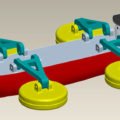

The concept was recently presented at the Clean Energy 2011 conference and expo in Boston. It would do away with the need for expensive transmission cables that currently take electricity from offshore power generation projects to the mainland. These cables typically cost more than $500,000 per kilometre and account for a significant fraction of the cost of conventional wave-generated electricity.
As reported by New Scientist, the 50-metre-long ships would harvest wave energy via buoys attached to their sides by pivoting arms. While the hull remains relatively stable, the buoys bob up and down on the waves, causing the arms to pivot back and forth and drive a generator producing up to one megawatt (MW) of electrical power. The batteries are planned to have a capacity of 20 MW/hours, so the ships would have to stay at sea for at least 20 hours to be fully charged.
The plan could produce electricity at $0.15 per kilowatt hour (kWh), which is far cheaper than energy produced from existing wave technology, which costs between $0.30 and $0.65 per kWh. In comparison, offshore wind energy costs from $0.15 to $0.24 per kWh, and solar power around $0.30 per kWh.
 Photo © Guigo.eu
One of the biggest benefits of this technology is the fact that when severe storms strike the ships can be kept in ports. However, this seems somewhat counter-productive because the strength of waves during a storm can produce huge amounts of electricity very quickly. Fixed wave-power generators must be built to cope with extremely high waves, which adds to their cost, but they can remain out at sea during storms and produce a great deal of energy. They also don’t involve the element of human danger apart from during maintenance.
Nonetheless, the cost savings of these vessels could signify a game-changer for the wave power sector. Furthermore, the fact that the technology can be retro-fitted onto existing ships makes for even more cost savings.
With cost being one of the few remaining barriers to renewable energy technology fulfilling our energy needs, projects like this are pivotal to our energy future.
+ Fraunhofer Center for Manufacturing Innovation
+ Boston University
Via New Scientist


