2005′s Solar Decathlon blew us away, but we were particularly fascinated by a stunning Solar House from Cornell University. This team brought a beautiful zero-energy home to the mall in Washington, D.C., and had just launched ZeroEnergy Design, a home design firm focused on zero-energy design. Continuing their momentum as green home design gurus, two of the Cornell Solar Decathlon team members have just launched a new endeavor aimed at bringing custom green design to the masses through an innovative business model called FreeGreen. Started by David Wax and his partner Ben Uyeda, FreeGreen is making green home designs free to everyone!
FreeGreen provides a selection of green home designs for free, with a range of styles from traditional to modern. While the basic designs are free, homeowners can take the process even further and customize their designs for an additional (and very reasonable) fee. The cost of the design process, and of the free home plans, is kept to a minimum through partnerships between FreeGreen and green building product manufacturers – paid placement from product manufacturers.
As homeowners consult with FreeGreen for customized designs, they are introduced to healthy, energy-saving, sustainable products that are sponsors of FreeGreen’s eco-enterprise. It is a win-win-win collaboration that introduces people to green building principles and products and allows consumers on any budget to own a custom designed, green home.
Ultimately, FreeGreen is about providing people with the options and knowledge to make informed decisions. Green building products are widely available but sorting through the myriad choices, or even knowing where to look, is a daunting task for most new homeowners. Freegreen is solving this problem by offering excellent green building consult at little cost to the consumer. According to the founders, “The goal at FreeGreen is not to produce the greenest possible home but rather to provide a variety of different home plans that allow people to create homes that fit their lifestyles in a responsible and equitable manner.”
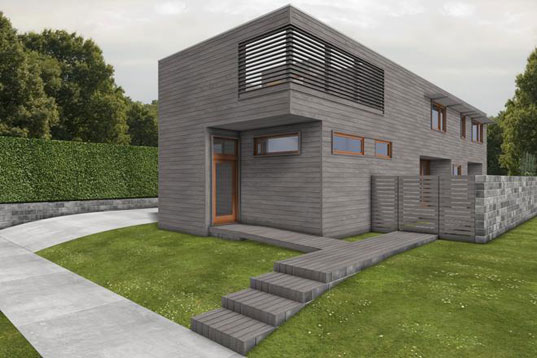
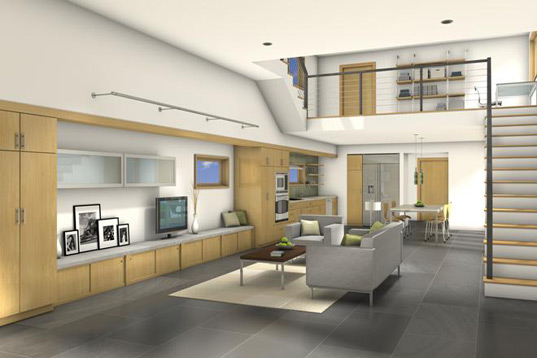
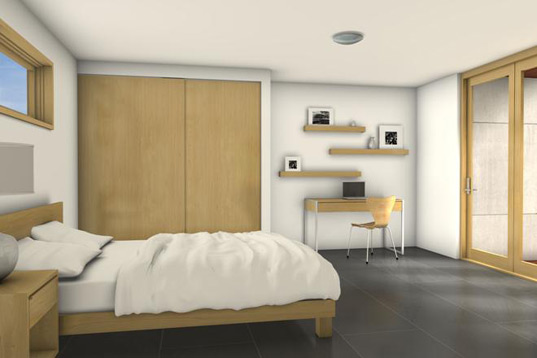
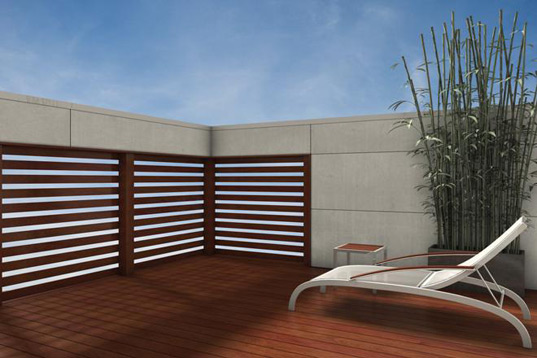
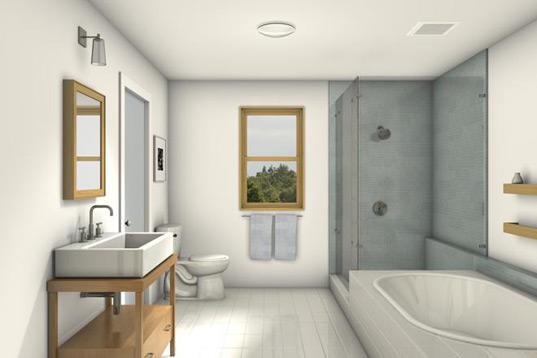
FreeGreen is launching this month starting with several great designs including our favorite, The Suburban Loft, a modern home suitable to all climates. Characterized by open floor plans and high ceiling loft spaces, this design will be available in a range of sizes to fit many lifestyles and landscapes.
We think FreeGreen is a great idea and a wonderful way to bring information, innovation and green design choices to everyone – “because green design should be accessible to all.” We are thrilled to announce the launch of FreeGreen!
+ FreeGreen
+ Independent Energy Homes
+ Cornell Zero-Energy Solar Decathlon Home


Great idea to help our society, all this house needs is solar energy….
Ashraf Naseer Amirrar
WOW ……………. this is great!
The Solar Decathlon is about immersing people into the challenge of building a high performance home that must achieve a series of stated goals. Every project usually starts with a series of stated goals. The multiple years spent researching and working on the construction of such a home allowed our founders to start two new companies, both with a focus on energy performance, indoor air quality, water conservation, and the use of sustainable materials. Total immersion in one extreme project for a long period of time allows for wonderful experience and perspective on some of the more mainstream projects to come accross our path later in life. Leveraging this sparingly is very useful.
Lastly, many of the Solar Decathlon houses after being used to demonstrate and inspire thousands, have been purchased and are being used by private individuals, not being \’scrapped\’.
The world could use more positive people and initiatives, for which I believe the Solar Decathlon fits the definition.
There has been much media attention paid to the Solar Decathlon event. And while the intent and purpose of the event may be of noble cause I feel it is mostly a PR tool for the EPA. Firstly, the EPA offers little to no financial assistance for competing teams. What is offered would barely cover moving expenses from anywhere in the nation to Washington D.C. This has created an exclusive arrangement where institutions that are able to fund the average costs of participation (around $500,000). In 2007 there were several entries that pushed the $1,000,000 threshold. This has left many smaller (but not lacking in talent institutions) out of the game that has created an inequitable disparity. Secondly, While the entries may appear to be energy efficient the criteria for judging and testing is set up such that quality of life issues are largely ignored if the buildings are to meet energy criteria. For example several entries would require all windows to be closed and blinds drawn in order to meet the testing criteria.
Lastly, How does this competition speak to the issues of sustainability? It is my guess that most of the entries are shipped back to their respective institutions (Not an insignificant amount of energy used there) and some might be sold or donated. But by and large it is my guess that most sit in a lot somewhere for a while and when nobody can figure out what to do with it they end up being scrapped and pitched in the dumpster.
While the intent of the Solar Decathlon is of a noble cause and the entries are can be a learning experience for all participants I feel the event has become nothing more than a marketing effort by the EPA to create the illusion that the agency is doing something about global climate change and sustainability issues. Firstly, the event is highly exclusive. Institutions must raise upwards of $500,000 in order to compete and several entries in 2007 pushed the $1,000,000 range. This effectively narrows the field to those institutions that have deep enough pockets to fund such an endeavor and excludes institutions that may have a worthy proposal but lack the monetary resources. To top it all off the EPA offers no financial assistance to the entrants. Secondly, the judging criteria is set up such that for entrants to meet the energy requirements during the testing portion of the competition the quality of life issues are largely ignored. For all intents and purposes a unit that meets the energy requirements will most likely have to have all the windows closed and blinds drawn. Thirdly, what becomes of these entries? My guess is that by abd large they get shipped back to their respective institutions, some are sold and some may be donated but it is my guess that most are either dismantled and scrapped or
Sounds like a great idea. Those look like really nice houses.
Anybody know what pre-visualization program they used for the photographs? It looks nicer than sketchup.
These guys are working to improve the status quo. They have created a platform by which progressive design can be distributed. Perhaps “theroberto” should submit a design that reduces construction waste. It seems as though they want to open things up to multiple designers which is super cool. Anyways, it is a wonderful site with great visuals and a very real step towards a more sustainable building culture.
This is great that it is free. But this doesn’t do much for solving the real problem, “building Construction Waste and ineffiency in the builing construction practice.” There is so much Energy that is wasted within the process of building….that is what people really need to start addressing. Sustainability should just be a given.
Love the new suburban loft design, and to think I can get the design for free…unbelievable. Thank you, Free Green!
WOW, this is great! I can’t believe it is actually free