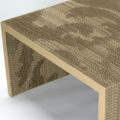
We covered British designer Giles Miller back in October when we covered the first [re]Design show in London. Now [re]Design is back, and the fabulous Miller has made an appearance again with his ingenious method of working with recycled cardboard, using the internal corragations to create patterns – a method he calls “fluting”.
Related Posts
-
Recycled cardboard has enjoyed a fair bit of action as far as the sustainable furniture circuit is concerned – but how often is it that
-
With the overwhelming number of generic black laptop totes flooding the market these days, it was refreshing to have a close encounter with Giles Miller’s
-
Giles Miller has wooed us with his intricate cardboard creations before, and now he’s brought us the world’s largest cardboard Christmas tree! Standing at roughly
9 Responses to “GILES MILLER FLUTED CARDBOARD FURNITURE”
-
Featured Author
PHOTOS: The Best Green Designs From ICFF 2012!
24 Gorgeous Green Lamps That Look Great With Energy-Saving LED Bulbs
Inhabitat is Hiring in New York City!
VIDEO: Boston ‘Bike Czar’ Nicole Freedman Talks Bike-Share & Urban Cycling
This author's twitter feed is currently unavailable. Please try again later.
-
Read Inhabitat
-
Search Categories
-
Recent Posts
-
Recent Comments
-
Browse by Keyword
follow inhabitat on:
popular today
all time
most commented
more popular stories >
© Inhabitat.com 2012 | About Inhabitat | Contact Us | Advertising with Inhabitat | Terms Of Use | Privacy Policy | Inhabitat, LLC


Interesting. Great looking… but isn’t cardboard a bit flamable ? How is this addressed ? Is there a flame retardent added ? I’ve been to the website and there’s no mention of this. Also, is the table sturdy enough to bear the weight of someone sitting on its edge ? If not… maybe blending in some really thin structural elements might help ? Are the edges glue laminate wood tape, or something else more structural ?
I really like the lamp as seen in: http://www.inhabitat.com/2006/10/26/corrugated-cardboard-lamp-by-giles-miller/ . I feel that it, and all the other ‘fluted cardboard’ products of Giles Miller, would really do well with a few changes, however. These are: (1) Using corrugated plastic instead of paper (corrugarted plastic is recyclicable, sturdier, waterproof and more flame retardent), (2) mass produce these products where labor is very inexpensive, thereby halving the prices of the final products, (3) Have a version of the lamp available as a hanging pendant, and also do a version that extends it’s height to create a floor lamp. This ‘fluting’ is a Great Idea. Good luck with its further development.
My cats would love this. Of course it wouldn’t last long.
[...] Farm Designs :: via [...]
I posted my remarks about this—very enthusiastic remarks yesterday, but they’re not here. I said I liked this stuff so much that I’m in the market, especially if it’s collapsible. Is that the problem—why the remarks weren’t posted? That you’re not supposed to include any “where to buy” info on this site?
[...] what else can we do with you? We’ve already featured some interesting uses of cardboard as furniture, as a structural component, and as a coffin. So we’d like to add one more to the “things to do [...]
I am somewhat amazed with the casual way in which ‘manufacture the products using cheap labor’ is offered as a piece of design advice. Not to be ‘wet blanket’, but labor is not a material, it is the time an individual sells to manufacture an object. It is no surprise that western impulses are to consider labor just another factor – it has been so far removed from our consciousness that we are barely able to consider the reality that it is a human component. It is just another variable in the complex economic equations that we allow to govern our lives and value judgments. I would remind you that labor is not a standalone factor; exporting labor is often bundled with so-called externalities that end up contributing to massive long-term costs to the health, safety, and livelihood of the dehumanized worker that produces this product, not to mention the environmental cost. Though, it is probably best to ignore these until they become problematic.
Me encanta tu trabajo
-_-
i would just like to give an answer to richie. first of all i am currently doing a project on modular furniture which involves cardboard and i know that you have outlined some problems with cardboard but can i just say that corrugated plastic is not the way forward. plastic is much less eco-friendly than cardboard and as for you point on manufacturing costs they are both extreemly cheap and virtually that same. the ponts which you raised to do with flamability and moisture resistancy are perfectly valid and yes are a downside to the use of cardboard but let us remember that all designs involve a compromise and it is getting that compromise correct which is what makes a good design. now the makor problem with corrugated plastic is that it only can be made at 4mm thick and is extreemly hard to layer it up ontop of each other using eco-friendly methods in order to make a thick stable material which could be used as a table top for instance. cardboard on the other hand can be made either using a single large fluting which can be customised to the designers requirements or it can be layerd up on top of each other either in alternating layers (like plywood) to increase bending strenght or just by simply folding multiple layers upon itself in order to create a thick board. none of these can be done with corrugated plastc at an industrial level because of the different manufacturing processes in which they are made.
plese feel free to critisize my points and suggest alternatives
My family is in the business of corrugated cardboard packaging and I thought I would just chime in on the eco and strength factor. As far as its´ eco friendliness goes cardboard is about as good as it gets. Cardboard is recycled paper, it is essentially garbage that has been reused. As far as its strength, that depends on its flute combination (the wavy centre). For example, we make a box out of KC flute that is certified for up to 2.3 metric tonnes. Cardboard can be made to be extremely strong. As far as moisture is concerned wax is a good alternative. There are organic waxes such as cucumber wax that can allow the cardboard to be recycled again and will keep moisture out of the paper.
Cool community here guys!