


Start Slideshow




 Interview with Koen Olthuis, Water Architect and Principal at Waterstudio.nlArchitect Koen Olthuis of Waterstudio.nl has been fascinating the Inhabitat editors for years with his innovative floating buildings and aqua-tecture. Far from being confined by convention -- or by the boundaries of dry land -- Olthuis has made a name for himself as an architect who pushes the boundaries of possibility when it comes to the built environment....<br><br><a href='https://inhabitat.com/inhabitat-interview-water-architect-koen-olthuis-on-floating-buildings-hydro-cities/'>READ ARTICLE</a>1
 Floating Maldives Island by Koen Olthuis WaterstudioThe Floating Maldives Islands are an answer to rising sea levels - construction of the design is already underway.2
 aerial view of the water saturated netherlandsAn aerial view of the Netherlands - most of the land is surrounded by water.3
 FLoating Cruise Terminal Design by Koen Olthuis Waterstudio<h3><big>Inhabitat: What is your favorite floating building project that you've worked on and why?</big></h3> <h3>Koen:</h3> I would say the floating harbor for <a href="http://waterstudio.nl/index.php?option=com_projects&task=view&id=45&short=pa">Dubai</a>. This project ticks all the boxes in terms of what's important in communicating the potential of floating developments, helping to make them a reality worldwide: <strong>- The size.</strong> Shaped as a triangle with three sides of some 700 meters each, the buildings dimensions are huge. <strong>- Change of perception.</strong> It’s one of those buildings that makes you realize how solutions can sometimes be found by thinking differently. A harbor itself can be floating too. <strong>- A different kind of architecture.</strong> On the water there is more space, so we can project buildings that do not have to fit within the urban limitations of size and structure. <strong>- The sustainable possibilities. </strong>The building shows how building on the water can take advantage of new technologies in creating sustainable projects. This building for example will use <a href="http://inhabitat.com/worlds-first-floating-golf-course-set-to-break-water-in-the-maldives/">water cooling</a> and generate its own energy by means of <a href="http://inhabitat.com/new-solar-panel-array-doubles-the-energy-and-halves-the-cost-of-traditional-solar/">solar cells</a>. <strong>- Technical innovation.</strong> The building will also function as a breakwater for the inner harbor which is used for the smaller transit boats. The structure itself thus provides protection for wind and waves. <strong>- Showcase of proven technology.</strong> The building uses a combination of existing offshore technologies like huge oil tankers, <a href="http://inhabitat.com/abandoned-oil-rigs-reborn-as-bustling-aquatic-villages">oil rigs</a>, ocean liners, and so on; each of these elements show us how solutions can be found if we look beyond the confines of our own architectural profession.4
 Floating Museum in Gambia by Koen Olthuis Waterstudio<h3><big>Inhabitat: You've made quite a name for yourself as a designer of floating buildings. What attracts you to floating architecture? What got you started in this space?</big></h3> <h3>Koen:</h3> I grew up in the<a href="http://inhabitat.com/netherlands-to-roll-out-energy-generating-solaroad-bike-path/"> Netherlands</a>, half of which is situated below sea level. Thirty percent of its surface is covered with lakes, rivers and canals. What got me started was my refusal to believe that <a href="http://www.inhabitat.com/water">water</a> is a border for urban components - I wanted to go beyond the waterfront. But what attracts me the most about floating architecture is the enormous flexibility water offers us, and the virtually unexplored limitless possibilities water brings to metropolises worldwide. Planning for urban change using water will help us cope with the yet unforeseen effects of climate change and urbanization.5
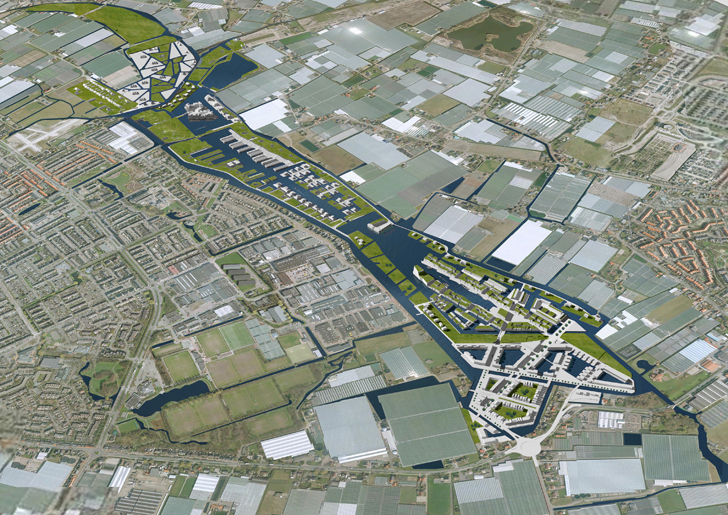
 New Water City Master Plan by Koen Olthuis Waterstudio<h3><big>Inhabitat: You're a proponent of the Hydro-City, and this is not just because you're from a country that sits below sea level. What are the advantages of floating buildings? Of a floating city? What are the challenges and the limitations?</big></h3><p> <h3>Koen:</h3> Floating urban components will be a new tool in the ongoing search to make our greatest cities worldwide more sustainable and livable. I strongly believe that we will enter an era of consumption urbanism in which floating urban components will help us to react quickly and sustainably to the growing mix of changes. Cities will start using City Apps, which are a set of combined urban components that can be ordered via City Apps Stores. In these stores a city council or government can lease a function that can offer instant relief to a occurring problem. These city apps are already built and in stock. When someone leases a City App it can be transported in smaller urban components to cities worldwide over water. This will create a new market and flexibility. The life span of the urban components themselves are very long, so that if they are not needed any more they can be sent back to the lease company or been sold to another city. City Apps are not so different from smart phone apps - they upgrade the functionality of the existing hardware, which in this case is a city's structure.6
 Floating Mosque by Koen Olthuis Waterstudio<h3><big>Inhabitat: Floating architecture might be a hard concept to understand for people who aren't used to this idea - how do you help potential clients and stakeholders visualize your ideas?</big></h3> <h3>Koen:</h3> The biggest challenge we face is to convince our clients and stakeholders, and this comes through changing their perception. With floating developments people tend to think about <a href="http://inhabitat.com/31-architects-modern-houseboat-floats-peacefully-on-the-river-amstel-in-amsterdam/">boats and small structures</a>. With our visualization tools, as well as our animations, we can offer our clients a view into their future situation. These computer tools make it possible to show the floating building in all kinds of scenarios, whether they are the effects of climate change through rising water levels, or simply the local site situation.7
 Floating Mosque by Koen Olthuis Waterstudio<h3><big>Inhabitat:Floating architecture might be a hard concept to understand for people who aren't used to this idea - how do you help potential clients and stakeholders visualize your ideas?</big></h3><p> <h3>Koen:</h3> The biggest challenge we face is to convince our clients and stakeholders, and this comes through changing their perception. With floating developments people tend to think about <a href="http://inhabitat.com/31-architects-modern-houseboat-floats-peacefully-on-the-river-amstel-in-amsterdam/">boats and small structures</a>. With our visualization tools, as well as our animations, we can offer our clients a view into their future situation. These computer tools make it possible to show the floating building in all kinds of scenarios, whether they are the effects of climate change through rising water levels, or simply the local site situation.8
 Water Citadel by Koen Olthuis Waterstudio<h3><big>Inhabitat: A lot of your projects have amazing, provocative renderings. How have digital 3D modeling tools helped you explore and shape your ideas, especially as it comes to building on water?</big></h3> <h3>Koen</h3> In our business there are three important catalyzing facts that have created momentum for our floating ideas. First there is this focus on climate change. In particular the work of Al Gore and president Nasheed of the <a href="http://inhabitat.com/maldives-to-fight-rising-sea-levels-with-floating-islands/">Maldives</a> has helped to raise awareness, as they have both had the courage to tell a difficult message as well as to open the way for innovation. The second catalyst is urbanization and its request for urban space - the need for more density in our cities will only continue to grow. Thirdly, there are the 3D tools available today.9
 Water Citadel Docking by Koen Olthuis Waterstudio<h3>Koen:</h3> When I studied <a href="http://www.inhabitat.com/architecture">architecture</a> in the early nineties, 3D tools were not as common as they are now. I had to explain my somewhat strange ideas with drawings and sketches made by hand. It was always necessary to convince my professors with a lot of verbal explanations in addition to the visual material. Now we do not only present our ideas with 3D renderings, but we also use those models to study and design our projects. All of our projects are constantly developed and evaluated through research in a series of digital 3D models. This way of working also allows serendipity to have influence on our work. Working with the computer sometimes generates possibilities and shapes that we didn’t deliberately think off.10
 Floating Mosque by Koen Olthuis Waterstudio<h3><big>Inhabitat: In the wake of the tsunami that hit Japan recently, there is for good reason growing concern about building near the water, let alone building directly upon the water. How safe are floating buildings or developments such as the <a href="http://inhabitat.com/maldives-to-fight-rising-sea-levels-with-floating-islands/">Floating Maldives</a>? What precautions are taken to ensure their safety?</big></h3> <h3>Koen:</h3> We dare to say that if your land is threatened by <a href="http://www.inhabitat.com/water">water</a>, the safest place is to be is in fact on the water. The effects of the average tsunami are much less on open waters than close to the shore because the wave will gain height as it hits the shore. All our plans are the result of intense engineering by the best maritime engineering companies that taking into account the existing and expected extreme weather conditions, as well as local wave conditions. Together with insurance companies, and using maritime safety regulations, we find a balance between safety and feasibility. The enormous shockwave, caused by earthquakes like the one we recently saw in <a href="http://inhabitat.com/update-shigeru-bans-modular-shelters-provide-relief-to-quake-and-tsunami-victims/">Japan</a>, will be absorbed by the water and not affect the floating developments. The flash-floods that made even land based houses float will indeed also affect floating developments in urban waters and near the shore, but they will be subjected to less damage from the impact because they are already floating and will move in tandem with the waves.11
 New Water Satellite by Koen Olthuis Waterstudio<h3><big>Inhabitat: How does floating architecture tie into sustainable design?</big></h3> <h3>Koen:</h3> The first and most important goal in all of our plans is to design scarless developments. This means that both during as well as after the lifespan of the functions, the building leaves neither a physical footprint nor carbon footprint. Compared with building on land, water provides several opportunities for a more sustainable design approach. For example, one can think of water cooling and heating. These developments can use sea wind for cooling, floating solar fields for the local production of energy, and there is also potential for re-using a building at other locations and organizing the building process more efficiently by centralizing construction. ‘Sustainaquality’ is the search for new ways to increase sustainable developments. Sustainaquality brings together sustainability- aqua and quality.12
 New Waterkamer Housing by Koen Olthuis Waterstudio<h3><big>Inhabitat: Living on water is an idea that is finding itself on the radars of more and more people. What do you see as the catalyst for this movement going from a novel idea to widespread reality?</big></h3> <h3>Koen:</h3> The predicted growth of the world’s population to about 10 billion people by the year 2100 - this is the strongest catalyst for this movement. Mega-cities are desperately in search of space, and if we want to protect our planet while creating new density at the same time, we have to use the existing water in and around our cities.13
 Gambia Floating Museum by Koen Olthuis Waterstudio<h3>Koen:</h3> The key to a sustainable future for humanity can be found in a healthy balance between the use of land and water for the production of food, <a href="//www.inhabitat.com/energy">energy</a>, <a href="//www.inhabitat.com/water">clean water</a> and shelter. Going beyond the waterfront is an efficient and exciting way to bring extra flexibility to our planet.14
 Drijvend Floating Apartment by Koen Olthuis WaterstudioA studio focused on designing for a future water world, Olthuis has been at the forefront of this once unconventional, yet now timely design vernacular.15
 Floating House for the Netherlands by Koen Olthuis WaterstudioMore of Koen's work can be found <a href="http://waterstudio.nl/">here</a>.16
 Autodesk LogoArchitect Koen Olthuis of Waterstudio.nl has been fascinating the Inhabitat editors for years with his innovative floating buildings and aqua-tecture. Far from being confined by convention -- or by the boundaries of dry land -- Olthuis has made a name for himself as an architect who pushes the boundaries of possibility when it comes to the built environment....<br><br><a href='https://inhabitat.com/inhabitat-interview-water-architect-koen-olthuis-on-floating-buildings-hydro-cities/'>READ ARTICLE</a>17


