


Start Slideshow


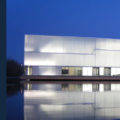 Steven Holl banner interviewInhabitat Interview with Steven Holl1
 Inhabitat Interview with Steven Holl<a href="http://www.stevenholl.com">Steven Holl</a> has risen to become one of the most celebrated and well-respected architects working today. His architectural work is widely recognized and covers extensive ground ranging from the <a href="http://inhabitat.com/2010/07/19/steven-holls-modern-art-museum-is-a-luminous-iceberg/">museums</a>, educational facilities, residences, retail design, <a href="http://inhabitat.com/2010/03/15/steven-holls-horizontal-skyscraper/">office design</a>, public utilities, and master planning. But unlike the indistinguishable corporate work or ego driven monstrosities that litter the physical and cultural landscape, each of Steven’s structures rises above any predictable style, and are instead inspired by a unique contextual awareness. His ability to masterfully blend space and light in subtle forms has turned him into a central figure in the discussion of contemporary <a>sustainable design.</a> It also comes as no surprise that his work has garnered him wide acclaim not only from critics, but most notably, from his contemporaries. <p> On this rare occasion, Steven was kind enough to sit down and answer a few of our questions regarding his style, green design, and even a little something about his childhood. Read ahead for our seven questions with Steven Holl.2
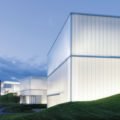 Steven Holl Nelson Atkins Museum of Art<em>Steven Holl's Bloch Building was completed over three years ago, but the beautiful extension to the Nelson-Atkins Muesum of Art in Kansas City continues to garner significant acclaim.</em> <p> <big><strong>1. How would you describe your signature style? As we all know, we're in the era of the 'iconic building' and the 'starchitect'. However facile this might be, the designs of public institutions are often offered to the biggest names, and the most 'iconic' architects. How do you feel about this trend, and how do you work in a system like this and continue to create thoughtful, meaningful architecture, when so many developers are looking for 'the next Bilbao'?</strong></big><strong></strong> <p> <strong>Steven: </strong>I believe that <a href="http://www.inhabitat.com/architecture">architecture </a>needs to be completely anchored in its program and site. Its meaning must be so deeply rooted in the conditions of its inception that it’s unfazed by fashion. My first book <a href="http://www.stevenholl.com/books-detail.php?id=28"><strong>Anchoring </strong></a>describes the relation of a building to a site, to its culture and to its metaphysical origins. If architecture’s original concept can go deeper, rather than broader, it builds a meaning on the site. It fortifies a locus of thoughts and philosophical hopes, or even humor and stories, which are oblivious to whatever style it is.3
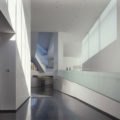 Steven Holl Nelson Atkins Museum of Art Interior<em>The luminous energy-efficient modern art museum boasts a green roof garden and a beautiful translucent facade that floods the interior spaces with light throughout the day. </em> <p> <big><strong>2. Are you concerned about environmental and social sustainability in your buildings? If so, what role does green building play into your work?</strong></big><strong></strong> <p> <strong>Steven: </strong>The 21st century presents us with one third of the earth already developed, much of it in sprawling waste. A fundamental change of attitude, a re-visioning of values must take place. We emphasize <a href="http://www.inhabitat.com/sustainable-building">sustainable building</a> and site development as fundamental to innovative and imaginative design. <p> In Shenzhen China, a city that went from 8,000 to a population of over 12 million, natural landscape has been rapidly obliterated. New strategies for cultivation of urban vegetation are crucial to maintain a balance of flora and fauna as well as natural aquifers and general climatic balance. Advanced structural <a href="http://www.inhabitat.com/technology">technologies</a> and construction techniques open up the potential for new flying architectures,<a href="http://www.inhabitat.com/2010/03/15/steven-holls-horizontal-skyscraper/"> horizontal skyscrapers </a>and public function bridges developing new urban layers. Our multifunctional “horizontal skyscraper” in Shenzhen, China won the architectural competition due to the maximizing of public landscape while rising to the 35m height limit and maximizing distant ocean views from the living/working spaces. Due to sophisticated combinations of “cable-stay” bridge technology merged with a high strength concrete frame there are no trusses in this floating skyscraper. The lush tropical landscape below is be open to the public and will contain restaurants and cafés in vegetated mounds bracketed with pools and walkways.4
 Steven Holl Nelson Atkins Museum of Art<em>The extension serves to compliment the existing buildings by bringing a modern green vision to the historic museum.</em> <big><strong>3. What do you feel is the greatest challenge when it comes to designing for environmental sustainability?</strong></big><strong></strong> <strong>Steven: </strong>The space, the geometry, the light of an architecture in great proportions must remain the core aim, while engineering aims for zero carbon, ultra-green <a href="http://www.inhabitat.com/architecture">architecture</a>. But this balance between the poetry of architecture and its green engineering is crucial.5
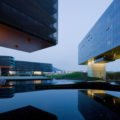 Steven Holl Horizontal Skyscraper<em>The Vanke Center in China was completed this year, and is an innovative take on take on the vertical skyscraper. Not only is the mixed-use building green, diverse, and tsunami-proof -- it's also in the running for LEED Platinum certification.</em> <big><strong>4. Many of your fans would say that you design your buildings with a strong focus on both user experience and natural light, is this correct? Can you tell us more about this?</strong></big><strong></strong> <strong>Steven:</strong> Space is oblivion without light. A building speaks through the silence of perception orchestrated by light. Luminosity is as integral to its spatial experience as porosity is integral to urban experience. For our Helsinki Museum of Contemporary Art, Kiasma the most important building material was light. Of the twenty-five galleries which make up the main function of the museum all have a slice of natural light. The behavior of light guided many decisions. The low angle of the Helsinki sun – never reaching above 51 degrees – helps give sectional form to the curved “light catching” aspect of the architecture. Changes in natural lighting conditions are left visible – so passing clouds bring shadow – brightness varies as the interior experience varies. We conceive of the space, light and concept of a work from the very beginning. Often in concept watercolors the aspects of light are there in the first sketch, integral to the concept of the <a href="http://www.inhabitat.com/architecture">architecture</a>, unique to the site and place. The infinite possibilities of light have been evident from the beginning of <a href="http://www.inhabitat.com/architecture">architecture</a> and will continue into the future. The revelations of new spaces, like interwoven languages, dissolve and reappear in light. In magnificent spaces, light changes and appears to describe form.6
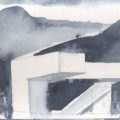 Steven Holl Nanajing Museum Watercolor<em>In addition to being an architect, Steven Holl is also a watercolorist who uses this medium to explore the possibilities of light. Above is a watercolor "sketch" of one of his studio's latest projects, the Nanajing Museum.</em> <big><strong>5. Can you tell us about the house you grew up in?</strong></big><strong></strong> <strong>Steven:</strong> In the small town where I grew up, I wasn’t exposed to architecture. Things that we (my brother the sculptor and painter James Holl and I) did that were related to architecture were to build tree houses. We made clubhouses, sometimes two stories, three stories, complicated constructions and when I was seven or eight years old we had as many as three different buildings under construction at the same time: a two-story tree house, a three-story free-standing club house and an underground club house; which I remember had logs for a<a href="http://www.inhabitat.com/green-roof"> roof </a>with old carpets laid on top. Earth and grass were put over the carpets. A children’s ‘mythological landscape’, it was like a small city with all these different constructions that we made. In my mind I was already an architect by 1959.7
 SIMMONS HALL, MASSACHUSETTS INSTITUTE OF TECHNOLOGY<em>Completed in 2002, the Simmons Hall at MIT is an undergraduate residence envisioned with the concept of "porosity." The "sponge" concept transforms the building through a series of programmatic and bio-technical functions. Large, dynamic openings are the lungs, bringing natural light down and moving air up. An 18" wall depth shades out the summer sun while allowing the low angled winter sun to help heat the building.</em> <big><strong>6. Who inspires you?</strong></big><strong></strong> <strong>Steven:</strong> I interviewed and was tentatively hired to work in the studio of <a href="http://en.wikipedia.org/wiki/Louis_Kahn">Louis Kahn</a>. However, he died in March 1974, just before I was to move from San Francisco to Philadelphia. His works and philosophy were very inspiring, as is the work of Le Corbusier. It seems to me inspiration is contagious. I remember a text by Louis Kahn entitled, “How was I doing, Le Corbusier?” Kahn held him up as a measure of inspiration.8
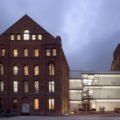 PRATT INSTITUTE, HIGGINS HALL INSERTION<em>Designed for the Pratt Institute in Brooklyn, New York, this insertion to the Higgins Hall is a modern masterpiece which sits amicably with the traditional brick aesthetic of the school. A two-throated skylight marks the top, striking dissonance and joining two types of light, and brick from the burned section has been recycled into a slumped brick and concrete base that form the entrance and a viewing terrace. Rising from the burnt brick is a concrete frame supported on six columns spanned with concrete and sheathed with an economical industrial material with translucent insulation able to create a translucent glow at night.</em> <p> <big><strong>7. What is your ultimate goal when it comes to your work? What do you want to be remembered for?</strong></big><strong></strong> <p> <strong>Steven: </strong>I want to live by inspiration and concretize inspiration in space and light. <a href="http://www.inhabitat.com/architecture">Architecture </a>can be a gift left for others to enjoy – architecture together with landscape can form a special reality – a special place, a place that is alive – inspires alive.9
 STOREFRONT FOR ART AND ARCHITECTURE<em>Designed with artist and architect Vito Acconci, the Storefront for Art and Architecture is a unique construction sited on the corner of a block that marks the intersection of three distinct neighborhoods: Chinatown, Little Italy and SOHO. The gallery itself is a limited, narrow wedge with a triangulated exhibition interior, and uses a hybrid material comprised of concrete mixed with recycled fibers. Beyond the unconventional footprint, there are a series of hinged panels arranged in a puzzle-like configuration which mark the facade of the building. When the panels are locked in their open position, the facade dissolves and the interior space of the gallery expands out on to the sidewalk.</em>10
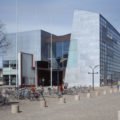 KIASMA MUSEUM OF CONTEMPORARY ART<em>The Kiasama Museum of Art is one of Steven Holl's most notable buildings. An entry in the 1992 competition for a new contemporary arts museum in Helsinki, Finland, Steven's competition entry won first prize out of more than five hundred international entries. A building washed in light, the concept of Kiasma involves the building's mass intertwining with the geometry of the city and landscape which are reflected in the shape of the building.</em>11
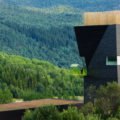 KNUT HAMSUN CENTER<em>Completed in 2009, the Knut Hamsun Center is a museum located above the Arctic Circle near village of Presteid of Hamarøy. The concept for the museum is "building as a body," creating a battleground of invisible forces. Strange, surprising and phenomenal experiences in space perspective, materials and light provide an inspiring frame for the various exhibitions.</em>12
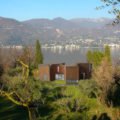 SUN SLICE HOUSE - Lake Garda Italy<em>Designed as a weekend house on Lake Garda for an Italian family is organized to frame slices of sunlight which are the focus of the home. While most elevations are simple rectangles strategically sliced and cut for the play of light within, the north façade is made of glass with views of Lake Garda. In order to emphasize the bends and changes in the strips of sunlight, simple cubic volumes form the basic building geometry. These are loosely joined in topological sheet rubber-like geometry, which also inscribes wind-protected courts on both sides of the house. Natural ventilation and geothermal heating and cooling are part of the energy plan.</em>13
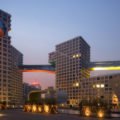 LINKED HYBRID BEIJING CHINA<em>Located in Beijing, the <a href="http://inhabitat.com/2009/09/17/steven-holls-linked-hybrid-complete/"> Link Hybrid</a> was recently completed in 2009 and houses 644 apartments, public green space, commercial zones, hotel, cinemateque, kindergarten, Montessori school, and underground parking over an area of 2 million square feet. </em>14
 LINKED HYBRID BEIJING CHINA<em>The Linked Hybrid is an incredible complex both heated and cooled by a 655-well geothermal energy system -- the largest residential geothermal system in China -- and employs green roofs and a separate grey water recycling system which is connected to all 650 condominiums. The system provides all landscape irrigation, and is the water source for the central pond, which also hosts natural reeds, water lilies and wildlife. Given its size, destinations of use and sustainable forward thinking, it could certainly be considered a modern, green city in its own right.</em>15















