Site Meter
Piper Kujac

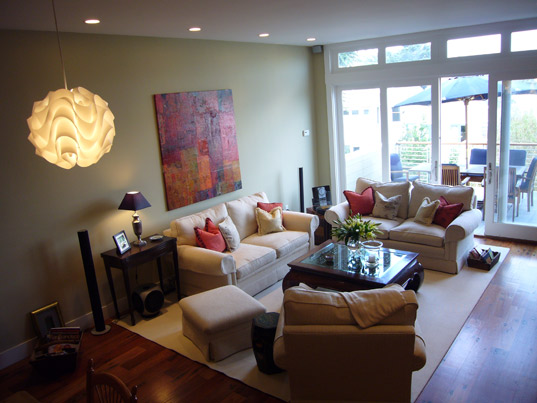
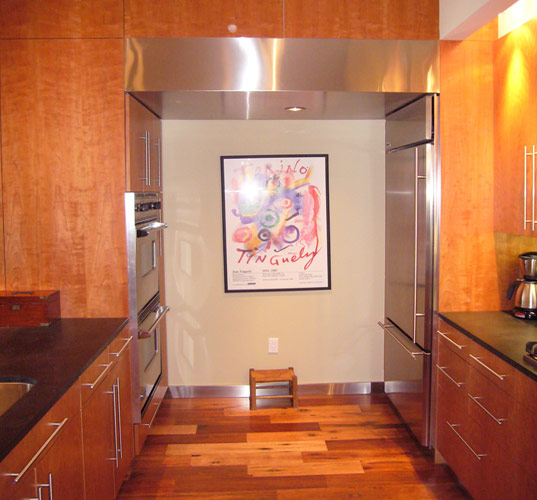
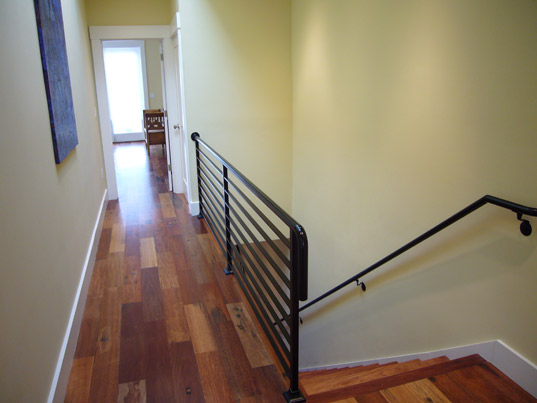
LORAX’S “GREENEST HOUSE IN SAN FRANCISCO”

by , 10/02/06

west coast green, lorax house, clipper street house, greenest house in san francisco, sustainable design, san francisco, green building san francisco, reclaimed wood, rain catchment
I am the Lorax. I speak for the trees. I speak for the trees, for the trees have no tongues.
— Dr. Seuss, The Lorax

You may remember Dr. Seuss’ legendary tree-protector and earth-lover, the Lorax. Five years ago, Mike Kerwin, Pat Loughran, and Joel Micucci founded Lorax Development with a Seussian mission “to build environmentally responsible homes with renewable materials, energy efficient systems, and smart technologies.” Today, they are doing just that.

Related Posts

17 Responses to “LORAX’S “GREENEST HOUSE IN SAN FRANCISCO””

  1. Grego Ree Grego Ree says:

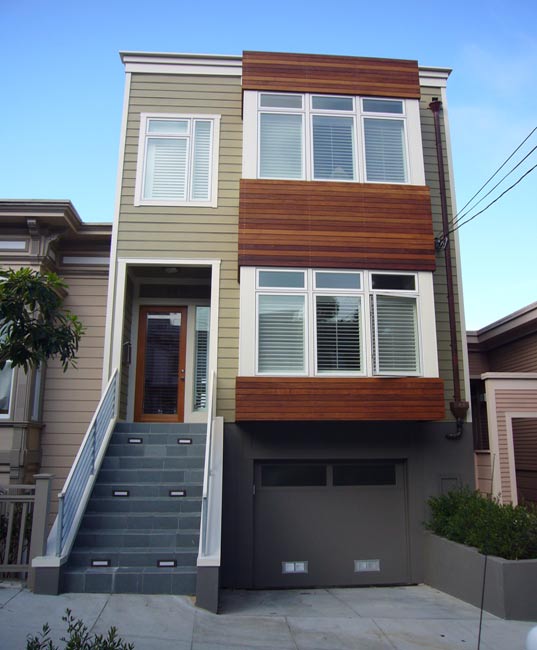
    That house sure went through a lot of conspicuous consumption to become as “green” as it is. The thing which struck me most was in the very first picture, though, which shows the exterior of the house and its retrofitted garage door. How can any San Francisco house built with special accomodation for an automobile, that most-loved source of suburban independence and widespread air pollution, be called the greenest? San Franciscans don’t need cars to get around a 7x7mi city. I sincerely hope that garage door conceals a flock of bicycles instead–possibly Serottas, Orbeas or Litespeeds, judging from the residence.

  2. Piper Kujac Piper says:

    Grego-
    I’m glad you’ve responded to this post. When we were invited to tour a home touted “the greenest house in SF” we were of course curious as to how one could make such claims. The assertion is based on the fact that this house has the first ever approved rain catchment system in San Francisco, and for a conventional family of five- that’s huge! But the inhabitants of this residence are not the only ones who benefit from a sensible design… when we interviewed the folks at Lorax Development, we found builders who love their work- banging a hammer and doing construction. They don’t want to be subjected to the fumes of offgassing paint or toxic dust particulates in conventional insulation, to name a few. Why should they be? This house shows that mainstream construction can be sustainable. Though I see your point about the (2-car) garage, I think we should demand more efficient public transit from our municipal planners, before asking a family with three children to endure the rolling hills of San Francisco without auto transport.

  3. kr kr says:

    In response to Grego -

    Why the hate?

    If you live / have ever lived in SF, you know that Clipper St. is one of the steepest hills in SF in certain sections, and is pretty isolated from most urban amenities such as grocery stores, pharmacies, etc., by at least 1/2 mile in any direction. Judging from the view published in the photos, this house is definitely somewhere towards the top of the incline. Trying to suggest that a family with children could live there without a car is either due to ignorance or arrogance. San Francisco’s public transportation is lackluster at best, and definitely not adequate for a family on Clipper street.

    It should be applauded that _someone_ is actually building houses in a green manner. Yes, as your inference to ultra-expensive premium bicycle brands (a poorly veiled attempt at reverse-snobbery) suggests, this house will be bought by someone with a lot of money. However, so will pretty much all other real estate in SF. I lived there for almost 7 years and couldn’t even buy a studio, much less a house like this, but I think it’s fantastic that houses like this are being built. It could have been built to look exactly the same without the solar power, water re-use, bio-friendly insulation, etc., just like all of the other quick-n-dirty construction happening in all of the new ‘designer’ lofts and apartment popping up everywhere.

  4. BC BC says:

    Imported wood from SE Asia, is beautiful but hardly green. Not only has it traveled thousands of miles to reach its destination, but woods used for outdoor purposes are often pressure treated with chemicals. I would imagine those would off-gas. Kudos for salvaging wood, but I am sure there is some beautiful wood in the SF area worth salvaging. Any comments?

  5. Grego Ree Grego Ree says:

    In response to Piper and kr:

    There’s no hatred here–just what I consider to be an honest assessment of facts. I love all the ideas of environmentally friendly building materials, non-polluting construction practices, and sustainability in all its forms. My complaint is with branding this “the greenest house in San Francisco”. In some senses, as Piper described, this could be claimed. But the heart of environmentalism is “Reduce, Reuse, Recycle”. The recycled and non-polluting (or lesser-polluting) building materials are GREAT! But the construction of this house shows a conspicuous lack of the “Reduce” principle.

    Don’t get me wrong, I’m not “hating” this house in any way. I’m sure that the precedents set in its remodeling will both encourage and aid others who wish to utilize less destructive building materials and practices in their own homes and remodelings in SF. The part I have a problem with is the claim of “greenest house in San Francisco” when it seems clear that the lifestyle facilitated by the residence will not by any stretch be the greenest in San Francisco. A house cannot be evaluated without considering its use and environment.

    P.S.: what happened to all the building materials removed from this house when it was gutted for its redesign? How many years of rooftop solar cells’ output will it take to recover equivalent energy to the gasoline, diesel and electricity used to move the teak railroad ties from Southeast Asia to San Francisco?

    P.P.S.: The true greenest house in SF is probably a (grubby, asbestos-insulated) Mission collective house of vegan rockabilly Bikes Not Bombs members who go about town scrounging food and project materials and *being* the roots of grassroots environmental activism by living the most appropriate livestyle they can. Again, it’s not as simple as “vegan SF hippies are good and cutting-edge environmental building practices for the very rich are bad”, but that there is an entire spectrum of what is “green” and someone is ignoring a whole swath of environmental theory when they give this home that superlative title.

  6. rickentropic rickentropic says:

    Amen to kr’s post. Correct on the street, the city, and the observations re:grego ree’s sniping. Lead, follow or get out of the way.

  7. In response to BC’s legitimate concerns about the environmental footprint of reclaimed wood from Southeast Asia I have the following comments. BC would be wise to do his homework before making blanket statements and assumptions. While it is true that ANY products manufactured in Asia (including many with “green” attributes – Bamboo flooring for example), must travel thousands of miles to their destinations, containerized shipping is one of the most efficient methods of transport on the planet. It is even more efficent than rail shipments. One of the unfortuante realities of our commodiy based economy is that ALL goods (no matter how green) must, at some point in their lifecycle, travel by truck, which is a very inefficient form of transport . It makes much more sense to save this irreplacable wood from the creamatoriums and boilers of Southeast Asia (yes, its’ true, they often burn it for fuel) locally manufacture it into flooring and efficiently ship it in a contaner to a West Coast port and give it another 100 years of functional use, than it does to let it get de-cycled and be lost forever. Every board foot of reclaimed wood used in construction is a bourd foot of wood that is not harvested from a forest.
    On the issue of chemical treatment, tropical hardwoods do not require treatment to last for decades of use in exterior environments. Temperate softwoods do. That is why RR ties in North America are typically creasote treated softwoods such as pine or fir. TerraMai never uses treated woods of any sort in the manufacture ot their products. To do so would be stupid, irresponsible and unnesessary.
    Yes, there is beautiful wood available to salvage in SF. TerraMai regularly slavages Redwood and Douglas Fir from the Bay Area. However, these are softwoods and do not make very durable flooring.
    I hope this addressses all fo your concerns.

  8. Chris Chris says:

    Yah, a bit ostentatious, but very interesting from a technical point of view. And if this exercise helps some of this technology get commercialized for the mass market, then all the better…

    The cistern system is expecially intriguing – I wonder if it’s adaptable to colder climates?

  9. Stop swetting the small stuff. The big picture is more important. Bravo to the owners of this home! May we see many more.

  10. Chris Chris says:

    Trees have no tongues, lips, epiglottis, tonsils, or that little connective tissue under your tongue that hurts so much when it gets nicked. They have no teeth, or gums, really not a mandible of any sort.

    When you think about it, there’s a whole bunch of reasons why trees don’t talk.

    They’ve got no brains, cerebrum, cerebellum, hypothalamus…

  11. Justin Justin says:

    It’s nice to see a move towards sustainable construction and architecture – but how feasible is it, price-wise? Developers and general contractors won’t be very willing to adopt these practices for their massive McMansion developments if it’s more expensive and more difficult to build sustainable structures than through traditional methods. I want to see sustainable living become more than a niche market or a eccentric curiosity.

  12. I agree with the more compassionate posts above. We are trying to build a green house in southwest FL. I guess right there we’d run into some conflicts with green building’s location factor. However, it is important to note that “trying” to build green in and of itself is at least something notable. The fact that Lorax faced changing city codes for its catchment system is extremely important. One day hopefully in the near future this will all be mainstream, common sense both with city codes (willingness for change) and with personal “attempts” at pulling off green building. It is incredibly difficult to be perfect when you are faced with the non-green norms of this current civilization. In our case we only have so much money to incorporate aspects of green. There are compromises to be made but I believe each attempt lets others into the complicated world of navigating a green build. This allows hands on knowledge for those that follow to improve on and further push forward these ideas… until everybody gets the obvious benefits of things like rainwater harvesting for instance.

  13. “it isn’t easy being green.”
    – Kermit the Frog

  14. richard richard says:

    The primary thing with any new technique ro technology is that at the beginning it’s always going to be expensive and elitist. Someone has to do this sort of thing at the high end, in order to show that it’s doable, and then the increasing scale of use brings the price down, which is a virtuous cycle. Lorax has gotten the rainwater catchment system through the building department, setting a precedent that others can use in future.

    Criticizing this house for being too expensive is liek criticizing Tesla Motors for not making an electric minicar — it misses the point, and forgets that this is a stage that these technologies have to go through in order to break through to mass acceptance and use.

    (And yes, the house is huge and is bound to cost millions of dollars — but better this than yet another pseudo-Victorian built with MDF and fresh cut wood floors.)

  15. Anna Anna says:

    According to socketsite, the asking price back in March was $1,899,000 (and it sold for “over asking”).

    http://www.socketsite.com/archives/2006/03/the_greenest_ho.html

  16. Better to try and be green than to do nothing at all.

  17. pex tubing solar pex tubing solar says:

    what happened to all the pex and other building materials removed from this house when it was gutted for its redesign?

Leave a Comment

Please keep your comments relevant to this blog entry. Email addresses are never displayed, but they are required to confirm your comments.

Please note that gratuitous links to your site are viewed as spam and may result in removed comments.

Add your comments

NEW USER

CURRENT USERS LOGIN

Lost your password?

get the free Inhabitat newsletter

Submit this form
popular today
all time
most commented
more popular stories >
What are you looking for? (Solar, HVAC, etc.)
Where are you located?