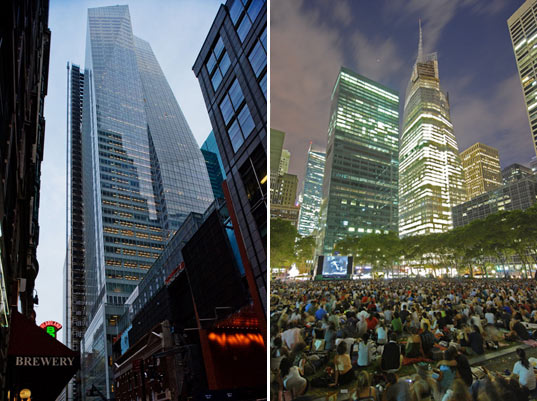
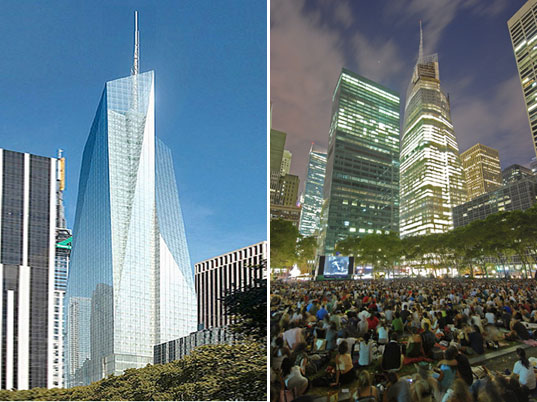
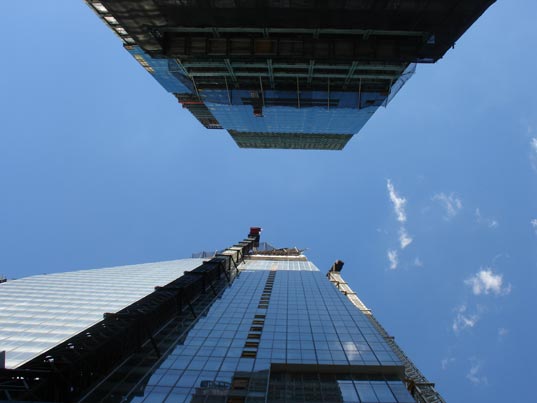
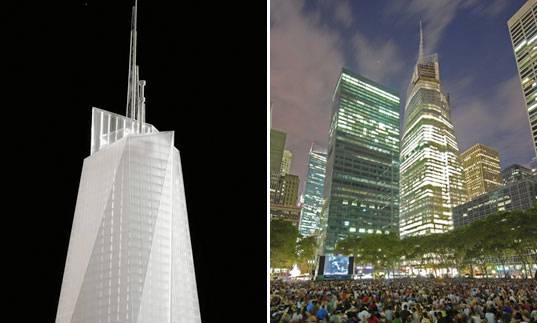
After four years of construction the world’s most sustainable skyscraper is nearly completed! Situated at One Bryant park in Midtown Manhattan, the crystalline structure will be the first high-rise to receive LEED Platinum certification. Designed for Bank of America by Cook+Fox Architects and Gensler and developed by The Durst Organization, the luminous spire will introduce a dose of levity to New York’s skyline while incorporating an excellent assortment of sustainable strategies.
Related Posts
-
Last weekend at the AIGA Grow conference I had the opportunity to hear first hand about the massive green skyscraper that is under construction
-
New York City’s 1 Bryant Park building (also known as the Bank of America building) is the greenest skyscraper in the world and Inhabitat was fortunate
-
Pittsburgh will soon see the completion of its first skyscraper to be constructed in 20 years. Dubbed Three PNC Plaza, the structure will be situated
5 Responses to “The First LEED Platinum Skyscraper Nearly Completed”
-
Featured Author
-
Read Inhabitat
-
Search Categories
-
Recent Posts
-
Recent Comments
-
Browse by Keyword
follow inhabitat on:
popular today
all time
most commented
more popular stories >
© Inhabitat.com 2012 | About Inhabitat | Contact Us | Advertising with Inhabitat | Terms Of Use | Privacy Policy | Inhabitat, LLC


Nice building. Futuristic in its design.
One really shouldn’t use a headline like, “The First LEED Platinum Skyscraper…”, or a descriptive phrase like, “will be the first high-rise to receive LEED Platinum certification”, for a building which has not been actually certified yet.
It feeds into a arms race of exaggerated PR claims, which just doesn’t help the factual basis of real sustainability. And it is unfair to projects (and publishers) who avoid such hyperbole. Finally, it devalues the certification process, and the authentic brand value of LEED certification, by taking it for granted and short-cutting the appropriate time for recognition.
I know what you’re getting at Architecture week, yes it is factually inaccurate if certification has no in fact been granted. When this is a factual article, a misleading headline does detract somewhat from the content. There is far too much hype in the world already.
That said, a headline doesn’t always have to be factual, but can simply be used to set a tone or foreshadow aspects of the article. After all a headline’s purpose is primarily not to report information but to grab attention. You should see some of the headlines I use on my blog – I use them to hint at the post’s themes, to attract readers, to set tone, to play devil’s advocate, to provoke thought, to be controversial, to raise awareness… the list goes on.
As for the building, the statistics are very impressive – as is the structure itself. However, I’d like to have seen some stats on how much this building actually cost, plus the expected savings from its green technology, compared to how much a comparably sized skyscraper would cost without all the green technology. Basically, is this one cheaper in the long run? If so, then where is the argument for all buildings not to be built like this? If it’s more expensive, then what government initiatives could be implemented to offset some of those costs for the sake of the environment?
Steve N. Lee
author of eco-blog http://www.lionsledbysheep.com
and suspense thriller ‘What if…?’
” … the luminous spire will introduce a dose of levity to New York’s skyline …”
No! Not “levity!” It is on days like this that I imagine a future in which ideas are conveyed by video and no one remembers what words mean, much less how to apply them.
Levity. n : lightness of mind, character, or behavior; lack of appropriate seriousness or earnestness.
This is exactly the opposite of what the author had hoped to convey.
That is just way too cool
http://www.FireMe.To/udi