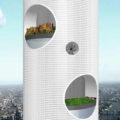
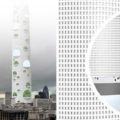
The term “mile high” isn’t just for airplane action anymore- British firm Popularchitecture has proposed a mile-high eco tower for London that’s sure to be just as exciting. At a full mile tall and housing over 100,000 people, this concept tower really is just that: a cool, uber-green concept. With 500 floors would contain schools and hospitals to shops and pubs, and everything else under the sun. While it will likely never be realized, the design does push our thinking forward.
Related Posts
-
We’re all in favor of urban density, but why do we need a skyscraper that’s a mile high? Saudi Arabia-based Kingdom Holding Company, headed by
-
Tower City, another concept from the 2010 eVolo Skyscraper Competition, re-envisions the city of Marseilles as a stacked skyscraper that sits on stilts above the
-
Prepare to be blown away: the latest addition to London‘s skyline is a striking modern skyscraper that is heralded as the world’s first building with
25 Responses to “Mile-High London Eco Tower by PopularArchitecture”
-
Featured Author
-
Read Inhabitat
-
Search Categories
-
Recent Posts
-
Recent Comments
-
Browse by Keyword
follow inhabitat on:
popular today
all time
most commented
more popular stories >
© Inhabitat.com 2012 | About Inhabitat | Contact Us | Advertising with Inhabitat | Terms Of Use | Privacy Policy | Inhabitat, LLC


What kind of fire safety would be implemented for something of this magnitude?
yep, nice idea and nice visuals…..although i’d love to see prince charles’ reaction to this one!
No doubt this looks very very cool indeed. But are those really openings all the way up there? Wind speeds would make standing in one of those pretty dangerous, don’t you think?!
If they incorporate some floors for vertical farming, this could be relatively self-sustaining.
I’m pretty sure this is right on a flight path too. Ouch.
I’m all for high density, all for sustainable city living, etc., etc. But once we’re done with the ooo’s and aaah’s (the same that greeted Frank Lloyd Wright’s proposed mile-high building . . . 50 years ago), I’m left wondering Why? Who would want to live in such a place or shop or go to school in such a place? The only bright side I can see is that with enough people shut up in mile-high towers, those of us who love living in reasonable proximity to the ground will have more that much more of it to ourselves.
Is this even practical or is this some grandstanding and or a PR stunt for the architectural firm proposing a structure that will never be built or lived in!
thankgod! it will never be done! london would become a very ugly city…
I don’t understand the constant pursuit of this “mile-high” status. It was already proven a long time ago by FLW of all people that it is “possible.” However the first building to do so must be as important as it is tall. This proposed building is not. Also, the biggest challenge to height is not structure but rather conveying people to the various levels. The elvator bank alone would take up the footprint of this building. Grandstanding indeed.
My only reservation with the comments here about communities is that spaced high density living can often lead to delinquent behaviour in surrounding areas and not the proposed security of high volume pedestrian activity. This kind of development needs to synergise with surrounding lower density development to be successful imho.
In disagreement to some other comments though, some of the greatest architectural designs have never been built…
Do Ecological and tall buildings go together? It’s a complex question but their construction emits more carbon and uses more resources more than low height buildings. They also consume more energy when in use. Those mile high lifts going up and downwill consume a lot of energy.
To build a skycraper that is one mile in height (5280 feet), you will need at least 3-6 square blocks of ground space for the foundation and or the base to support it’s own weight, provide ample protection against high winds and to defy gravity otself. This is not only NOT feasible but and a ridiculous idea that will never be built period. BTW – the the estimated costs to build such building would be between 3-6 billion US dollars…
If you people work in the sector God help us, if your mathematical workings are as shoddy i wouldn’t want to live in any of your buildings…
Anyway you are all a tad negative – the point of such designs are not to be built but to instill creativity within the sector…
C’mon, building such as this one are all about the architects ego. It’s yet another trophy (to themselves, as usual).
If you want to promote ‘tall’ and/or integrated ‘community’ and/or ‘small footprint’ … why is there no mention of Paulo Soleri’s Arcology. That is the true innovation! Function, form and style … all evolved out of deep principles.
I’ve lived at the Arcosanti for a few weeks. That most certainly is not the way forward, nor is anything else associated with Soleri…
In regards to this concept, it is little more than a piece of theoretical design created to prompt discussion – which is exactly what it has done. It is interesting to think of what height is actually optimal (bearing in mind that this may change depending on site, climate etc) in terms of sustainability…
Sorry – that is simply an ugly structure without any architectural merit.
I agree with previous comments – this says more about architectural ego than it does about environmental issues.
Where is the human scale? This is just a Fritz Lang wet dream.
Awful!
[...] as i accurately hypothesized before, is completely out of touch with everything human. according to inhabitat, the tower would rise some 500 stories and, “would contain schools and hospitals to shops and [...]
Der,
woss gonna happen when i fling me pepsi can down frum up dere?
It gonna rain kentucky fried wrappers ennit?
Have you ever seen the film Fifth Element? Not a great vision of the future.
Architecture needs to be on a human scale.
This is an old idea first conceived by John Wagner in Judge Dredd for 2000AD back in 1977. Suffice to say it doesn’t work in his eyes…
[...] Inhabitat. Puedes seguir las respuestas a este post mediante nuestro RSS 2.0 feed. Puedes dejar una [...]
In the 1930\’s we thought this would have become a standard by now, much caused by the rapid erection of such buildings like Empire state building and Crystler building (ref. Delirious New York by Rem Koolhaas ). There was no limit for how tall a building could become. But now it seems that high rises has gotten a revelation, due to people with lack of impotence in some Arabic and Asian countries. My point is that this must be a temporarily phenomenon. that we will overcome.. Because it can\’t be cool to stand in an elevator with a bunch of people with high perspiration for twenty minutes just to get down… and it can\’t be economical…
This design is about totally removed from what it is to be human. I suppose, when you’ve spent thousands of dollars getting educated in architecture, you have to come up with such things in order to justify the expense, and to protect the fragile ego from scorn. It seems to me that the basic premise of this design is imagining that people already know how to live in peacful communities. If they don’t (and they don’t) all that will happen is that you will transport all our current social problema into mile-high towers. The novelty factor of living in such places will wear off quite quickly. I reckon that the focus should be on “what causes all our social ills?” with a total, stop-at-nothing willingness to unearth these causes. Such an attitude should go a long way to re-humanising architecture.
And also, there are major flaws in the design.
gosh what a nice design