Site Meter
Mike Chino

Porsche Unveils 911 Hybrid With Flywheel Speed Booster

by , 02/12/10
filed under: Green Transportation

sustainable design, green design, Porsch 911 GT3 R Hybrid, green transportation, hybrid vehicle, alternative transportation, eco vehicle, performance hybrid

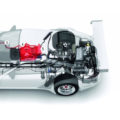
Green racing fans rejoice! Porsche has just unveiled its 911 GT3 R Hybrid, a 480 horsepower track vehicle ready to rock the 24-hour Nurburgring race this May. Porsche’s latest supercar will use the same 911 production platform available to consumers today, with a few race-ready features including front-wheel hybrid drive and an innovative flywheel system that stores kinetic energy from braking and then uses it to provide a 160 horsepower burst of speed.


Related Posts

14 Responses to “Porsche Unveils 911 Hybrid With Flywheel Speed Booster”

  1. Bean Bean says:

    “This generator stores energy each time the vehicle breaks”

    Oh dear, I suppose it’ll only do it once then, seeing as the vehicle has to break for the flywheel to gain energy.

  2. mstrebe mstrebe says:

    So what happens to that 40KRPM massive flywheel in an accident? I wouldn’t want to be standing in it’s path!

  3. stoffer stoffer says:

    I think that the flywheel isn’t all that massive. Let me remind you, that kinetic energy of a rotating body is proportional to the square of angular velocity and linearly proportional to the moment of inertia. However, moment of inertia is proportional to the square of the radius (there are some simplifications here, in fact it is an integral of radius squared over mass of the body).

    That means, that you can store a large amount of energy in rapidly spinning, lightweight, but large diameter body.

    Relating to post of user “Bean” – the cars slow down before taking a turn and accelerate after clearing the turn. normally during braking the energy is converted into heat on disc brakes and brake pads. Here the energy goes to the flywheel and provides boost after clearing the turn.

    One thing worth noting, is that regenerative braking is very ineffective at low velocities, while it recovers a great deal of energy from braking at high velocities. Partly because kinetic energy deepens squarely on velocity, partly because generators efficiency is poor at low speeds.

    The Le Mans race scenario involves braking from high speed to well, lower, but still high speed. It does not involve braking to zero velocity, apart from finish line of course. That means that energy recovery can be highly effective and it is a perfect scenario for regenerative braking.

  4. j-foo@teammajors.com j-foo@teammajors.com says:

    stoffer said:
    ‘Relating to post of user “Bean”…’

    I believe Bean’s post was a humorous attempt at pointing out the author used the spelling “break” when he should have used “brake”. Once a race car breaks, it tends to be out of the race.

  5. otto otto says:

    To staffer,

    Bean was pointing out your spelling error.

    break, noun an act or instance of breaking; disruption or separation of parts; fracture; rupture.

    brake verb (used with object) 8. to slow or stop by means of or as if by means of a brake.

    Editorial staff should learn not to rely solely on spell checkers.

  6. damianesteves damianesteves says:

    Stoffer, I’m pretty sure Bean was referring to the typo “breaks” which should have been “brakes”. It was a joke ;)

  7. Bean Bean says:

    was just being silly about the spelling :)

  8. flyingelephantom flyingelephantom says:

    I wonder if they thought of using the gyroscopic intertia of the flywheel to keep the car pushed to the road. Of course, there’d be a conflict of interest there: the more you brake, the faster the flywheel turns, the more you keep the car on the road.

    I’d have to do a calculation to see what kind of force this would provide, and I’m just too lazy. Any takers?

  9. Solomoriah Solomoriah says:

    Assuming the flywheel mentioned is a standard “superflywheel” such as is sometimes used in the communications industry, it’s made of carbon fiber or another composite material. When such a flywheel fails, it delaminates, becoming sort of like a wad of fishing line. A metal flywheel tends to break into three or four large pieces which fly off and, like, kill people, which would be consistent with mstrebe’s commentary.

  10. stoffer stoffer says:

    @Solomoriah – that is absolutely correct. However, flywheels are placed in confinement vessels and I wouldn’t worry too much about breaking flywheel. I think that it should be also possible to come up with some mechanism of slowing down the flywheel in event of an accident. If the sensors detect rapid acceleration, one could inject some viscous fluid into the flywheel casing and kinetic energy of the flywheel would be dissipated via heating of the fluid. Of course pressure will build up and it has to go out through some sort of a blow off valve. Not that in normal operation a flywheel is preferably kept in vacuum and on magnetic bearings.

    NOTE 1: If this solution is not patented yet, this post constitutes prior art.
    NOTE 2: If the solution suggested is already patented, then NOTE1 is void.

  11. idear idear says:

    thats some good constituting of prior art you done there- but what about no to the flywheel altogether and use an assisted air compression braking system and (even use the compressed air as a no carbon part -time system for a hippy variant)- optimising engine speed for maximum efiiciency and having variable pressure/turbo boost- youd need some crazy pressures tanks and stuff- youd have to redesign the whole braking setup.
    even a wound spring working back off the brakes would give you a big chunk of assisted momentary torque, hyrdaulic high pressure braking system where pressure increases according to the heat in the braking system, assisted by air brake- all electronically control for optimum efficiency -used to run an air pump to a hold tank, even adding an engine braking feedback system utilising hot pressurised air from the cylinders in non load bearing motion.

  12. NickFW NickFW says:

    Flywheel and Gyro Effect…

    Many times the gyro effect is lifted up adressing flywheels in cars. Magnetal has made a calculation example here http://www.magnetal.se/MagnetalGyro.pdf
    It turns out that the generated forces are very very small. It is likely to believe that the crank shaft and engine flywheel induces more gyro effect than a flywheel energy storage would.

  13. Sangamesh.B.M Sangamesh.B.M says:

    this was a great idea of using a flywheel to store kinetic energy into a fly wheel, and using it when required.
    what about the gyroscopic effect it builds up in that huge speed
    with a turn. will it not take exta pains to chek that parameter

  14. soessex soessex says:

    We are well along with a patent for a FW system far superior to and more efficient than this Porsche concept. Our system is suitable for most size vehicles including trucks and it is applicable to electric as well as conventional 2, or 4 wheel engine drives.As with these things it is extremely simple but exceedinglt not obvious.

Leave a Comment

Please keep your comments relevant to this blog entry. Email addresses are never displayed, but they are required to confirm your comments.

Please note that gratuitous links to your site are viewed as spam and may result in removed comments.

Add your comments

NEW USER

CURRENT USERS LOGIN

Lost your password?

get the free Inhabitat newsletter

Submit this form
popular today
all time
most commented
more popular stories >
What are you looking for? (Solar, HVAC, etc.)
Where are you located?