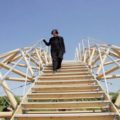
You wouldn’t expect cardboard to be strong enough to build a bridge, but that’s exactly what ingenious architect Shigeru Ban decided to use to build a bridge across the Gardon River in his latest work of architectural innovation. You might be familiar with his previous work (his Curtain Wall House, Nomadic Museum, and Paper Church in particular), but the bridge, his latest work, proves that Shigeru Ban is truly a brilliant architectural mind in the world of green and context-sensitive design.
The bridge, located over the Gardon River in southern France, is made almost entirely out of cardboard tubes (281 to be exact), and is strong enough to carry 20 people at a time. The steps of the bridge are constructed from recycled paper and plastic. And how does it stand up, you may ask yourself? It turns out cardboard is surprisingly strong when engineered as precisely and creatively as Ban has designed it, but the foundations do get a little help from wooden boxes packed with sand.
The bridge also sits adjacent to an ancient Roman Bridge, creating an interesting juxtaposition. “It is a very interesting contrast, the Roman stone bridge and the paper bridge. Paper too can be permanent, can be strong and lasting. We need to get rid of these prejudices,” Ban said.
The cardboard masterpiece will be open for 6 weeks to the public before being dismantled prior to the rainy season.
+Paper bridge unveiled in southern France
+Shigeru Ban Architects
Via Spluch


[...] camera! Other carefully crafted tributes included cassette tapes, boom boxes, and luggage. We love to showcase that sort of craftiness here at [...]
just want to say that it has been built by students of National School of Architecture of Montpellier (France) and they could ensure you that it’s totally waterproof. Each tube has been treated 3 times.
http://www.montpellier.archi.fr/index-fr.html
I believe the architects at 51% has done this before, and with child labour even! (ok, so it was voluntary with a school class but still). I had to dig it up when I saw this…. http://51pct.com/go/paper
They made some other funny bridge projects as well — http://51pct.com/go/wobbly and http://51pct.com/go/floating
All projects are very inspiring!
I got really sad with some comments… These closed mind atitudes doesn’t help the curiosity, which is so important to go look what we have around us.
And yes, before saying anything as we would know better how to make this brigde or something else, we should get some informations about the artist and his work…
[...] read more | digg story [...]
[...] read more at Inhabitat [...]
[...] Go to original in Inhabitat. [...]
bravo for the bridge and the material investigation, though that river looks like it could be crossed on foot… just remove your shoes and socks, roll up the pants a little…..
[...] Source: Inhabitat [...]
[...] Read [...]
This bridge is not cardboard. It has steel connectors and steel tension members, using this method one could build this bridge out of pasta. The tubes are not cardboard, which uses paper liner board and fluting between the layers, they are made from rolled paper which is much stronger than cardboard, especially in compression. Mr. Paterra above mentions a similar project, this was a true cardboard bridge used with a Rolls Royce on top, it was an advertisement for ST Regis Paper Co.
DF
[...] Our bridges here in the US might have superstructure deterioration but what about that cardboard bridge in [...]
Isaac: it will crumble into pieces, which is why they dismantled it before the rains come.
Cardboard pallets supporting 1,000kg have been around for ages. Even pieces of paper, when folded properly, are amazingly strong. This is mildly interesting.
I would be much more intrigued if it could actually be used as a proper bridge.
[...] (Via) [...]
[...] Source [...]
[...] Inhabitat » CARDBOARD BRIDGE by Shigeru Ban This entry was posted on Wednesday, August 8th, 2007 at 5:49 am and is filed under Web Stumbling. You can follow any responses to this entry through the RSS 2.0 feed. You can leave a response, or trackback from your own site. [...]
thought you might enjoy this:)
What happens when it rains?
Love the design. How did he get Zoning to allow it? Here in New York, he would probably be getting a ticket.
[...] Thing – Cardboard Bridge Rym’s Thing – History Bites [...]
Way back in the ’70′s or ’80′s a paper company had an advertisement showing a car parked on top of a corrugated cardboard platform, with a ramp of the same material leasing from the ground to the platform.
and why is it so tall? he shouldve coated the cardboard in fiberglass resin
Hello! Help solve the problem.
Very often try to enter the forum, but says that the password is not correct.
Regrettably use of remembering. Give like to be?
Thank you!
[...] Source [Inhabitat] All Natural, card board, Eco Friendly, foot bridge, Green Architecture, spans, UK and EuropeAll Natural, card board, Eco Friendly, foot bridge, Green Architecture, spans, UK and Europe TrackBack | Suggest A Site | View blog reactions [...]
Interesting, yet ugly.
That’s pretty awesome. I’d actually like to know what other materials he used to create this.
If you’re familiar with the work of Shigeru Ban, you would know that many of his structures are not meant to be permanent. No it’s not waterproof, hence taking it down before rainy season, and no it’s not meant to be a ‘sustainable’ structure. I believe the main purpose of the work of Shigeru Ban is to demonstrate qualities of materials that have previously gone unnoticed. He has shown that when manipulated properly, materials such as these cardboard tubes can have incredible structural integrity. This design reflects the beautifully symmetric patterns that his work often exhibits, and I look forward to his next project.
it is beautiful, but really. i can’t see how you can call it sustainable or green if it can’t stand up to rain and has to be deconstructed and rebuilt to avoid getting wet. it’s no ‘prejudice’… paper exposed to the elements is never permanent unless it’s mixed with other materials in which case, it would no longer be a c2c material. as a temporary structure, it’s a great success.
I always love when the architect pushes past the limits of conventional engineering (but who doesn’t?). I wonder, though, is this water proof? And is it meant to be temporary, or semi-temporary, or what?
[...] Source inhabitat.com [...]