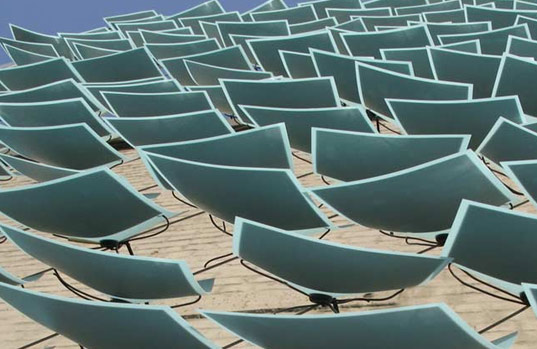
Our friends at Ecolect, the go-to sustainable design and materials community, have launched a monthly spotlight on sustainable design called Limelight – and the first feature is tough act to follow. Teresita Cochran’s sustainable design group, SMIT (Sustainably Minded Interactive Technology) has a compelling new project called GROW that’s an innovative and aesthetically arresting solar and wind power solution. Combining the best of green tech and ecology, GROW draws inspiration from ivy growing on the side of a building – resulting in a hybrid energy delivery device of flexible, ivy-like fluttering solar leaves that provide power via both sun and wind.
Related Posts
-
Solar Ivy (or SMIT Grow) is a spectacular system of thin, fluttering solar panels that generate energy by sparkling in the sunlight. The wind and
-
Solar Ivy is a modular and customizable photovoltaic product with a wide range of applications. The “leaf” is roughly the size of a cantaloupe with
-
We love NAU and we love Ecolect (one of our recent holiday party cohosts). So it’s natural that we’re wishing we were in the Midwest
26 Responses to “SMIT’s GROW: Solar and Wind Photovoltaic ‘Leaves’”
-
Featured Author
-
Read Inhabitat
-
Search Categories
-
Recent Posts
-
Recent Comments
-
Browse by Keyword
follow inhabitat on:
popular today
all time
most commented
more popular stories >
© Inhabitat.com 2012 | About Inhabitat | Contact Us | Advertising with Inhabitat | Terms Of Use | Privacy Policy | Inhabitat, LLC


I wonder if it also reduces heat in the summer by providing shade like real ivy.
Should be easy to convert this design into “shingles” for the roof. Ditch the wind motion portion, and make them act like asphalt shingles, and you could easily have a replacement for asphalt shingles.
Seems like it would provide ivy-like shade too. Maybe you could use them all over for wood-shingled houses! (Without the wood.)
exactly what i thought, brian. i know plenty of people whose tastes are too traditional to employ a wall of fluttering solar panels on their house, but would be plenty eager to have panels on the roof. and the fact that there are color options avaliabe makes it that much more viable. although, the original design is really lovely, of course.
Living roofs and walls are the way to go. The photovoltaic leaf design would intergrate well with a living wall; especially, if photo-leaf was shaped more like a leaf.
United Solar Ovanics makes a photovoltaic solar-shingle for those of you looking; the solar shingle is said to have a quick payback. http://www.unisolar.com
Best Wishes,
James
make this into nanotape and you’re set for life, make it clear and paste it to absolutely everything, you will win world peace. (copyright)
I think it’s a great blend of nature and technology, but my concern would be how loud would these panels be when they are rattling on the side of my house, and i would hate to have strong winds blow away my investment.
Great work. This is a very fine example of sustainable design of great quality. If this will be really affordable I would love to cover some of my projects in it!
Would be interesting if it could convert heat into electricity as well. Imagine if the shingle itself got hot enough, a thermocouple could convert just a bit of that heat into even more electricity.
This is cool.
Wind = destruction.
Sorry guys.
Great. Flap, flap, flap, stress fracture. Flap, flap, flap, Connection failure. Snap.
Great reliability in design.
Fu*king engineers. Get some real world experience already.
That solar wall was pretty fricken’ ugly. You’d definitely need to live in a subdivision without a homeowners association b/c I can’t imagine them allowing this. I wouldn’t put that on my roof either. Here in GA we have tall trees. Leaves, pinestraw, pine cones, bird crap, hail, kids balls/frisbies (if the house were a one story) would all screw with your power production and it’d be a pain in the rear to clean or replace individual pieces. In one year, you’d have a hideous, expensive and useless piece of work that will make your house difficult to sell. And if you did sell it, your buyers would be suing you in no time b/c you didn’t tell them about the constant brownouts.
This has to be The best and worst Idea at the same time.. art it is …science it really is.. engineering.. it is really so not!
This would be really great in a wind free rain free valley.. that does not exist
They really need to think again about the application of this Idea
Constantly Flexing wire will snap so fast you will be up that wall every week replacing panels and wires
Constantly Flapping Panel scraping against the wall, will wear down the front and back of them you will be up that wall every week replacing panels and wires.
Lots more work on this is required.. How much did they get paid to research this ?
Regarding the concerns of those who worry about the “leaves” blowing away or the connection being broken in the same way, there are very strong materials available on the market right now than can take a heck of a lot of weather abuse, so maybe these aren’t such mig concerns. Sure, if a tornado or hurricane hit, you’re probably out of luck, but since the entire house may be gone anyway, that’s a smaller worry!
I, for one, find it . . “charming” is the word that first comes to mind. Green and cute — a winning combination. If these folks can offer a good ROI, alleviate worries the things are going to fly off in even a modest wind, and so on, I bet they’ll be rolling in the mullah — and sooner, not later.
Thanks for showcasing this product! Send it to us in Thailand!
We sometimes get sustained winds of 15-40mph for days at a time. I’m wondering if these are built to sustain real wind, or just a breeze?
Ivy flutters prettily in a breeze. In a heavy wind, the leaves blow off, or just get torn to shreds.
It’s elegant though, and I’d love to see it work our practically.
Gee, lummox, I assume that you are an engineer? Ever seen a plastic bag snap under wind force? I don’t think so. Engineering polymer applications is certainly something different. Polymers are subject to rapid development, getting stronger and more sustainable by the day. I think this is a hell of an innovation to make solar power (and wind energy) more attractive and dynamic! These kind of engineers make the world a nicer place to live in!
And, please, don’t swear…
nice, this would also help cools the wall it’s on as a shading device too
I still have many concerns, but the saddest thing is that, we’ll probably never see this commercially marketed, at least not soon enough.
another project to check out: http://www.solarnetwork.net/
[...] Inhabitat, one of my favorite blogs, has a super slick recent post on this great new green building solution, Solar and Wind Photovoltaic ‘Leaves’. [...]
[...] » SMIT’s GROW: Solar and Wind Leaf Photovoltaic Shingles Inhabitat » SMIT’s GROW: Solar and Wind Leaf Photovoltaic ShinglesNow this is cool I am not a greenie but this idea if brought in in a decent price point would be [...]
[...] :: EcoGeek and Inhabitat Related Post – Solar traffic lights a hit in Cape Town Inflatable photovoltaics [...]
Neat article. Go look up Nikolai Tesla’s patents 685956 (apparatus for utilizing effects transmitted through natural media) and 685957 (apparatus for the utilization of radiant energy) at the US patent database. Free energy was here over 100 years ago via Tesla and suppressed by J.P. Morgan. Spread the word FAST because time is running out…
[...] gördüğümüz yanları sarmaşıklı evler vardırya, işte ondan ilham alınarak hazırlanmış bu projeyi gerçekten ilginç ve yararlı [...]
Awesome idea!!
But I have my reservations: as Will said in the first response I do believe that this would help shelter the wall from solar heat. The question I have is that the season leaf shed of a bio-ivy (god that sounds pretentious) then allows for the passive solar heating desired during the winter months. hmmm, wonder how the numbers work out…
Hi kidNeutrino. I am curious about that too. I’m going to ask Teresita, one of the designers, to chime in on the convo, so check back to see her answer. Thanks for reading!
When drems and ideas are put together to become reality, we need to appreciate it. I appreciate the efforts of SMIT. But would need improvement to meet international standard. I might want to experiment the investment in Africa, Nigeria in particular that is eco-friendly.