


When Cornell students David Wax, Emile Chin-Dickey, Stephanie Horowitz, Benjamin Uyeda, and Jordan Goldman set out trying to create an off-the-grid solar-powered home for the biennial Solar Decathlon Competition, little did they know that their efforts would launch their careers as gurus of Zero-Energy design. The Solar Decathlon, which is held on the mall in Washington DC every two years — and kicks off again tomorrow! — is a green design-build competition where student teams compete to see who can create the most energy efficient solar house. The Cornell students’ cleverly designed home was so smart and energy efficient that it took second prize in 2005’s prestigious competition, inspiring the group to start their own business dedicated to designing zero energy homes.
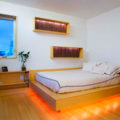

Now with several zero energy homes under their belt, and the firm Independence Energy Homes taking in more and more residential commissions, these Cornell graduates are proving that zero energy homes are not only eco-friendly and beautiful, but also cost effective and financially smart as well.
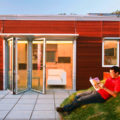
The 2005 Cornell University Solar Decathlon (CUSD) team had to compete on many challenges in order to win one of the coveted top awards, and this resulted in a house with many ‘over-designed’ features. Independence Energy Homes founder David Wax calls the little portable house a “race-car” of a home, since it is so energy efficient and high-powered for its size.

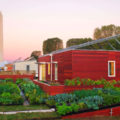
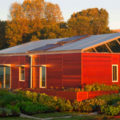
PHOTOVOLTAIC SOLAR ROOF With a large photovoltaic array covering the entire roof of the 800 square-foot home, the Cornell University Solar Decathlon house is so efficient that it produces far more energy than it actually consumes. The entire sloped roof is covered in 56 modular roof tiles which provide a uniform smooth surface that is both elegant and highly functional in terms of energy generation and water drainage. The 56 solar roof tiles generate 6000 W of power per day, which is more than enough to power the small eco-friendly house, as the energy consumption of the entire house is mitigated with smart appliances, insulation and efficient heating, cooling, and water systems.
SUPER INSULATION The walls of the CUSD house are composed of structurally-insulated-panels (SIPS), which are filled with expanded polystyrene to provided maximum airtight insulation.
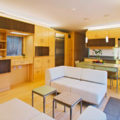
INTEGRATED HEATING, COOLING & WATER SYSTEMS One way that energy use is kept low in the Cornell University Solar Decathlon house is that central heating, hot water, water filtration and water reuse are all consolidated within a central space in the house. On the roof, evacuated tubes collect heat which is used to heat water for both hot water and central heating needs (through a hot-water-based radiant floor heating system). Wastewater from the washing machine, bathroom sink and show are diverted to a grey water storage tank below the house, which is filtered and merged with collected rain water from the roof to provide irrigation for the landscape. ELECTRIC CAR CHARGING CAPABILITY One of the tests during the 2005 Solar Decathlon competition was the ability to charge an electric vehicle which could be driven around Washington DC in a race. With its high-powered battery system, the CUSD house aced the test and took second prize in the car competition out of the 18 teams.

WHERE IS IT NOW? After the CUSD Zero Energy house took second place in the prestigious 2005 Solar Decathlon contest, it was sold to a private owner, and moved to a small town outside of Ithaca, New York. The current owner, a Cornell professor, loves the house and gives daily tours to teach principals of energy efficiency to the community. Now off on their own, the founders of Independence Energy Homes are working to spread the knowledge throughout the residential market, designing energy efficient and zero energy homes for both developers and individuals.
Next week members of the 2005 CUSD team will travel to Washington DC to help advise this year’s 2007 CUSD team for next week’s competition. GOOD LUCK CORNELL!
Inhabitat will be on the mall in DC next week to check out the winning Solar Decathlon entries – so stay tuned!
+ CUSD 2005 Zero-Energy Home + Independence Energy Homes
+ Solar Decathlon + Cornell University Decathlon Design 2005 + Cornell University Decathlon Design 2007

