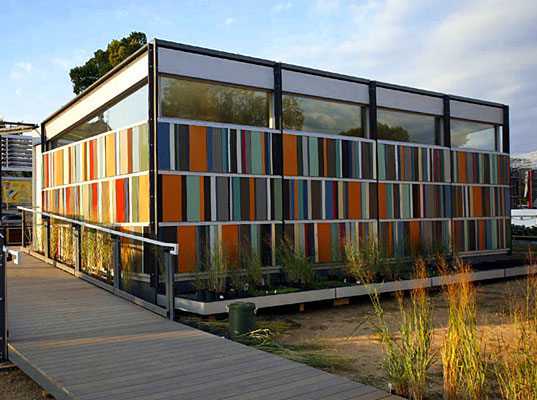
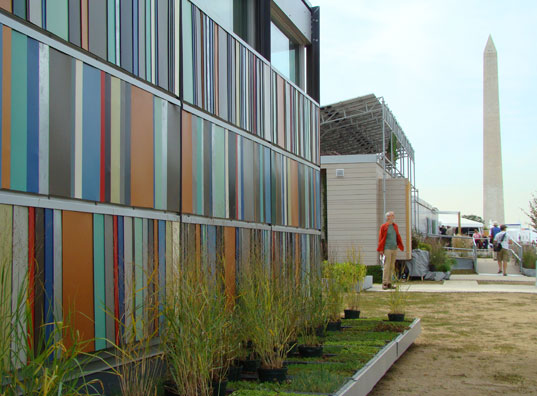
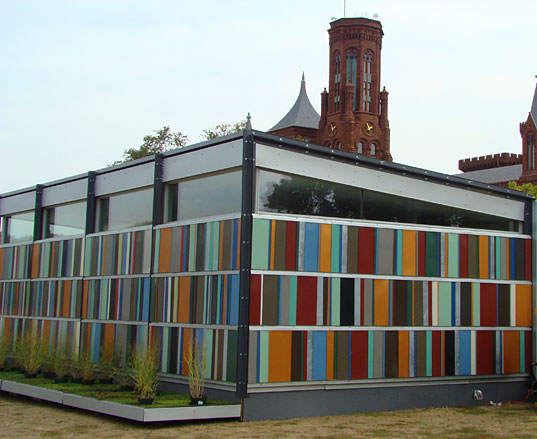
What’s multi-colored, solar-powered, and green all over? The University of Cincinnati’s zero energy home at this year’s Solar Decathlon. The student team’s solution is not only a stylish-looking residence (the multi-colored “tiles” are recycled Formica), but is also easy to transport, scale, and modify in any way shape or form. Throw in some very green materials and systems, and you’ve got yourself a solar powerhouse!






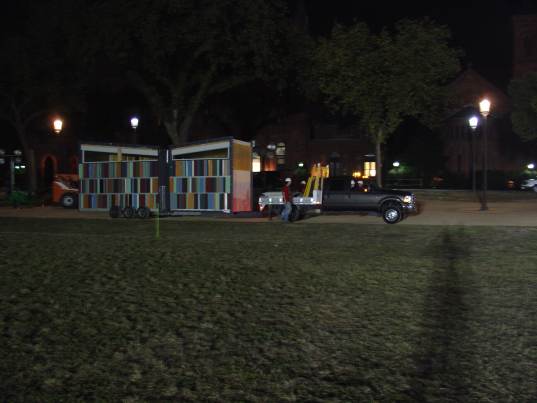
The University of Cincinnati’s uber zero energy residence was built out of four 8-foot wide house sections built into trailer beds. This created two challenges for the team. The first problem was that the roof slope had to be slightly lower than that which would be optimal for the solar panels to operate to their maximum efficiency. The second problem proved to be a bit trickier. As the sections of the house were built to be self-sufficient and prefabricated, they had to be tied together once the final construction of the residence was done, and it had to be properly sealed as well, otherwise all the hard work of insulating the residence would be lost. The design team thus created an intricate ‘zipper-like’ steel frame, which could be coupled together when two sections of the residence were joined together.
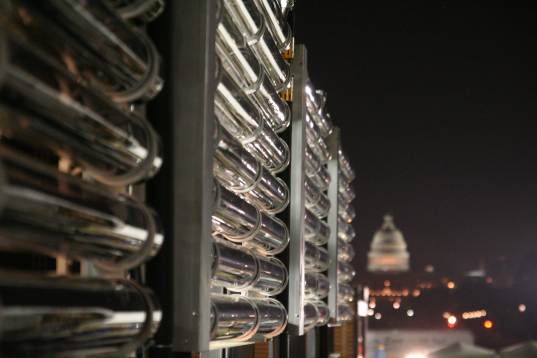
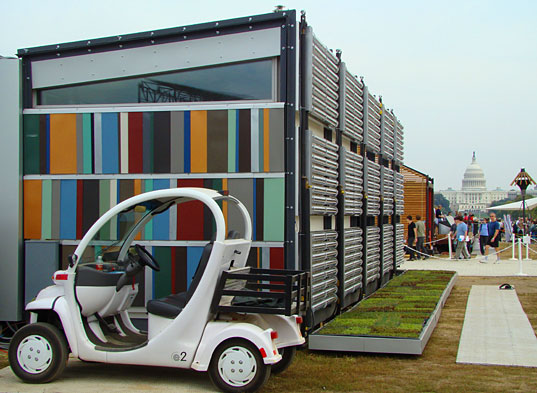
Of course, if you visit the Solar Decathlon, you will very likely not notice that at all. What you will notice is the signature “second wall” in the southern facade of the house. This wall, which is set a few feet away from the residence is a fence of 120 evacuated tube solar thermal collectors that will be filled with water and serve to provide most of the heating and cooling for this house via the use of an absorption chiller. By having two south facing walls (the “evacuated tube” and the triple pane low e-glass) the team is able to use the sun’s energy, not once, but twice.

The team also looked at how it could use materials differently. All the furniture was assembled by the students themselves, and rubber flooring covers the entire residence. Even Formica, a material usually reserved for kitchens and cabinets was used to create an exterior rainbow colored rainscreen wall to extend the life of the residence. “Novel, environmentally friendly, and efficient material use was a main goal,” says architectural graduate student Christopher Davis.
Inhabitat just landed at the Solar Decathlon yesterday, so stay tuned for more coverage of the event. And check out our photos of the event here > + University of Cincinnati Solar Decathlon: [re]form + Solar Decathlon Cincinnati Team
+ Solar Decathlon + Solar Decathlon: Inhabitat photo coverage