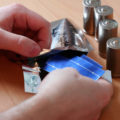
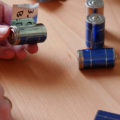
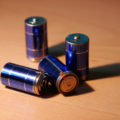
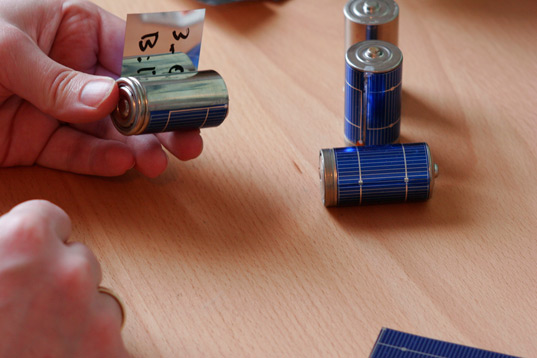
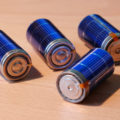
Designer and inventor extraordinaire Knut Karlsen recently unveiled an inspired approach to portable power that can’t be beat for its elegant simplicity: a prototype battery capable of charging itself when exposed to sunshine. His slick set of SunCat C-cells are wrapped in flexible photovoltaic panels and will slowly recharge when left to bask in the sun – just like a cat.
Related Posts
-
Although consumer electronics are tending towards rechargeable batteries these days, those ubiquitous alkaline disposables continue to present an environmental problem. Now Sungwoo Park and Sunhee
-
Next time you head to the park, consider bringing a Suntrica wearable solar charger. The Suntrica SolarBadge and SolarStrap are pocket-sized, durable, lightweight chargers covered
-
If you thought rechargeable batteries were a good green idea, the USBCELL rechargeable battery will blow your mind- it plugs into any computer’s USB port
14 Responses to “SunCat: Solar Batteries Powered by Sunshine”
-
Featured Author
-
Read Inhabitat
-
Search Categories
-
Recent Posts
-
Recent Comments
-
Browse by Keyword
follow inhabitat on:
popular today
all time
most commented
more popular stories >
© Inhabitat.com 2012 | About Inhabitat | Contact Us | Advertising with Inhabitat | Terms Of Use | Privacy Policy | Inhabitat, LLC


A great idea! innovative
Didn’t I learn when I was a kid not to sit batteries out near a heat source because they explode? I may be making that up.
Brilliant…and dare I say, obvious in retrospect. All batteries should be equipped like this!
There is no reason to wrap the solar cells completely around the battery. Sunlight comes from the South not the North. I would also suggest that Karlsen start with AA cells rather than C cells as AAs are the most common batteries in use.
Why stick them on each battery? Why not have it as a sleeve that you pop the battery into? That way you don’t have to throw away the solar panel when the batter is finished, and it won’t damage the solar panel when you put it into the appliance.
I like the idea of this solar-powered battery. Maybe one day someone would go a big step further (this may be a dumb idea, I’m not a science genius) and put a solar panel on a car battery. No more beeing marooned on the side of the road with no one to jump your battery!
YES! This is a brilliant idea. Bravo. Two thumbs up. (Y) (Y)
The idea seems cool … until some arithmetic is done.
The area of a C cell (excluding the end-caps of the cylinder) is about 0.004 square metres. So if the panel had perfect efficiency, and you illuminated it all with a full Arizona sun (~1000W/m^2), this battery would collect about 4mW of power. A typical NiMH today is about 2.9Ah, or about 3700mWh of energy (this is probably a high estimate, but not by much). So we can expect a total charge time of about 3700/4 = 925 hours = 38 days. The sun doesn’t shine for 24 hours — even in Arizona — so this 38 days is going to be more like 80 or 90 days in reality. Add in the fact only half of the cylinder is under illumination, and the circular geometry says reduces this by half again (cosine), and that the panel is going to be about 15% efficient, it looks like it’s going to take a several years to recharge the battery.
In essence, the average rate is about 0.1mW of power.
However, NiMH have a fairly high self-discharge rate of about 1% per day, after about a 5-10% drop on the first day (from a fully charged battery). Ignore the first day, we have: 3700*.01 = 37mWh loss/24hours = 1.5mW average. A discharge rate in excess of the trickle charge rate from these solar panels, suggesting the panel can’t even maintain the charge on a fully charged battery.
Off by a full 3 orders of magnitude! How embarrassing. Ah well.
Assume a 10% solar efficiency, which from what I understand is a little generous, but still… now, look at the maximum cross-sectional area that the side of the battery can present to the sun* and the solar power per square meter, and feed all that into Google calculator:
1000 watts/meter^2 * 1.9 inch * 1 inch * .10 = 0.1225804 watts
Probably enough that a good design could prevent loss thru self-discharge.
Of course, as an actual Arizona resident, the first thing that comes to mind is the fact that its a profoundly bad idea to leave any type of battery in direct sunlight for extended periods of time. It really wears them out!
We are manufacturers of various products that utalizes AA Batteries. We are interested to purchase CunCat Solar Rechargable battaeries.
Please contact me.
Taz Abas
drabas@payplusco.com
213-252-4433
now use some ultra capacitors and woha!
me want 3Million of these on the roof of my house, under a bullet proof glass sheet in mineral oil. (to stay cool)
hmm might need a bigger house!
Solar panels ought ot be placed where optimum charge is archieved. The shape and location of the panels on the batteries themselves does not seem optimal. Also ‘gmoke’ sun in not only in north. The predominant location of the sun depends on the hemisphere/latitude at which you are located. Ie sun is generally in the north for those countries in southern hemisphere.
For example, a breakthrough in better batteries could supplant hydrogen. Better solar cells could replace or win out in this race to the fuel of the future. Those, I see, as the three big competitors: hydrogen, solar cells and then better batteries. ying yang Team