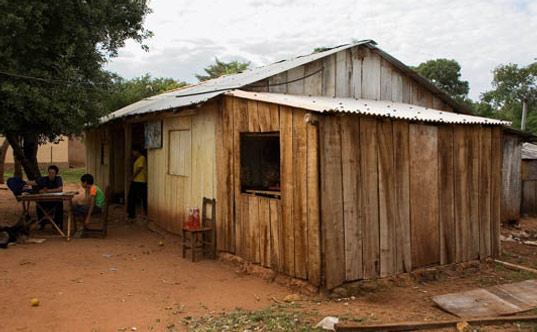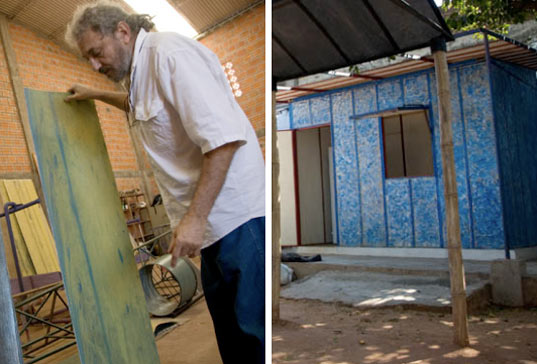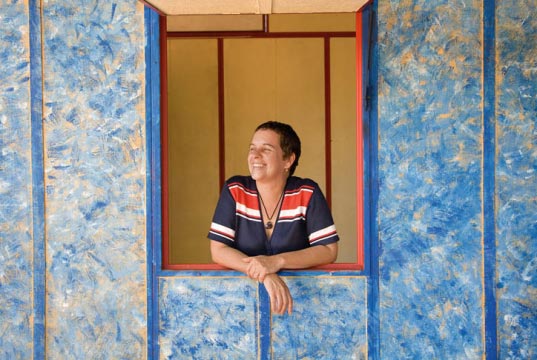

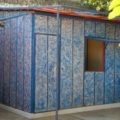
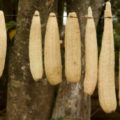
In Paraguay, forested areas have been reduced to less than 10% of the country, which means that wood is scarcely available as a building material. Additionally, 300,000 families do not have adequate housing. These two serious factors couple to form a sizable problem, which community activist Elsa Zaldívar is addressing with an innovative approach to sustainable building. Recognizing the waste being sent to the landfill and a need for housing, Elsa worked with an industrial engineer to develop a material made from recycled plastic and agricultural fibers, like loofah, corn husks and caranday palm trees. These panels now provide an inexpensive, lightweight, flexible building material that can help communities reduce their agricultural waste while generating income and providing sustainable housing to families.



The region around Caaguazú has experienced severe deforestation for more than four decades, and the area’s economy has declined considerably due to a collapse in cotton and an increase in cultivation of soya, a crop that has contaminated the soil and forced families to leave their land. To help the local economy, Elsa had previously worked with a group of women in Caaguazú to grow loofah and use it as a source of income.
Loofah is easy to grow, can be eaten before it fully ripens, and once dried it turns into the scrub we use in the shower. Elsa taught her community how to sustainably grow and harvest the loofahs, and how to turn them into cosmetic sponges as well as mats, insoles, slippers and other products. These women were growing and producing an exceptional product – even better than the plantation-grown loofahs from China and other countries. As a result their income grew and even the men of the region, who had previously laughed at the endeavor, were very proud.
But they also had wastes. About a third of the plants grown were of inferior quality and could not be exported, and then 30% of a good loofah is trimmed off. All of these scraps ended up going to the landfill, so Elsa teamed up with an industrial engineer, Pedro Padrós, to find a way to use the fibrous waste to make inexpensive building materials. They at first tried resins and glues that proved to be too expensive, and then they thought of using reground plastic to combine with the agriculture waste, and extrude to make panels.
After many trials and mixtures, along with a grant from Paraguay’s environment ministry, they finally developed a good panel that is flexible, durable, lightweight and recyclable. By carefully choosing which plastics they use, the panels can be ground up, melted and formed into new panels. Their current factory consists of a melter, mixer, extruder and cutter, and by varying the amounts of material and types of filler, they can create varying degrees of flexibility, weight and insulating qualities. Coloring can also be included at the time of mixing, which means homeowners will never need to paint their home. Panels are then joined together with special metal connectors, and are much easier to handle than brick or lumber. Production costs started around $6 per square meter and are now down to half that amount.
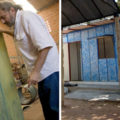
The hope is that this building material will allow families to easily and quickly construct simple homes in 3 to 4 days at minimal costs. Urban residents will also be able to use these panels for construction. Elsa and Padrós’ work has recently earned them the Rolex Award for Enterprise. This award will help them build 3 model homes and produce a video about their efforts.
Their goal is to reduce the need for wood in a highly deforested country, provide low-cost housing, and at the same time help generate income. Elsa says: “We want to find sustainable housing alternatives for the poor, while also discovering new markets for their agricultural products, particularly the loofah. This is a perfect combination.”
Via Springwise