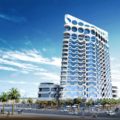
The 18-story façade of James Law Cybertecture‘s new Pixel Tower in Dubai was inspired by the moving bubbles in a champagne glass and built for the young, techie and trendy. Intended for the Dubai Waterfront, Pixel Tower draws on passive solar techniques and strategic facade geometry to minimize heat gain on the structure’s south side and optimize views out over the Persian Gulf to the north.
Related Posts
-
Like an non evil, sustainable version of the Deathstar, the Technosphere by James Law Cybertecture replicates the Earth as a structural concept. Inside the eco-sphere
-
James Law Cybertecture International brings high-tech solutions to large scale structures through innovative ideas for intelligent living. The latest future forward design from this firm
-
While David Fisher’s Twirling Tower is not the first rotating tower we’ve spotted (Dubai Tower Clocks the Sun), and not the first that generates power
7 Responses to “High-Tech Cybertechture for Dubai Waterfront”
-
Featured Author
-
Read Inhabitat
-
Search Categories
-
Recent Posts
-
Recent Comments
-
Browse by Keyword
follow inhabitat on:
popular today
all time
most commented
more popular stories >
© Inhabitat.com 2012 | About Inhabitat | Contact Us | Advertising with Inhabitat | Terms Of Use | Privacy Policy | Inhabitat, LLC


So would I. James Law calls himself “cybertect” and is mainly busy with putting loads of technology (not necessarily green) into buildings for the well being of it’s inhabitants. But I like his work and his innovative tendency.
Am I correct? Does the building light up like a bulb after dark? Hmm, green hey…
To me design of this building seems a bit ‘Miami Vice’ for those who didn’t see the show, I’m thinking 80s.
Also some architects don’t really understand the fine balance of living space and electronic/gadgets they put into them. There is a fine point where you can overdo on high-tech, you need to have technology that is effective but simple and actually makes our life less complicated. Simplicity is the next frontier in architecture, and technology needs to be invisible working to improve or sense of comfort and well being. Overloading the home with electronics just for the sake of having them, is like buying a remote control with hundreds of functions you never use.
The building is just plain ugly. Its shape and circular openings are not a must to achieve passive strategies. A number of other, more elegant solutions could have been designed. Also, simplicity is not the next frontier in architecture, simplicity has been around for a long time, especially in the Modern era around the 50\’s. \”Less is More\”, remember that?
I suspect the architect doesn’t have a very high regard for the, as he puts it:”young, techie and trendy” of Dubai. If his assesment is true perhaps they should change the name of the country in the future to “Dumb-ai”. Sorry, couldn’t resist, but really, it doesn’t do much to dispell the notion that the priveledged educated youth of the gulf region are not to be taken to seriously and have confused size with importance.
[...] passive solar gain and using untreated local wood, this sustainable home on Lake Laka in Poland was designed by [...]
[...] Holl Architects‘ winning entry is defined by a number of pairs: two towers, with two bridges, oriented in two directions that connect the city with the site’s history. The Langenlinine tower takes its geometry from the site’s old harbor, while the Marmormolen tower forms a connection with the city via an expansive main terrace and a public auditorium. The project also boasts a stunning public walkway that rises 65 meters over the harbor, securing the development’s status as an iconic new addition to Copenhagen’s waterfront. [...]
dubai buttons for my friendly sheik for this one.