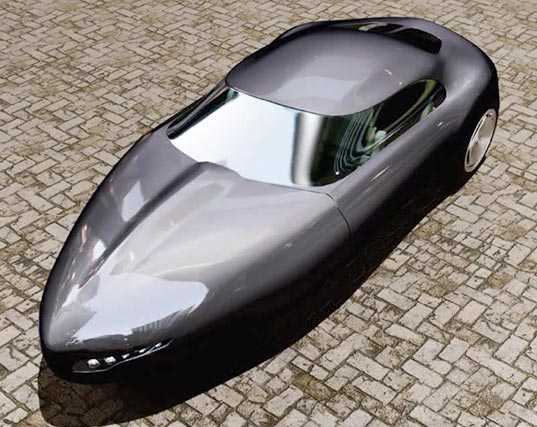
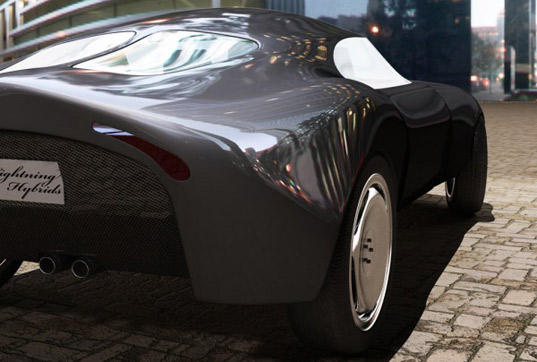
Loveland, Colorado-based Lightning Hybrids has its sights set on the $10 million automotive x-prize with a sleek biodiesel-fueled vehicle that they claim will break the 100MPG barrier for a production sedan. Once completed, their hydraulic hybrid prototype will boast 240 hp, a carbon fiber chassis, and a 0-60 speed of 5.9 seconds.

Related Posts
-
The EPA announced this week that they’ll be lending their new hydraulic hybrid technology to Chrysler to make a 35% more efficient hybrid minivan. The
-
While these days “hybrid” usually means a gasoline/electric vehicle, Valentin Technologies is exploring a different hybrid combination that promises a 5-passenger car with outstanding performance.
-
The Ford Motor Company Fund and the Georgia Institute of Technology have joined forces to create the U.S.’s first conversion of a traditional school bus
4 Responses to “The 100MPG Lightning Hydraulic Hybrid Vehicle”
-
Featured Author
-
Read Inhabitat
-
Search Categories
-
Recent Posts
-
Recent Comments
-
Browse by Keyword
follow inhabitat on:
popular today
all time
most commented
more popular stories >
© Inhabitat.com 2012 | About Inhabitat | Contact Us | Advertising with Inhabitat | Terms Of Use | Privacy Policy | Inhabitat, LLC


This is fantastic!! Hydraulic systems store more energy per lb than electric, and you don’t have chemical batteries to dispose of! Good luck to these folks.
I have read a couple articles about hydraulic hybrids, though they usually involve trucks. The latest one I found was “Big Green Trucks” found here: http://economicefficiency.blogspot.com/2008/12/big-green-trucks.html
I would love to see this hydraulic hybrid technology take off!
If you would put standard two-doors with hand roll up windowns on the car, I will buy 100,000 of them for openers. Bio-diesel is made from carbon taken from the air (not fossil fuel) and put back into the air when used. It is as carbon nutrial as solar electricity. This car essentially has no cluch, no battery (except for lights), no gears and very little else to wear out.
Jellymuscles
Hydraulic does not store more energy per pound than electric. That’s one of the reasons it’s seen more on heavy-duty vehicles. It does, however, have a higher power density. This means regenerative energy can be stored more quickly in a hydraulic system than an electric system. A hydraulic system could allow a vehicle to recapture nearly 100% of the energy normally lost during braking. Electric systems can only capture the majority of the energy when decelerating slowly. That’s the difference between energy density and power density.
HHV with a CVT transmission is cheap to build and much cheaper to keep for 10 years as opposed to replacing a $10k battery system. I think this would be a great application for minivans , suvs, midsize and fullsize pickup trucks too.
I’ll be one of the first to trade up when a midsized, versatile pickup truck with a midgate and under bed storage comes out with the technology.