Site Meter
Ali Kriscenski

THE CONCRETE HOUSE: How green is concrete?

by , 09/10/07
filed under: Architecture

concrete1.jpg, concrete house, sustainable concrete, concrete construction, green home

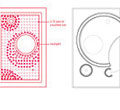
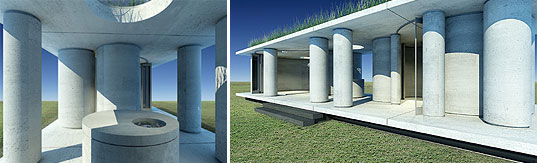
Australian Architects Peter Poulet and Michael Harvey contemplate concrete’s green side with The Concrete House, a free-flowing assembly of gravity-secured precast columns and slabs that the designers call a “commitment to living sustainably”. With renewable energy systems, a green roof, rainwater harvesting and waste minimization, the design tries to prove that concrete is an environmentally appropriate choice.

Related Posts

22 Responses to “THE CONCRETE HOUSE: How green is concrete?”

  1. Minsk Maz Minsk Maz says:

    According to the US EPA 516 pounds of Carbon emissions are tied to each ton of cement consumed. CO2 is emitted from the mining and transportation of limestone and other concrete aggregates such as chalk and clay, the calcination process of limestone itself, the combustion of fuels in the kiln and associated power generation.

  2. [...] Το σπίτι από μπετόν September 10, 2007 3:38 pm ma8u ενέργεια, αρχιτεκτονική, σπίτι Οι Αυστραλοί αρχιτέκτονες Peter Poulet and Michael Harvey παρουσίασαν ένα κτίριο αποκλειστικά κατασκευασμένο από μπετόν. Με μια φυτεμένη οροφή, χρήση των ανανεώσιμων πηγών ενέργειας, αξιοποίηση του βρόχινου νερού και ανακύκλωση των ακαθάρτων, οι σχεδιαστές προσπαθούν να τονίσουν την “οικολογική” ταυτότητα του μπετόν. Το επιτυγχάνουν αυτό, αξιοποιώντας της μεγάλη θερμική μάζα της κατασκευής που αποθηκεύει την ηλιακή ακτινοβολία της νότιας όψης και τον φυσικό αερισμό από τα βορινά παράθυρα, ενώ οι τεράστιες κολόνες χρησιμοποιούνται ως αποθήκες του βρόχινου νερού και ανακύκλωση των ακαθάρτων. Επιπλέον η φυτεμένη οροφή εγγυάται την ενεργειακή αποδοτικότητα του συνόλου, λειτουργώντας ως δίαυλος για της αξιοποίηση των κολονών. Αναλυτική παρουσίαση του σχεδιασμού του κτιρίου θα βρείτε εδώ. Το κτίριο καθώς και αρκετά άλλα συμμετείχαν στην έκθεση Houses of the future που έγινε στο Σίδνεϊ της Αυστραλίας το 2005, περισσότερες λεπτομέρειες εδώ. Τέλος ένα ενδιαφέρον άρθρο για την “οικολογική” φύση του μπετόν θα βρείτε εδώ. [...]

  3. Dave Waldorf Dave Waldorf says:

    AND…

    For every single cubic yard of concrete produced, 1,700,000 Btu’s of energy is consumed!! The raw ingredients in cement must be heated to a temperature of 1480 degrees Centigrade (2732 degrees Fahrenheit). This is far more energy intensive that other types of manufacturing in the U.S. economy — ten times more on the average, in fact.

    This energy consumption in turn results in 631 pounds of carbon dioxide being released into the atmosphere for every cubic yard of concrete. Eight percent of all carbon dioxide released into the atmosphere by human activities comes just from the production of concrete…

    In an era with dwindling energy resources, widespread air and water pollution, and global warming, wouldn’t using adobe or other natural materials in home building make a little more sense?

    *Sources: “Environmental Building News” (vol. 2, no. 3), 1993; “Serious Straw Bale” by Paul Lacinski and Michel Bergeron, 2000.

  4. Parker Parker says:

    This piece makes a strong case. I think a concrete house could last for hundreds of years. If rail was used to transport materials that would cut the carbon load. It would be possible to create the heat needed with sunlight. I don’t mean photo voltaic either. I just mean sunlight concentrated with mirrors.

    I like the assembly of just basically setting it down and that’s it.

  5. Where on this planet, save for an extremely small number of “heritage” buildings, is any one building used for more than a century? Very few. We would rather tear down and start afresh than try to retrofit a building, because it’s more economical to do so. With that being the case, the argument that “a concrete structure could last hundreds of years” is entirely moot, and misleading. Yes, its structural lifespan could reach into multiple centuries, but long before then someone will re-task the land and flatten the building.

    Unless anyone can determine whether a concrete structure has an energy ROI of less than 25 years, concrete use should be minimized wherever possible, if not eliminated entirely.

  6. Richie Richie says:

    The concept seems interesting. It would have been nice if the text that came along with these photos included the data that has been emailed in as responses, AND then showed that in spite of these challenging numbers… that since concrete buildings are meant to last 50 to 100 years… that the yearly average pollution generated by these buildings is very low ?. Maybe it’s even LESS than that of the standard building materoaials used so ubiquitously today ?

    I suspect that it is. And that this is the heart of the matter. Too bad it wasn’t addressed in the text.

    What about unsecured, except by gravity, concrete… and Earthquakes, hurricanes, tidal waves, and Tsunamis ? How would non-steel reinforced concrete structure, whose elements are not bound together through the normal concrete curing process into a single solid interconnected structure, fare during such cataclymic events ?

    I suspect that they would not do so well.

    Isn’t interesting that the ancient ‘builders’ of StoneHenge in the UK, did not leave behind dwellings fabricated in the same monolithic fashion. Maybe they didn’t believe that such a building protocol was safe or justifiable ?

  7. JS JS says:

    Where is any building used for more than a century? Maybe I’m missing something…but I’d add “most cities in Europe” to that list as well.

    Just because modern building practice revolves around a sense of short useful lives doesn’t make it an inescapable reality…

    Should we perform ROI’s on DaVinci’s works, or any of the other structures that have lasted beyond centuries…

    My only point is that we should acknowledge that the dominant paradigm today in many ways is disposability…and that it need not drive our decisions.

  8. dug dug says:

    many homes in new england have lasted more than a century.

    most of the brownstones in brooklyn are more than a century old.

  9. Curtis Curtis says:

    What about Papercrete – drastically reduce the energy input (anyone have any numbers?), possibly papercrete used in insulated papercrete forms… just a thought.

  10. shocka shocka says:

    reminds me a little of Le Corbusier and if u’ve ever seen concrete in action u’ll know how ugly it can look, thats not to say all buildings look awful when built with concrete as a finish material.
    putting aesthetic appeal aside, the co2 numbers cannot be missed

    and to Mr Netherton, who i assume is american where u may consider a “age-old” building to be 50 years old, there are many. many, many examples throughout the world which have stood for more than a century.

    i’ve not read into the facts and figure’s but at a guess i would sooner use quality building materials than inferior materials and construction techniques if it mean the building would last twice as long. obviously the nature of the site would be taken into consideration.

  11. I am not American, but Canadian. Your other assumptions, however are correct: “old” buildings over on this side of the pond aren’t nearly as anicent as what you have over in Europe.

    I will grant that many buildings in urban environments are continually re-tasked and re-purposed over and over again for decades (and centuries), but I guess my point is more whether that is truly the case for single-family dwellings as the Concrete House is showcased to be? Yes, many buildings are repurposed… but are residences, typically? I just don’t want to assume that because a building has a structural lifetime measured in centuries that it will remain standing that long, hence my call to use a much shorter-term ROI.

  12. Piriya Piriya says:

    even cutting the carbon emission from transportation and from heat generation, the process of making cement gives out around 700kg per 1000kg of cement produced anyway.

    but then again, concrete is very durable and can withstand time, but do we really want a prefab home that will last hundred of years? I love concrete, the feel, colours, texture.. I just love it but I don’t really agree with the ‘point’ of this particular house. Though, yes, I did get inspired by some of the concepts though, I might try experimenting them on my next chance.

  13. james morgan james morgan says:

    The special claim of durability attached to concrete is untenable. Any building that will last thirty years will easily last two hundred and thirty if properly maintained. Given a good hat and shoes (roof and foundation) even relatively modest wood structures are extremely durable – English examples built four centuries ago and more are not uncommon. In most parts of the US the drier climate and the vast renewable forest resources are even more favorable for wood buildings and offer the opportunity for long-term carbon-sequestration if thoughtfully deployed.

    On the other hand I have seen concrete structures less than fifty years old failing irrecoverably through neglect – the most common cause being foundation damage resulting from unchecked vegetation. In this regard their rigid monolithic construction is both their strength and their Achilles heel. Too, concrete buildings are notoriously unlovable: the notorious Pruitt-Igoe apartments in St. Louis lasted less than twenty years before they were put out of their misery and spectacularly blown to bits.

    If you want really durable and neglect-proof (but probably at the expense of comfort and cost), go for stone. Being non-monolithic it can adjust to moving foundations and endure a degree of neglect that would devastate other materials – the main walls of dwellings built 2,000 years ago are clearly visible at Chysauster in Cornwall, for example. And unlike concrete, the pieces can easily be repurposed (not just downcycled) to form new structures.

  14. art davis art davis says:

    i am amazed that so few people think urban!
    it is a true failing of today’s architecture schools, at least in this nation.
    most of the problem is that this economic system focuses on single plots of land that are developed singularly.
    we need to escape that mindset!

    we cant think of doing single family homes anymore! especially on nice big lots with views and few neighbors!

    but this project shows the greatness of concrete and this design can be applied very nicely to an urban scale.
    we have to move to high-rise! dramatic new, creative, community oriented shells, lots of varying spaces. then we get to design each space individually. 3-d lots.
    and concrete works great for that! so do the curves of this design.
    and you dont have to do any surfacing! just add your own creative elements.
    think of all the money, energy spent shopping for paint and all the other products in a framed house, no matter how green they are.

    think outside the 2-d box! and think urban design

    just as we’ve created new ways to motorize cars that dont pollute, we can find new ways to produce the heat needed to produce concrete. viewing concrete as a permenant polluter is being ….simpleminded?

    i love this design. yes, it brings le corbusier to mind. the curves are great.
    great work and very inspiring!

  15. art davis art davis says:

    ps…

    the most essential human needs are: air, water, food, and shelter. food and water are the primary needs that we have to spend energy on to produce.
    now, with 6 billion people to house we have to consider new urban structure that doesnt eat up open land so much, no more horizontal sprawl.
    concrete is an amazing product that allows great structural potential and creativity in form, as well as being a benign surface for interiors.
    so…even if we continue to produce it using “old school” methods, and considering how much concrete is used today…
    only 7% of the overall carbon output is a very small price to pay for the huge benefits it allows us.
    but im confident we can create more localized, decentralized concrete production facilities using thermal solar energy. remember…current large plants using “cheap” fossil fuels are a product of a capitalist economy with no cares for sustainability. we have to turn that mentality around.
    i will be presenting a new invention for a socio-economic system that solves many of the current complications we are running into.

    thanks again to the designer of this project to show on a small scale once again the greatness of the material
    and thanks to this site for the forum and offering us a wide spectrum of new projects to comment on.

  16. David Holmquist David Holmquist says:

    Please consider the advantages of a “monolithic dome” made of concrete that is sprayed up into an air-inflated form. The technology is very well developed. Website: http://www.monolithicdome.com. I’d like to see a green evaluation of the designs.

  17. Linnet Stuart Linnet Stuart says:

    Concrete continues to emit C02 not only in the making of it but throughout it entire lifetime just as timber does. This has been proved and documented but hardly spoken about. Could someone provide facts please

  18. Kat Kat says:

    no one has mentioned pumice yet. self-insulating, durable, applied as concrete, poured into forms or made into blocks. such an amazing, natural product.

  19. Kevin Kevin says:

    I wonder to what degree concrete structures that are small-scale such as one-story buildings can be built of concrete components that can be assembled and dismantled. I am thinking of Lego blocks here, but ones that can be disassembled and moved manually, and using a van or truck and not with special tools, machines or vehicles.

    I also like the idea of mixing materials.

    One fantasy I have is of a monolithic dome (mentioned above) covered with earth forming a hill of sorts with a wooden structure atop it and a structure below ground as well that utilizes steel and concrete and would be sheltered from the elements. Now _that_ would last for centuries! And everybody wants a house on a hill, right?!

  20. Michael Harvey Michael Harvey says:

    Just to let you all know, this project was successfully built for an exhibition back in 2004.
    http://www.archmedia.com.au/aa/aaissue.php?issueid=200501&article=7&typeon=2
    Since then, the building has been dismantled and re-assembled several times in different locations.
    The lifting eyelets cast in to the various panels have worked very successfully.
    By the way, all the columns are actually off the shelf sewer and stormwater pipes.
    The idea was that this house could be a form of affordable housing.

    And thanks for all the nice comments!

    Michael Harvey
    Architect

  21. [...] the central structure. The materials on the inside, such as the concrete floor, also have a high thermal mass allowing for less of a need of active mechanical control. The home also has two green roofs on [...]

  22. Melchor P. Sirilan Melchor P. Sirilan says:

    We surely need ideas such as this one. Current structures the practice of sustainabile design is not yet perfectm and the principles are not fully understiid nor embrace. However, we shall all continue to conjure and build on our ideas to achieve this goal.

Leave a Comment

Please keep your comments relevant to this blog entry. Email addresses are never displayed, but they are required to confirm your comments.

Please note that gratuitous links to your site are viewed as spam and may result in removed comments.

Add your comments

NEW USER

CURRENT USERS LOGIN

Lost your password?

get the free Inhabitat newsletter

Submit this form
popular today
all time
most commented
more popular stories >
What are you looking for? (Solar, HVAC, etc.)
Where are you located?