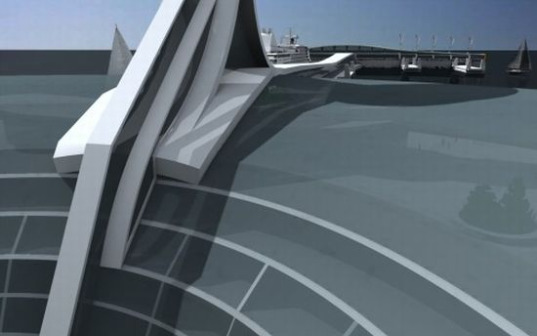
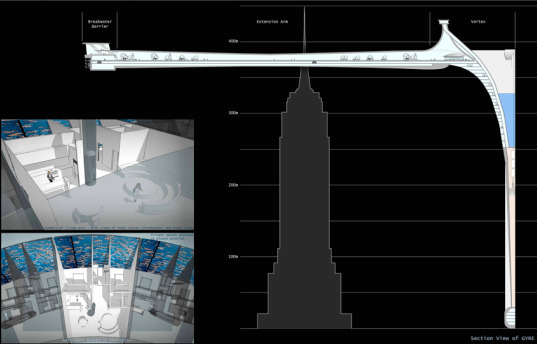
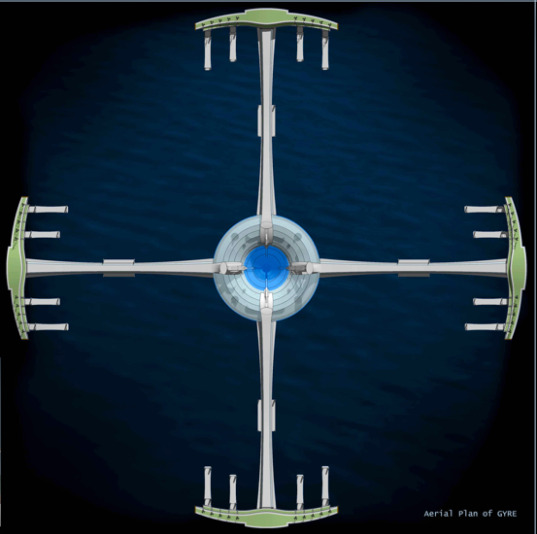
Can you imagine living in a high-rise apartment building where the 360 degree views are of fishes and saltwater? Although just a concept now, this upside-down, underwater eco-skyscraper could be the future of building, especially if sea levels rise as predicted and we end up living in a water world. Designed by Victoria BC-based firm Zigloo, the Gyre is a floating eco-development meant to be both a research station as well as an off-shore resort with shops, restaurants, gardens and recreation. Powered completely by the sun, wind and ocean, the Gyre would offer a zero emissions stay for both tourists and researchers hoping to gain a better understanding of the ocean’s ecosystem.
Related Posts
-
One the greatest untapped energy resources in the world is the motion of the ocean. And while floating wind turbines and wave-powered generators are being
-
Designed for Dubai by Woods Bagot, the Nakheel Tower is planned to be the world’s tallest skyscraper. The towering spire would stand over a kilometer
-
They’ve solved all of these problems with their adaptable, floating offshore wind and wave generation platform. The renewable energy plant of the future. The platform
11 Responses to “The Gyre: A Floating Upside Down Eco Skyscraper”
-
Featured Author
2012 Pritzker Prize Awarded to Wang Shu – First Chinese Architect to Win the Award
Curved House is a Modern Residence with Distinctive Sustainable Strategies in Missouri
Sugarhouse Studios Pop-Up Cinema & Workshop Encourages Community Interaction in London
Luxurious Floating Home Makes the Most of Its Small Footprint on Lake Union in Seattle
This author's twitter feed is currently unavailable. Please try again later.
-
Read Inhabitat
-
Search Categories
-
Recent Posts
-
Recent Comments
-
Browse by Keyword
follow inhabitat on:
popular today
all time
most commented
more popular stories >
© Inhabitat.com 2012 | About Inhabitat | Contact Us | Advertising with Inhabitat | Terms Of Use | Privacy Policy | Inhabitat, LLC


What about really big storms or typhoons, they might snap the whole thing =/
ok, so where does all the sewage go? and the trash? and where does the food come from???? for this to be truly zero emissions, the construction materials must be produced with no emissions and ALL the waste must be dealt without using ANY emissions…
there are oil platforms that float, so i’m sure some engineer a long time ago figured out a way to alleviate this problem – typhoons
I wonder if they thought about ways of using the really high atmospheric pressure at depths of 400 meter – trash compactor?
or using cable ties when anchoring (like some oil rigs) to then produce electricity via movement of Gyre, the amount of force produced by this thing moving would really produce some electrical current.
farming could easily be done down in the tube, basically make a bunch of Heliostat bouyes that transmit sunlight via fiber optic cables down to the deep farm.
i like it…
water storage tanks at the BOTTOM of the spyre?! so they have to pump it up again? serious design flaw…
There are serious issues with this design as I see it.
Firstly, the ‘arms’ seem to have little to no flex in them – waves would snap them into pieces or cause extreme sea sickness – this is why ships are only of certan lengths – it’s due to the wavelength of the sea they are traveling in.
Secondly, the deeper you go, themore materials you need to protect your cargo – this is going excedingly deep, and hus is going to be excedingly expensive in terms of carbon and money.
Next is the issue of food – you cannot produce enough to make the platform viable in the long run, and anything you do requires MASSIVE deliveries on a continual basis, which blows out of the water the carbon neutral basis.
Furthermore, how are you going to keep the outside windows clean at the depths that this is talking about?!?! No window washer that I know of will work at that depth, and the mass of crud that will acumulate will slowly drag the structure down to Davy Joanses locker.
Then we have the standard issue of the renewable energy. How are you going to store it for times when there is more demand than energy being produced? Batteries are expensive, energy inneficient, need replaced regularly (in terms of the lifetime of a structure like this) and are excedingly crbon expensive and enviromentaly damaging both in their production and their destruction after their useful life has expired.
All in all, it looks nice, but is highly impractical – someone was fishing for “ooo, isn’t it pritty” comments when they desged this.
Badspryo-i’m defending this idea because it’s fun, i have no idea who the people and their intentions were behind this
0. water tanks at bottom – atmospheric pressure to push it back up, then a mechanical device running on solar energy to push the base of tank back down
1. segment the arms and put in sensors and counterweights.
2. true- but versus an oil rig still a better project, no?
3. you have an ocean to float farms on.
4. robots
5. algea as excess biofuel
it’s pretty and can be engineered.
It’s really only a matter of time before we see things like this. They won’t be ideal, they’ll probably pollute, and there’ll even be a few failures where people die as a result. That always happens with progress. Considering how much ocean we have out there, and how many people we have on the planet, it doesn’t surprise me one bit that ideas like these start popping up.
I’d love to see some serious engineers tackle this issue. It’d be interesting to see the oceanic habitat options they’d come up with. I’ve often thought that one option would be to dredge soil from the ocean floor to build farms that float above on floating glass barges. There’s the desalinization to think about, or going deep enough where salt isn’t an issue anymore.
The point here is that sooner or later, this will happen. It’s just a question of when, and where, and by whom. Some may choose to embrace environmental standards, while others may choose to disregard them. This article gives us all a chance to discuss the options. The more we as people think about this as a future inevitability, the more we can try to think of the best possible scenarios that cause the least amount of harm. It’s only a matter of time.
So futuristic! An out of space design. I’d love to see it in action!
Maybe we need to learn from ocean-based communities already in existence — such as the Chinese boats that float enmasse in harbors. by providing flexible attachments, we might be able to build more sustainable ocean-based communities. New technologies are being developed in agriculture — such as aquaponics — and in other fields that can be brought together to colonize the ocean. The real question is whether we have an ethical and practical reason for taking over additional spaces on the earth that are better managed by the life forms that currently inhabit them. Will this mean another generation of genocide of species?
Due to change in climates,rising sea level,continental crust movement,tectonic plates movement threatening the life on earth that’s why the need for underwater cities and architecture has been felt more than ever before.And Canadian design firm zigloo is working on this.Its unique design permits the simultaneous application of winds,solar and tidal energy generation technologies.
[...] entry in next year’s eVolo Skyscraper Competition, the inverted skyscraper is a completely self-sufficient underground city capable of producing its own food and energy and [...]