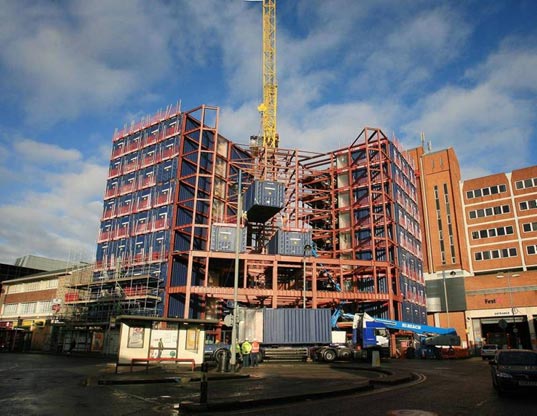
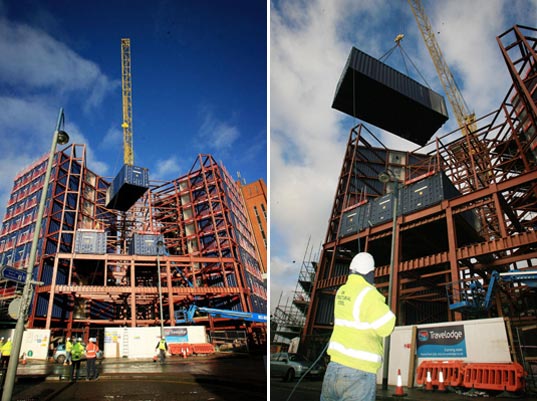
Travelodge recently opened a hotel in Uxbridge, England that is constructed entirely from prefabricated shipping containers. The completed design uses eighty-six containers of various sizes that were retrofitted into bedrooms and bolted together onsite. The exterior has been clad and fitted with windows, thus converting the assemblage into a seamless 120-bedroom hotel. Verbus Systems estimates that the structure’s prefab composition saved the hotel chain more than half a million pounds and at least 10 weeks of construction.

Related Posts
-
As summer hits its stride many might be opting for the stay-cation this year, but for those adventurous green travelers headed out into the world
-
Bio Hotel, a sustainable construction inspired by the LEED methodology, will be a 7-storey hotel located in Bogotá D.C. – Colombia. LEED is a certification
-
Seven ISO containers will make up the project, expanding the residence to a 3-story, 3-bedroom hybrid. The addition will include a master bedroom suite, gallery,
15 Responses to “TRAVELODGE HOTEL MADE FROM SHIPPING CONTAINERS”
-
Featured Author
-
Read Inhabitat
-
Search Categories
-
Recent Posts
-
Recent Comments
-
Browse by Keyword
follow inhabitat on:
popular today
all time
most commented
more popular stories >
© Inhabitat.com 2012 | About Inhabitat | Contact Us | Advertising with Inhabitat | Terms Of Use | Privacy Policy | Inhabitat, LLC


So, is that just wasted space in those angled corners? or are they cutting the containers apart for the areas adjacent to the corners?
Seems to me that designing a building with non-90 degree angles when you’re using prefab modules that are rectangular in shape is counter-intuitive.
Since the modules fit closely together top-to-bottom, they are likely using the “wasted” corner spaces to run electrical, plumbing, fire protection, and ventilation services.
This is great, I’d love to see more repetitive modular buildings built out of shipping containers.. I wonder how this would work with Fire Codes in the USA.
This is a big step forward towards truly affordable personal dwelling units. These big projects pay for the research that develops the systems, connectors and designs that will translate into very cost effective Housing units. Bravo !
Corners are also likely used for elevator shafts as well. I\’d be curious to take a look at the inside of a finished unit and how they worked in the w/c and shower areas.
Kitchen Plans
This is great, I have an assignment due soon on an Alternitive Design and I have choosen shipping containers as my topic. Here in New Zealand we have a hugh amont of containers sitting in ports allover our country, and some have been sitting there for 10years without ever being moved. So to see that these have now got another use it great, not to mention the fact that they are cheap.
Regards
Daniel
Q/S C/M student.
Corners are likely used for stair ways as well. Great project!
Here in the land of shake, rattle, and ash fallout each room would be it’s own quake resistant shelter. Too bad most US building codes are some of the most acrhaic on the planet, intended to protect 19th century business practices.
What is unfortunate in the design is that beautiful composition of the blue shipping container and red steel is masked by a disappointing brick and cement plaster veneer. Kudos for using shipping containers and saving so much material versus conventional building. However, the design really missed the mark.
selophane writes: This is great, I’d love to see more repetitive modular buildings built out of shipping containers.. I wonder how this would work with Fire Codes in the USA.
You think we don\\\’t have these in the UK. Working with tht Planning Authorities and Health and Safety Executive can be like try to work with the Gestapo and the Waffen SS.
Must say, what a disappointment. The building would have looked a damn site better if they had left the containers exposed… actually anything would look better than the average modern british office block cladding.
“So, is that just wasted space in those angled corners? or are they cutting the containers apart for the areas adjacent to the corners?
Seems to me that designing a building with non-90 degree angles when you’re using prefab modules that are rectangular in shape is counter-intuitive”
Let’s not forget about the need for vertical chases to run Domestic Water, Fire, Hydronic, Electrical, Low Voltage and any other Utility needed to serve all of the units.
Heart about this project last year, and visited. The interior is quite simple, anyway, it is a budget hotel chain. They spent 55,000USD for 2 rooms with simple decoration including wall, floor, ceiling, cables. Plus the furture, MK electrical stuff, and TV…. the cost of making 2 rooms will be higher than 70,000USD, which a bit more expensive than the product of Agson Engineers modular container hotel unit.
Agson Engineers are making higher level modular prefab container hotel for London as well.
You can visit http://www.agson.com.cn to get detail informaion. or you could use a design toy on http://www.agson.co.uk/fp/start.php
This is an interesting subject.
best thing since slice pan ( bread )