


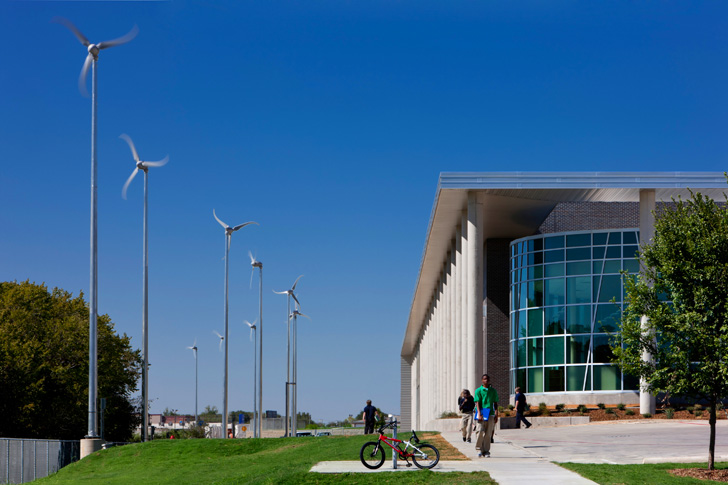


Lady Bird Johnson Middle School’s green features are apparent from the moment one approaches the school, as 12 wind turbines rise 45 feet into the air alongside the building. While visually impressive, the wind turbines actually only produce 1 percent of the school’s power needs. The other 99 percent is generated through the 2,988 Solyndra panels on the white roof that contain cylindrical tubes that capture sunlight from 360 degrees. Any extra energy produced is directed back to the regional grid.
The renewable energy production is coupled with a highly efficient building. 105 geothermal heat pumps help the HVAC system use about 30 percent less energy, and high-performance materials from Fabral Metal Wall and Roof Systems were used for the building’s physical structure. Insulated wall panels, sun shades, and light shelves are a few of the recycled and sustainable Fabral materials used. To help block the hot Texas sun from overheating the building, a large canopy was constructed on two sides of the building to help shade the windows.

“This structure blocks the hot Texas summer sun from passing through classroom and other windows while still allowing natural lighting,” notes Fabral. “In the winter, when the sun is lower in the sky, the rays pass directly through the windows, providing warmth and heat to the building. The width of the canopy was determined by analyzing the sun angles during the times and months when students are in their classrooms.”
Since the school serves as a learning laboratory, the regular K-12 cirriculum has been supplemented with lessons that focus on the school’s energy-efficiency. As noted on the school’s interactive website, “Elementary students may study the differences in solar energy production on a cloudy day versus a sunny day, while high school students may calculate the school’s average geothermal output.” Additionally, there is a viewing platform on the roof so students can examine the photovoltaic array, and energy monitors are placed throughout the hallways so students can see exactly how much energy the school is using at any given time.
In constructing the building, the school district’s main concern was energy use, but they are also seeking LEED certification. Lady Bird Johnson Middle School is not only a beautiful structure, but also a perfect example how green design can be incorporated into our everyday lives as an educational tool. Here’s hoping that more schools around the country follow suit.
+ Lady Bird Johnson Middle School
+ Corgan Associates


