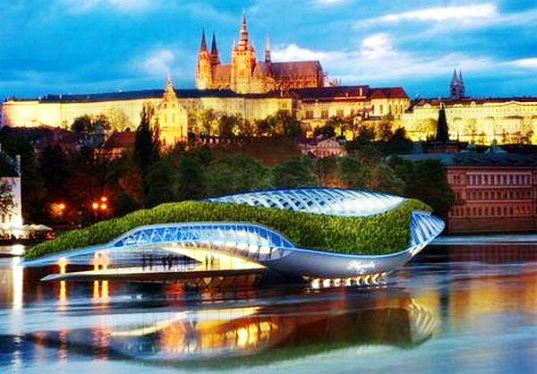
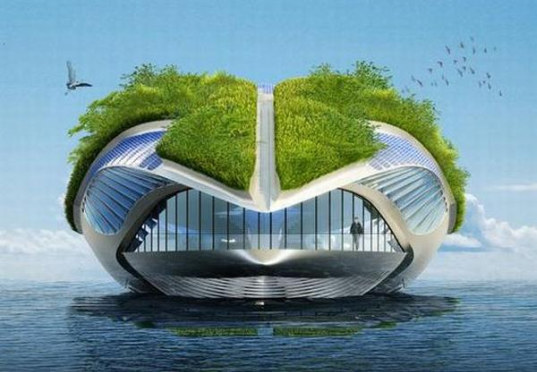
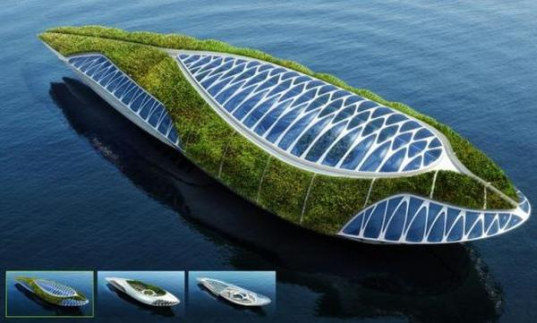
Vincent Callebaut, visionary behind the Lilypad and Dragonfly, has created a whale-shaped floating garden designed to drift through the world’s rivers while purifying their waters. The Physalia is a self-sufficient ecosystem that generates all the power it needs from the sun and works to reduce water pollution through bio-filtration.
Related Posts
-
There are very few urban design solutions that address housing the inevitable tide of displaced people that could arise as oceans swell under global warming.
-
Architect Vincent Callebaut recently unveiled a blue-sky plan for a high-flying fleet of self-sufficient aircraft that are one part zeppelin cities and one part hydrogen-generating
-
Architect Vincent Callebaut’s latest project balances public galleries, meeting rooms and gathering spaces over canals and abandoned railroad tracks in the 19th Parisian district. The
10 Responses to “Whale-Shaped Floating Garden Cleans the World’s Rivers”
-
Featured Author
2012 Pritzker Prize Awarded to Wang Shu – First Chinese Architect to Win the Award
Curved House is a Modern Residence with Distinctive Sustainable Strategies in Missouri
Sugarhouse Studios Pop-Up Cinema & Workshop Encourages Community Interaction in London
Luxurious Floating Home Makes the Most of Its Small Footprint on Lake Union in Seattle
This author's twitter feed is currently unavailable. Please try again later.
-
Read Inhabitat
-
Search Categories
-
Recent Posts
-
Recent Comments
-
Browse by Keyword
follow inhabitat on:
popular today
all time
most commented
more popular stories >
© Inhabitat.com 2012 | About Inhabitat | Contact Us | Advertising with Inhabitat | Terms Of Use | Privacy Policy | Inhabitat, LLC


I see this as a fantastic way to clean up rivers and we have one here in Wisconsin that could benifit from something like this.
http://www.myoakpro.com
Totally amazing!!!
You should take a look at what John Todd has done with cleaning ponds, lakes, and canals using biological filtration
http://www.toddecological.com/
It feels just like a glorified high-tech solution. I recommend projects as suggested by gmoke: http://www.toddecological.com
Similar wetland projects have been inplemented in Adelaide in an attempt to conserve its water supply. As a smaller example, a mine near Emerald in Queensland grows tomatoes in floating gardens to reduce algae and then gives the fruit[?] away for free to locals.
Let’s get away from green gimmickry and actually design stuff. Anyone who has designed something like this before knows this specific concept is overbuilt, too costly, and based on some incorrect treatment assumptions.
When it’s easier to design up some actuals, why are we circulating photos of lofty and unviable conceptual renderings, such as those drawn up by design school students?
@fishiisland @taroona while it may be high-design and not quite realistic in your eyes of the future, we are fortunate that it is in someones eyes. The dreams need to be big and appeal to the masses in the “anythings possible” world of “possibilities”. All we need is everyone to start thinking and believing in the concepts for these types of things and begin asking about them till it *does* become reality.
Just like in high fashion, you will see a designer create dreamy fantasy styles, but the end results that go to the store are “inspired” by these. Same with anything else. It takes a large vision and that is what many people want and need to help them see a greener future.
Is it practical? No, maybe not. Is it what it would look like if someone made it today, No, maybe not. Is it as cool as the utilitarian design that will probably be derived from it and be put into use… well we’ll see, but I’m glad to see this design… It’s inspirational!
Well, I have to agree with taroona and fish his land.
Yes, it’s good that people are thinking about novel ways to do things, the simplest ways are nearly always the best. We westerners want to make simple things highly technological and fancy, more often than not just exacerbating the problems we have.
Let the designers put things on paper (or make 3D projections), then just take the good bits out and throw out the unnecessary glitz and overkill machinery.
I visited natural floating gardens on the Kashmir lakes where they grow vegetables. Practical floating gardens pre-date fancy technology.
I own a fish pond and bio-filtration through the growth of water hyacinths and lotus plants has been my solution to keeping the pond clean. It’s amazing how nature takes its own course when left alone. A simple floating garden keep the water clean and clear without any human intervention.
This design is definitely a good vision and in fact has a good possibility of becoming a realistic project. God knows we need to come up with solutions to the ever increasing pollution in our rivers, ponds and lakes.
I am glad that i googled “floating gardens ” again.This concept gives verification to my conception that floats and feeds off sea water. This is more like a portugese man o war, maybe jellyfish. Solar bubbles distill the water,the crops are fed with seaweed and fish nutriens caught in the tentacles primarilay designed for floatation.Please have a look at the seacrete process of carbon fixation. A method of growing solid structures by absorbing calcium carbonate from the ocean.
Our fresh water supply is the sun in it’s action.
OK these concepts have been with us for a long time so let’s get the next phase active
phase 2???