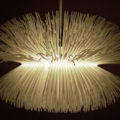
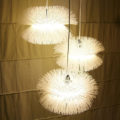
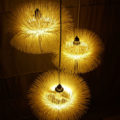
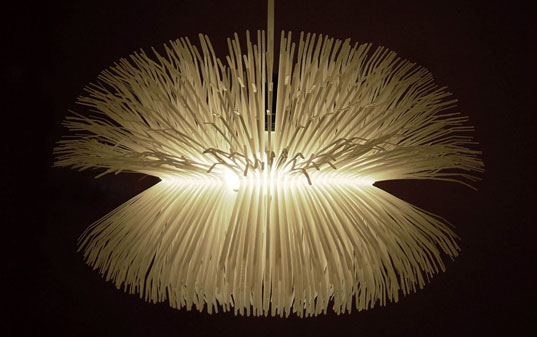
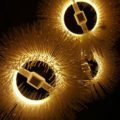
Who knew such mundane little plastic devices could be so beautiful? Steven Haulenbeek, for one, as his Zip-Tie lights turn piles of these oft-overlooked plastic gizmos into stunning, anemone-like light fixtures. We’ve seen zip-ties used before, like in Carlos Alberto Montona Hoyos’ A La Lata chair, but even then, they were hardly the main event. Haulenbeek, an alumnus of the School of the Art Institute’s graduate design program, conceptualized the lights began as a critique of the luxury home accessory market. The project, while still under development, is evolving into a successful (and gorgeously simple) product. For more information, please refer to the designer’s website.
Related Posts
-
Using everyday objects as design inspiration is nothing new, but rarely do we see it executed in such a poetic and gorgeous way as Steven
-
Inspired while unpacking artwork from shipping crates in Milan, the Beijing-based artist began designing her furniture range to embody unusual forms, yet remain adaptable. A graduate
-
Ali was first captivated by sustainable design while snowboarding past green buildings in Colorado ’s Rocky Mountains . After several years quieting her inner ski
14 Responses to “ZIP-TIE LIGHTS by Steven Haulenbeek”
-
Featured Author
-
Read Inhabitat
-
Search Categories
-
Recent Posts
-
Recent Comments
-
Browse by Keyword
follow inhabitat on:
popular today
all time
most commented
more popular stories >
© Inhabitat.com 2012 | About Inhabitat | Contact Us | Advertising with Inhabitat | Terms Of Use | Privacy Policy | Inhabitat, LLC


Nice – if they are used.
Stupid – if they are new.
I think it is really funny that this has now become what the artist was originally critiquing (luxury home accessory)
it is lovely though. I always wonder with these plastic tabs, are they using old ones, or buying new ones?
Meredith:
What about this design screams luxury? (Aside from the fact that they’re gorgeous, isn’t luxury primarily defined by price point?)
Old ones tend to retain much of their former shape, and wouldn’t give the uniform shapes seen here. New ones aren’t expensive if you buy in thousand-count bags, and in this application, the cheap all-plastic ones would actually be superior to the expensive ones with metal gripper teeth.
The dictionary defines luxury not on the basis of elevated price (though that comes as part of the deal), but as anything beyond a basic need. You don’t need to have thousands of zip ties to decorate a light, you just need a light. Adding the zip ties makes it beautiful but because they are not necessary to the function of the light, they are a luxury.
Please note that I am not advocating that we all should live in cardboard boxes with bare lightbulbs. It is nice to have luxury! Luxury makes life more beautiful and comfortable – which is why we tend to pay extra for the prettier item. But I agree that it’s ironic that this was originally designed to critique luxury but can actually be classified as a luxury item itself. It would have been better to leave the ‘protest’ element out of it and just market it as a beautiful thing.
Based on these photos, the zip ties are tied around the halo-flourescent bulb (?) When the bulb dies you are out you’re purchase price or you get to spend a Saturday with a pen knife un-zipping zip ties to retain your eco-ness.
how is this “green” design, exactly?
Habitat (www.habitat.de) has been selling a zip-tie based lamp for some years now. It was a wire sieve globe with the zip ties attached. The ends of the ties were painted black.
Hi J-
I would think this would be pretty obvious why we are interested in this in terms of “green design”. By recycling old zip-ties to make a lamp, you are both reusing a material that would otherwise be headed to landfill, and you are also eliminating the need to produce a new material to create these lampshades. Plus, by making art out of “junk” – this provokes people into thinking about and recycling things like zip-ties, plastic bags, etc.
-Jill
Green??? I don’t think these are recycled zip-ties!
Zip ties are not designed for re-use. They usually
need to be cut off an item. It seems these zip-ties
are actually attached to the flourescent tube . . .
which makes the whole lamp disposable and not
recycleable in any way. Green indeed.
I’d love to have one though!
A clever “ready-made” hack of the Habitat design.
Zip Ties are not the Devil’s instrument. Plastic is a recyclable material… and these fixtures are *beautiful*, and surprisingly timeless in their design.
The great thing here is that Steven is not selling the light fixture as an object. He’s selling it as an idea. You buy the instruction manual, and source your own local materials. How much greener can you get? So, the zip ties *can* be post-consumer, but it’s up to you to source them. No extra packaging materials… no shipping across the world in a larger than necessary box filled full of Styrofoam packing peanuts…
I think this product is a great example of conscious design (beyond the typical green preach); the material is recyclable/reusable, and the supply and use of materials is limited to the direct demand of the end user. Whoever makes one of these, most likely *really wants one*, and thus will most likely cherish it and pass it on to a friend or family, or excited collector some day.
I’ve made some lamps from both used and new sacks (click on my name). These could easily go in production. Not everyone likes them though.
very nice.
awesome steve. love them.