


Start Slideshow




 New Tools for Sustainability-Minded Designers and DevelopersThe purpose of the research is to understand the relationship between urban design and energy performance of cities at the neighborhood scale and to use this knowledge to design new prototypical clean energy neighborhoods for China.1
 New Tools for Sustainability-Minded Designers and DevelopersThe researchers' recently published their neighborhood "pattern book", Energy Proforma and other findings as Clean Energy Cities: New Approaches to Urban Design and Energy Performance.2
 New Tools for Sustainability-Minded Designers and DevelopersTwenty-seven neighborhoods and over 7500 households were surveyed to understand the energy performance of different urban design forms.3
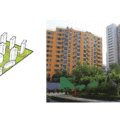 New Tools for Sustainability-Minded Designers and DevelopersThe research team, led by Dennis Frenchman and Christopher Zegras from MIT’s School of Architecture + Planning, intends for the lowest-energy forms to replace existing typologies, which were developed without regards to energy performance.4
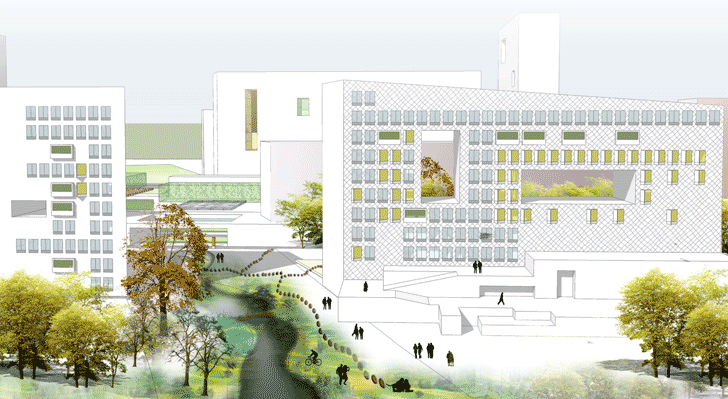
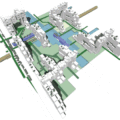 New Tools for Sustainability-Minded Designers and DevelopersThe research and new tools were also used this past summer by five teams of graduate students from MIT and Tsinghua University to develop proposals for new Clean Energy Neighborhoods in a town being planned on a new high-speed rail line. Their "Criss-Cross" prototype was assessed to not only be exceedingly energy efficient, but also highly livable.5
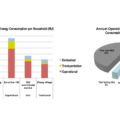 New Tools for Sustainability-Minded Designers and DevelopersTypical Energy Proforma© output: In this case, the "Criss-Cross" Clean Energy Prototype, is shown to consume substantially less energy/area than existing neighborhood types in Jinan. The Proforma compiles 3 types of energy data: how the neighborhood form affects the type and amount of transportation used, the amount of energy used for operations such as heating and cooling and the amount of energy consumed in construction.6
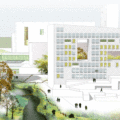 New Tools for Sustainability-Minded Designers and DevelopersAnother low-energy neighborhood prototype: the Reinvented Enclave. This urban form creates clusters of development around wind and water features that mitigate climate. This reduces the need for heating and cooling, as well as water transport.7
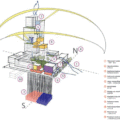 New Tools for Sustainability-Minded Designers and DevelopersA third Clean Energy Neighborhood Prototype proposed by the MIT/Tsinghua graduate students: the "High Low Rise".8
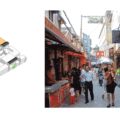
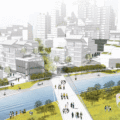 New Tools for Sustainability-Minded Designers and DevelopersThe Urban Sponge Clean Energy Neighborhood Prototype. This proven low-energy urban form is characterized by fine grained, high density, mixed use development carefully oriented to the sun.9
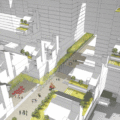 New Tools for Sustainability-Minded Designers and DevelopersThe proposed “Urban Sponge” prototype focuses on very high density with very mixed uses.10
