


Start Slideshow




 Aidan Dwyer's Solar Power Breakthrough Using the Fibonacci SequenceWhile most 13-year-olds spend their free time playing video games or cruising Facebook, one 7th grader was trekking through the woods uncovering a mystery of science. After <a href="http://www.amnh.org/nationalcenter/youngnaturalistawards/2011/aidan.html">studying</a> how trees branch in a very specific way, Aidan Dwyer created a <a href="http://inhabitat.com/ross-lovegrove-solar-trees-take-to-the-streets-of-vienna/">solar cell tree</a> that produces 20-50% more power than a uniform array of <a href="http://inhabitat.com/yosemite-flips-the-switch-on-the-largest-ever-solar-array-in-a-national-park/">photovoltaic panels</a>. His impressive results show that using a specific formula for distributing solar cells can drastically improve energy generation. The study earned Aidan a provisional U.S patent - it's a rare find in the field of technology and a fantastic example of how biomimicry can drastically improve design1
 Aidan Dwyer's Solar Power Breakthrough Using the Fibonacci SequenceIt turns out that the pattern and its corresponding ratios are reflected in nature all the time, and Aidan’s keen observation of how trees branch according to the formula lead him to test the theory. First he measured tree branches by how often they branch and at what degree from each other.2
 Aidan Dwyer's Solar Power Breakthrough Using the Fibonacci SequenceAidan Dwyer took a hike through the trees last winter and took notice of patterns in the mangle of branches. His studies into how they branch in very specific ways lead him to a central guiding formula, the <a href="http://en.wikipedia.org/wiki/Fibonacci_number">Fibonacci sequence</a>. Take a number, add it to the number before it in a sequence like 1+1=2 then 2+1=3 then 3+2=5, 8, 13, 21 and so on a very specific pattern emerges.3
 Aidan Dwyer's Solar Power Breakthrough Using the Fibonacci SequenceTo see <em>why</em> they branch this way he built a small solar array using the Fibonacci formula, stepping cells at specific intervals and heights. He then compared the energy output with identical cells set in a row.4
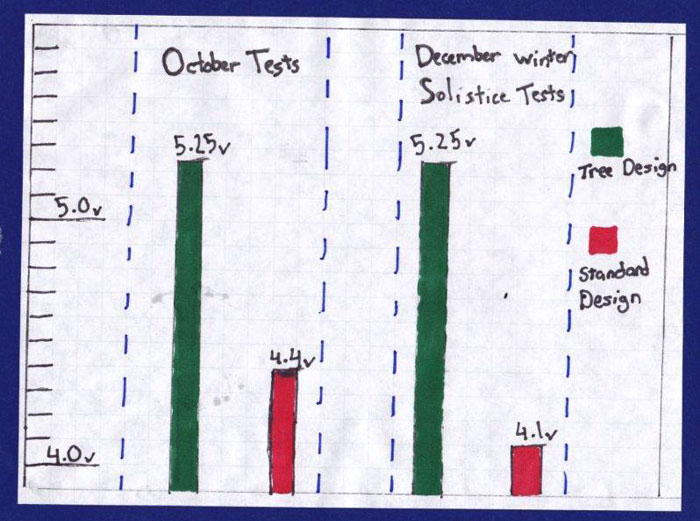
 Aidan Dwyer's Solar Power Breakthrough Using the Fibonacci SequenceAidan reports the results: “The Fibonacci tree design performed better than the flat-panel model. The tree design made 20% more electricity and collected 2 1/2 more hours of sunlight during the day."5
 Aidan Dwyer's Solar Power Breakthrough Using the Fibonacci Sequence"But the most interesting results were in December, when the Sun was at its lowest point in the sky. The tree design made 50% more electricity, and the collection time of sunlight was up to 50% longer!”"6
 Aidan Dwyer's Solar Power Breakthrough Using the Fibonacci SequenceHis work is certainly piquing the interest of the solar industry, and even more impressively he is demonstrating the<a href="http://inhabitat.com/finding-design-inspiration-in-nature-biomimicry-for-a-better-planet/"> power of biomimicry</a> -- a concept that many see as the pinnacle of good design, but one that thus far has been exceptionally difficult to achieve. Way to go!7


