


Start Slideshow



 Biophotovoltaics by Alex Driver and Carlos PeraltaDid you ever dream that your <a href="http://inhabitat.com/light-reading-is-a-literary-lamp-made-from-recycled-books/">reading lamp</a> would one day be powered by living organisms? Well, commercialization of such a product is at least five years out, but UK designers are working furiously with Cambridge University researchers to develop biophotovoltaic (BPV) devices that generate renewable energy from the <a href="http://inhabitat.com/stanford-scientists-harvest-electricity-from-algae-photosynthesis/">photosynthesis of algae and moss</a>. Because this is such a crazy concept for many people to absorb, <a href="http://www.ifm.eng.cam.ac.uk/people/ajd95/">Alex Driver</a> and <a href="http://www.ifm.eng.cam.ac.uk/people/cmp60/">Carlos Peralta</a> have come up with a few renders of ordinary objects that could eventually be powered with BPVs in order to facilitate both imaginations and the research process. The moss lamp featured above is just one of them, but check out the off shore power station comprised of algae-filled lily pads that produce the same amount of energy as <a href="http://inhabitat.com/worlds-biggest-offshore-wind-farm-is-activated-today/">a standard wind farm</a> and a few other designs after the jump!1
 Biophotovoltaics by Alex Driver and Carlos PeraltaClose up of moss-table cells2
 Biophotovoltaics by Alex Driver and Carlos PeraltaAlgae solar panels for domestic use3
 Biophotovoltaics by Alex Driver and Carlos PeraltaNear shore generator harvests desalinated water4
 Biophotovoltaics by Alex Driver and Carlos PeraltaAlgae-filled Lily Pad power plant produces same amount of power as a standard wind farm5
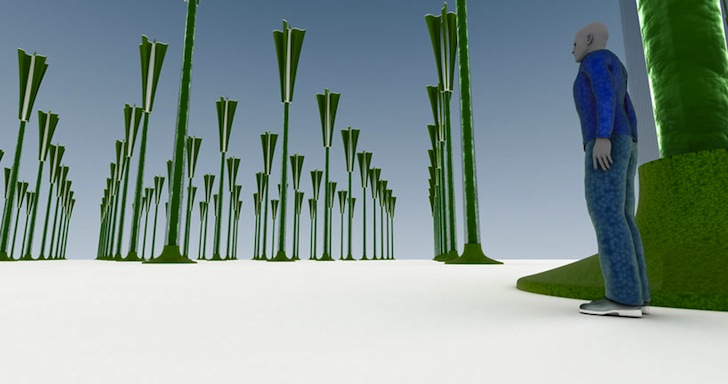
 Biophotovoltaics by Alex Driver and Carlos PeraltaForest of solar collecting masts6
 Biophotovoltaics by Alex Driver and Carlos PeraltaClose up of masts harvesting water from the ground or rain to keep algae alive7


