


Start Slideshow


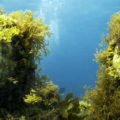 Jason de Claires Taylor underwater sculpturesWhen we last checked in on artist <a href="http://inhabitat.com/tag/jason-decaires-taylor/">Jason de Caires Taylor</a>, he was lowering <a href="http://inhabitat.com/8-ton-volkswagon-beetle-scultpure-joins-400-other-objects-in-an-artificial-reef-in-mexico/">an eight-ton Volkswagen Beetle</a> made of cement into the waters off the coast of Mexico to create an artificial coral reef. Of course the Beetle isn't the only thing de Caires Taylor has lowered into the ocean; for the past several years, he's been building an entire sculpture park about 8 meters beneath the surface of the Gulf of Mexico. Before that, de Caires Taylor installed <a href="http://inhabitat.com/%E2%80%9Csilent-evolution%E2%80%9D-builds-a-beautiful-coral-reef-from-statues/">underwater sculptures off the coast of Grenada</a>, and in the time that's passed since he first installed them, colorful coral, starfish and seaweed have all colonized de Caires Taylor's sculptures, creating unique and at times creepy growths on the human forms.1
 Jason de Claires Taylor underwater sculpturesThe cement sculptures serve a dual function: they provide a surface on which coral, sponges, tunicates and other marine organisms can make a home and they attract divers, drawing them away from some of the more sensitive and fragile underwater habitats.2
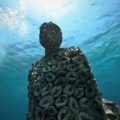 Jason de Claires Taylor underwater sculpturesBut why do corals need cement statues -- why can't they just find a place to set up shop on the ocean floor?3
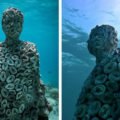 Jason de Claires Taylor underwater sculpturesThe problem is, most of the ocean floor is soft and sandy; only about 10 to 15 percent of the bottom is naturally solid enough to host a coral reef.4
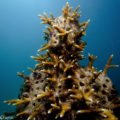 Jason de Claires Taylor underwater sculpturesWhile de Caires Taylor's medium is cement sculpture, the coral serves as his paint, adding vibrant colors and interesting textures to the otherwise plain sculptures.5
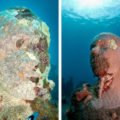 Jason de Claires Taylor underwater sculpturesAt the sculpture park in Granada, the long-term impact and beauty of de Caires Taylor's work is apparent.6
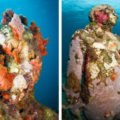 Jason de Claires Taylor underwater sculpturesDivers can see small clusters of human forms located about 5 meters below the surface that are completely covered in brightly-colored corals, sponges and sea urchins. Some of the sculptures look like psychedelic abstractions, while others have become so overgrown that they scarcely look like people anymore.7
