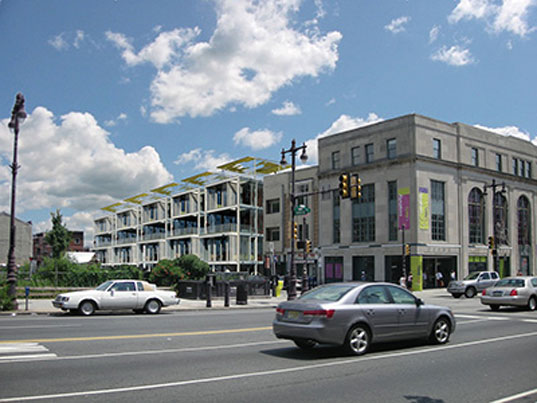
Environmentally-savvy and forward-thinking architecture firm KieranTimberlake Associate has high hopes of bringing customized prefabricated homes to the masses starting with their new Cellophane House. As one of the five full-scale prefab productions at MoMA’s exhibit, Home Delivery: Fabricating the Modern Dwelling, the Cellophane House is the latest iteration of the firm’s research and investigation into new fabricating processes and sustainable customized homes. The firm’s goal is to make these homes available at a variety of scales. The prototype is a 1800 square-foot two-bedroom, two-bathroom house and was assembled on MoMA grounds in a mere 16 days. If its ease of construction doesn’t amaze you, consider the aluminum frame and structural polycarbonate floor plates. Or the easy bolt connections that facilitated the easy assembly and the available built-in environmentally-friendly features, and then you just might be wondering if you covet the ingenuity behind these homes.
Related Posts
-
Imagine if your house came delivered to you in over a 1,000 precisely-cut jigsaw-like pieces. This is the idea that New York-based, Jeremey Edmiston of
-
Prefab is taking center stage this summer at The Museum of Modern Art in NYC with the Home Delivery: Fabricating the Modern Dwelling exhibit opening
-
The prefab home builder designed, fabricated and installed the two story house in just 9 weeks this past fall. Located on a derelict subdivision lot,
6 Responses to “PREFAB FRIDAY: Cellophane House by KieranTimberlake”
-
Featured Author
INTERVIEW: Gensler’s Irwin Miller on Sustainable Architecture and Opportunity Green
MOD.FAB: Stunning Prefab by the School of Frank Lloyd Wright
BOOK REVIEW: KieranTimberlake Publishes Their Second Monograph, ‘Inquiry’
Recycled Hockey Sticks Transformed into Incredible Snowflakes at the Montreal Botanic Gardens
This author's twitter feed is currently unavailable. Please try again later.
-
Read Inhabitat
-
Search Categories
-
Recent Posts
-
Recent Comments
-
Browse by Keyword
follow inhabitat on:
popular today
all time
most commented
more popular stories >
© Inhabitat.com 2012 | About Inhabitat | Contact Us | Advertising with Inhabitat | Terms Of Use | Privacy Policy | Inhabitat, LLC


10 year lifecycle on buildings? Where do numbers like this come from? Furthermore, there’s no relevance to a number like this unless you’re trying to say it can be crappy because it’ll be levelled or gutted in ten years. … Oh wait, no, the owners are going to take the building apart and set it up somewhere else. these would be perfect for migrant workers or a logging camp. Get your heads out of the clouds. Tards.
An aluminum structure? I thought this was supposed to be green. Aluminum is filthy material to produce and should be used sparingly.
As homes, these things are underdesigned, under insulated junk. Furthermore, that the same thoughtless design has been plinked into numerous sites with little or no modification illustrates that there is no thought to context adaptations here. I want to see floor plans, or floor plan flexibility demonstrated. I want to see a variety of skins too. PV integrated into the glazing… big woop. That’ll keep the place cool in the summer! Pft. And as for those ventilation cavities that keep the place warm in winter, cool in summer… genius.
This is garbage.
I agree with R202; this whole item is a bit of a joke.
“10 year lifecycle”;is this countng straw huts and shantytowns?
Iif you’re going to make a statement likethis back it up.
Aluminum structures have been tried before. In fact, I’m pretty sure I saw them here at least htree years ago.
Aluminum is a very good contuctor which is why we often use it for electric wire. Unfortunately this also makes it a great thermal bridge to the outdoors.
Lastly, an 18000 sq. ft. house ???
VERY green
Aesthetically a very pleasing design, however how is home sustainable, green or eco-friendly at 18,000 SQ FT?
An the average lifecycle of a building is a mere 10 years?
Is this some kind of joke?
No… this is greenwashing!
CORRECTION: As two people have pointed out, the statistic for the house’s square footage is incorrect. It is actually 1800, not 18,000. The post has been edited, and thanks for pointing out the mistake!
This concept has relevance to disaster relief……transitional shelters were erected in Aceh Jaya……and subsequently permanent structures built………..I believe that the original structure could have been engineered to provide the core of an adaptable unit………one floor off ground to avoid flooding then a double height volume which could be subdivided as required over time……then clip on balconies and shades could be added features …..showing how such objects can be linked together would form another component of design.
what was built was too inflexible/inappropriate/ and the value cum usefulness to original cabins was missed.
Wha! A house to bring to the ‘masses’. How’s that? An 1800 sq ft glass / aluminium blockhouse now touted for sale at $US1.75MILLION! OK MOMA is either raising funds or KT are getting their investment back. Whatever… The intent is overrun by intellectualising a simple equation. form + function / cost … or a variation if it’s for a price sensitive appliaction. It sure looks like KT or MOMA or both believe their own publicity aka self-importance.
Despite the lovely-ish compositing with integrated country and seaside vistas the ‘cellophane’ does NOT fit either of those environments; too stark, garish, angular, industrial and intrusive. It works in a city – nowhere else. That could account for the NYC price tag – and exclusion from it stated intent for the ‘masses’. More like massive. And the aluminium IS a big problem. The Navy Chair or Barstool this aint.
Nah…