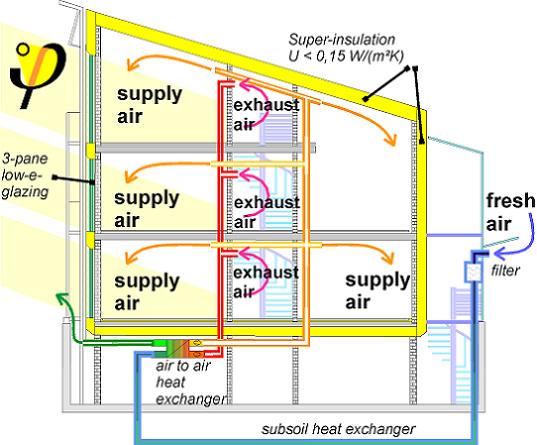
Passive design is architectural design that eliminates the need for mechanical heating and cooling of a building through the use of smart, time-tested heating and cooling strategies such as natural ventilation, solar heat gain and solar shading and efficient insulation. Around 15,000 passive houses have been built around the world in a few short years, yet few are cropping up the United States. Scandinavian and German-speaking countries are sweeping the industry and streamlining the modern family’s heating bill in the process. Passive homes seem to be the next logical step in, well, logical design – German Bauhaus style coupled naturally with Scandinavian modernism, later exploding into what we now know as mid-century modern. Now with 2009 well underway, the world’s budding designers are leaning on the shoulders of sustainability, while passive design is planting its feet in the homelands of Alvar Aalto and Ludwig Mies van der Rohe.


Bauhaus architect and designer, Mies van der Rohe coined the ubiquitous ‘less is more’ that is so often referenced in design today. His philosophy is characterized by a slew of -itys: clarity, simplicity, functionality, and rationality shines right through the south facing windows of passive architecture. Passive design emerged in Darmstadt, Germany in 1990 with the construction of the first passive house.
Of course, designing a home withsolar panels on the roof and wind turbines on the lawn is an awesome way to increase efficiency while sparing the environment. But why not build a house that doesn’t need them in the first place, at least for most of the year? Indoor climate control in passive houses can be up to 90% self-sustaining. Like the saying goes: Give a man (a house) a fish (a solar panel) and you feed him for a day; teach a man (a house) to fish (self regulate its heating) and you feed him for a lifetime. You get the gist.
The Passivhaus-Institut was founded in Germany in 1996 and now promotes and controls the standard in Germany. Today, CEPHEUS, Cost Effecient Passive Houses as European Standards, does the same for passive building in Germany, Austria, Switzerland, France and Sweden. As of yet, these are the only countries with passive building standards, though similar characteristics exist in obtaining LEED certification.
So, can German-born passive design further permeate the international design community? Prospects are good, but only time will tell.
Via The New York Times