Site Meter

Gallery: GREEN PAVING SOLUTION: Salvav...


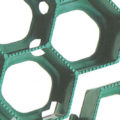
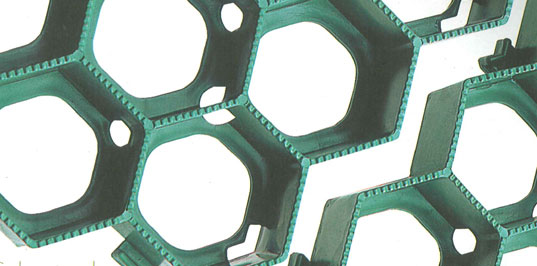
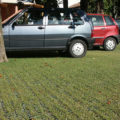
Have you ever wanted to put in a grass driveway, but you found yourself worried about ruining the grass every time the car pulls in and out of the garage? Salvaverde is an interlocking modular system that gives extra strength to lawns for parking and walkwaks. Made of recycled high-density polyethylene (HDPE), the same stuff used for plastic milk bottles, Salvaverde can support huge loads up to 35 tons per a square foot without allowing any soil compaction. This means that rainwater will continue to filter into the ground naturally, the grass will keep growing and remains healthy, and you won’t be left with tire tracks, puddles, or mud.

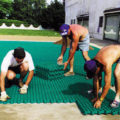
The size of the cells in Salvaverde actually promotes grass growth in an even homogenous manner. The system can be filled with vegetation to support an entire lawn or with aggregate to support pathways. The module goes together in a manner of minutes and simply needs to be installed over a drainage layer of either gravel or stone. When used with grass or other vegetation, this super porous paving system minimizes the urban heat island effect, while allowing for natural filtration of rain and water runoff.

+ Salvarverde

27 Responses to “GREEN PAVING SOLUTION: Salvaverde”

  1. This is a good idea. I have used this technique for many years now, in Sweden 10 yeras back now.
    Architect Leopold Mac Ender

  2. Ariel Ariel says:

    Does anyone know how these hold up in areas with extreme winters?

  3. J. A. Forni J. A. Forni says:

    Here in Chile we have some steel nets that get the same soluction. It’s so similar. It’s coevr with plastic.
    Excellent idea.

  4. Hallo, yes I know how we do it in Sweden.
    Under the paving you put 10 centimeter with mealed granit…
    Leopold

  5. willow willow says:

    We use something similar to create a pathway for emergency vehicles to reach our rugby pitch. It’s concrete tiles so the proportions are larger, but it still allows rain water to be absorbed and vehicles can drive on it without fear of getting stuck.

  6. Tim Tim says:

    Yes, concrete block solution has been used for years in NZ for this purpose. It is a little coarser but doesn’t use any plastic.

  7. Eric Eric says:

    They use this at the University I attend. It looked like it held up to the traffic and the winter weather well. However, the grass was sparse, and you could always see the plastic. They used black plastic, though. I see they’re using green here. That would be better, assuming the color doesn’t fade.

  8. Alex Alex says:

    They made a small mention of this sort of thing at the World Urban Forum last week in Vancouver as a way of decreasing city tempurature, as well as a means of returning rainfall into the water table rather than drain-off.

  9. Elizabeth Elizabeth says:

    ooooh! This is so cool!

  10. PENiCHE PENiCHE says:

    Does anyone know how this would hold up in the NORTHeast– winters with snow and such ?

  11. Rachel Rachel says:

    Being from Australia I am used to thinking of thirsty lawns as anything but a green idea. I’m surprised in the US at how little awareness I see of the problems of water shortage including things like using the hose to “sweep” a path – things that died out in Australia years ago. However, I guess that in the wetter parts of the world a lawn can look after itself.

  12. Laura Aquino Laura Aquino says:

    Something to think about is the type of lawn or ground cover to be used. It should be “native” in the sense that it can survive without any, or very little, maintenance because it would be planted in its “natural” environment considering the amount of sunlight, rain, temperature range, etc. It’s like planting a banana tree in Sweden or tulips in the Caribbean. They just won’t last. Without considering such an important factor, this product is nothing but a failure. There are numerous species of lawns and ground covers. It’s a matter of choosing the right one.

  13. Allysen Allysen says:

    Does anyone have recommendations for a plant that would survive well in the northeast? If I put something like this in for a driveway, what might work besides grass? And what about removing snow… looks like this might be a bear to shovel. Anyone have experience with this?

  14. Allysen Allysen says:

    Uh… re my previous questions about plants and shovelling, I mean the northeast United States.

  15. Leopold Mak Ender Leopold Mak Ender says:

    OK, you can use Salt, and if you doing it right you can use other mechanic things on the surfes.
    Well, I´m talking about the Concrete plates we use in Sweden, 600x400x100 mm and the weight are 35 kilo per unit.

  16. Chip Chip says:

    Wait this means I have to weed my driveway too.

  17. G’day, I am trying to assertain a supplier of your product (Salvaverde) in Australia. This is posing to be a difficult task. I reside on the east coast of Australia, Newcastle which is 2 hours north of Sydney. If a supplier is not available, I am prepared to import this product for this single occasion. Would it be possible to obtain all specifications for this product? Also pricing and/or time delays to recieving this product would be greatly appreciated. Having only just discovered this product, I consider that it will have a vast array of applicable uses in the Australian environment.
    Yours faithfully

    Justin Peterson

  18. Silvia Edelstein Silvia Edelstein says:

    Has anyone tried creeping thyme? I’m imagining it would smell nice, but would it work with the mesh? You just couldn’t cook with it but then you wouldn’t have to mow it. :-)

  19. jay shuler jay shuler says:

    I live in San Jose, CA, where garages are used for storage and driveways are used for parking vehicles. Will this system work if cars are left parked on it for hours per day, or even multiple days on occasion? What would be the best vegetation to plant? Standard grass requires regular watering in CA in the summer. Do people use underground drip irrigation on these things, or does the drip hose get crushed by the weight of the vehicles? Etc! Any tips?

  20. noel noel says:

    i want some. where can i find it?

  21. ewan ewan says:

    yep the stuff is hard to shovel it just needs a special technique is all. keep the blade angle low. creeping thyme,Thymus serpyllum does do very well in these applications. once established both grass and thyme will over a few years build up to such an extent they defeat the traction ability of the rough edges of these products, but with severe butchering the rootstocks of any established herbs will resprout. irrigation pipe would not usually be installed below these products but may be enabled along the perimeter only

  22. Sue Darby Sue Darby says:

    Where can I get more information about your Green Paving Solutions?

    Where to see and purchase the product?
    Installing requirements?
    Prices?

    Your help will be appreciated. Thank you.

  23. View the photo gallery for various installations – http://www.greeninnovations.ca or contact 888-725-7524

  24. jose jose says:

    what is the cost compared to concrete?

  25. Dave Dave says:

    Where can I purchase Salvarverde in the USA? Is it sold on line?

  26. grass_paver_expert grass_paver_expert says:

    The information provided to visitors on this page is highly inaccurate.

    The users of this blog require accurate information about the history and functionality of plastic-based pervious paving systems.
    That is: (1) all the paver systems mentioned on this page (http://www.inhabitat.com/2006/06/24/salvaverde/#comment-72200) refer to HDPE grid systems.
    (2) all HPDE grids are supremely inappropriate as vehicular traffic surfaces, because HDPE is prone to shatter when vehicle tires come in contact with any of these HDPE grid systems. This is a well documented fact, and is beyond dispute.
    (3) All the HDPE grids mentioned on this page are the result of SALSEMEN wanting to make a higher R.O.S. (margin); hence they create a cheap, low-quality replica of the only non-HDPE grid (the original, from Germany), and represent the grids as being acceptable for vehicular traffic surfaces.
    They are not appropriate, specifically because contact of vehicular traffic with the edges of the grids will cause shattering of the HDPE, when those vehicular loads traverse horizontally across the surface: accelerating, decelerating, or turning the steering axle while the vehicle is stationary. Such traffic dynamics require that the roadway surface be FLEXIBLE (see TS&W studies performed for the FHWA and DOT in the 1960\’s-1980\’s).

    The above holds true for ANY vehicular traffic surface, whether conventional concrete or asphalt paving, pervious paver system, grass turf, non-engineered gravel, dirt, sand, or swamp.
    The primary factor in designing a durable, long-lasting vehicular traffic surface is its ability to resist the damage resulting from HORIZONTAL movement of loads across the surface. \”Compressive Strength\” (i.e. resistance to pressure at the surface) in only applicable to: STATIONARY objects.

    For too long, first Europeans and now American consumers and businesses have been misdirected and/or intentionally misled into believing that: any vehicular traffic surface which has a high \”compressive strength\” rating is sufficient for vehicular loads.
    The above misconception has never been true, and never will. It derives from the laws of physics, not from annecdotal and/or superstitions relating to pavement engineering.

    mit freundlichen grüßen/with kind regards,
    LazyRRanch in Seattle

  27. beechwood188 beechwood188 says:

    we would like to cover our front garden. how much? we would be requiring the area of one car.

    Ruth Halsey

Leave a Comment

Please keep your comments relevant to this blog entry. Email addresses are never displayed, but they are required to confirm your comments.

Please note that gratuitous links to your site are viewed as spam and may result in removed comments.

Add your comments

NEW USER

CURRENT USERS LOGIN

Lost your password?

get the free Inhabitat newsletter

Submit this form
popular today
all time
most commented
more popular stories >
What are you looking for? (Solar, HVAC, etc.)
Where are you located?