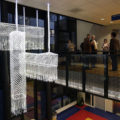
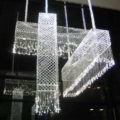
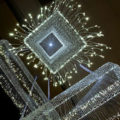
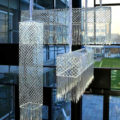
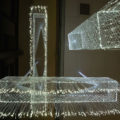
We’re die hard fans of both Dutch design and fiberoptic lighting here at Inhabitat, so it should come as no big shock that we were wowed by this gem of a light fixture designed by Niels van Eijk and Miriam van der Lubbe. Currently hanging in the atrium at Amsterdam’s SKOR (Foundation Art and Public Space), the three fiberoptic “Lace Bobbin Lamps” provide stunning light without the use of lightbulbs. Instead, their light is delivered via a remote power box — and of course we like to imagine that this type of fiber-optic chandelier would go perfectly with a fiberoptic sunlight device such as the Cold Lamp. We love the juxtaposition of the high-tech fiberoptic technology and the man-made woven aesthetic. Leave it to the Dutch to be both forward-thinking and nostalgic at the same time. Niels van Eijk and Miriam van der Lubbe have been collaborating since 1997, and are part of the Dutch design force Droog.
Related Posts
-
The Cold Light, a new fiberoptic sunlight tranport device, is the main attraction on display in Vienna at the Haus der Forschung. Called “0-24
-
Neues Licht means “new light” in German, and we can’t think of a more appropriate name for this innovative lighting design company which creates futuristic
-
Here’s another something I spotted at ICFF, which I’m just finally getting to. Swedish design company Lyx makes these beautiful fiber-optic chandeliers which mimic
13 Responses to “WOVEN FIBEROPTIC CHANDELIERS”
-
Featured Author
-
Read Inhabitat
-
Search Categories
-
Recent Posts
-
Recent Comments
-
Browse by Keyword
follow inhabitat on:
popular today
all time
most commented
more popular stories >
© Inhabitat.com 2012 | About Inhabitat | Contact Us | Advertising with Inhabitat | Terms Of Use | Privacy Policy | Inhabitat, LLC


After reading this article I had to read your mission statement to see if this design fits what it is you are trying to promote. I really don’t think it does. First, to say it does not use light bulbs is fairly silly given the fact that the design uses fiber optics and it’s night time. Second, how much useful light is given off by this design. I suspect that a lot of energy is used to get the effect while not giving off a great deal of workable light. I have no problem calling it art but I can’t call it functional.
I think this design is firstly gorgeous, and secondly that it will contribute significantly to consumer’s awareness of the usefulness and flexibility of fiber-optics. Chandeliers’ primary reason for existence is decorative, and this design accomplishes that goal in spades, without requiring metalwork or additional light bulbs. I think that while it is not as sustainable as using another light source (ie no chandelier), that this design is far better for the environment than its traditional competition.
From our mission statement: “We believe that good design balances substance with style.”
Thom, I appreciate your opinion, but I do believe that this is a great example of what we believe design can and should be. Fiberoptic technology is forward-thinking, functional, and has a variety of potential applications, decorative lighting being only one. I am also a huge fan of many of the Dutch designers who constantly (and quite shrewdly) combine the high-tech and low-tech, coupling cutting-edge technologies with relateable, interactive, engaging, even old-fashioned aesthetics or techniques (the macrame-esque weaving of the fibers in this example). And lastly, you speak of art and function as if they’re mutually exclusive, when in fact I think they are inextricably linked (is a functional yet beautiful building not art? Or do you believe that art is inherently UNfunctional?) Just something to chew on… Thank you for your comment, though- we love to hear from readers who initiate a worthwhile dialog.
I think it is beautiful, but cringe becasue I know it will never be cleaned appropriately and after a few years you will not be able to distinguish the cobwebs and dust from the fibers….or maybe that’s a good thing!
Absolutely beautiful!
I absolutely love it when you feature chandeliers like this one. Hope to see more of them!
what is the cost
310 454 7960
I love this innovative use of fibreoptics. Beautiful. Do you have any more examples of art/products using this technology?
Remarkably Beautiful work!
Andrew had previously mentioned that fiber optic lighting such as this is good for the environment.
Does anyone know the wattage of the driver/ lightsource for a chandelier of this size -or- is it daylight-driven by an outdoor mounted light collector (hence, only usable during daylight hours)?
Just curious.
I don’t think that Thom’s concerns were fully addressed in Emily’s reply. Yes, Thom is right. The lamps do indeed use a powerful incandescent light source(s). I am guessing that the double hung chandelier shown here uses, at the very least, (2) 150 watt halogen bulbs. Each lamp produces an ambient temperature of 700 to 1000 degrees F. I can roast the Thanksgiving turkey in this lamp’s housing unit. Power consumption versus Lumen Output and energy loss through heat is off the scale here.
Let’s not confuse our lighting. “Cold Light” produces through passive optical solar collectors has nothing to do with the particular fiber optic application shown. Also, please do not confuse this type of fiber optic chandelier with EL Wire (electroluminescent wire which uses extremely low electrical power.)
The lights are beautiful I would agree that they are more like art than anything else. But you need to remember that a chandelier is typically art in a sense that its generally not a source for light and more of a statement/art piece.
I like them, but I would have nightmares about being externally digested by a deep sea jellyfish.
Hi,
How are you? I am fine.
Will you send me a new catalog for mail?
My address here is:
Miss Rose Hebert
P.O. Box 1529
Plattsburgh, NY 12901
Then i will order something when.
Thank-You, Rose Hebert