


Start Slideshow


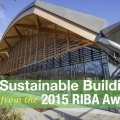 riba leadThe <a href="http://inhabitat.com/tag/riba/" target="_blank">Royal Institute of British Architects</a> (RIBA) in London just unveiled this year’s winners of the annual RIBA awards. Recognized as 2015’s best British projects in the UK, these 37 structures include a wide variety of architecture types from contemporary private homes to buildings in higher education. While we wait for RIBA to reveal which of the RIBA award winners are still in the running for the <a href="http://inhabitat.com/tag/stirling-prize/" target="_blank">Stirling Prize</a>—an annual prize awarded to the most significant contribution to British architecture this year—we’ve rounded up eight of the greenest RIBA-award winning buildings of 2015.1
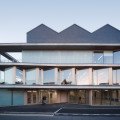 The Foundry by Architecture 00<h3>The Foundry by Architecture 00</h3> <a href="http://www.architecture00.net/" target="_blank">Architecture 00</a> repurposed a former shoe-polish factory into the Foundry, an office facility that houses various charities in London. Built on a former brownfield in Vauxhall, this <a href="http://inhabitat.com/tag/adaptive-reuse" target="_blank">adaptive reuse</a> project sports a zigzagging and glazed facade that allows generous amounts of natural light into the building. The architects retained many of the architectural elements of the former factory building, a strategy that not only preserved the area’s traditional character, but also had cost-effective and environmentally friendly benefits.2
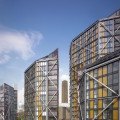 NEO Bankside by Rogers Stirk Harbour + Partners<h3>NEO Bankside by Rogers Stirk Harbour + Partners</h3> <a href="http://inhabitat.com/x-marks-the-spot-at-the-striking-naturally-daylit-neo-bankside-residences-in-london/" target="_blank">NEO Bankside</a> is a mixed-use development that overlooks enviable views of the adjacent River Thames and is a short stone’s throw from the Tate Modern, one of the most visited museums in the world. Designed by <a href="www.rsh-p.com/" target="_blank">Rogers Stirk Harbour + Partners</a>, the 217-unit complex comprises four hexagonal residential blocks. The structures are supported by external bracing system that remove the need for interior load-bearing walls and allow the architects to maximize natural light and views.3
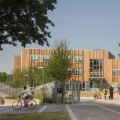 Ashmount Primary School by Penoyre & Prasad<h3>Ashmount Primary School by Penoyre & Prasad</h3> North London’s Ashmount Primary School is a <a href="http://inhabitat.com/tag/zero-carbon" target="_blank">zero-carbon</a> school designed by <a href="www.penoyreprasad.com/" target="_blank">Penoyre & Prasad</a>. Built as part of a carbon-negative development, the school won a <a href="http://inhabitat.com/tag/breeam/" target="_blank">BREEAM</a> Award for Highest Scoring Project in the Education Sector. The building minimizes energy consumption and is powered with renewable energy and a gas-fired CHP plant.4
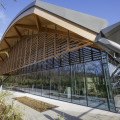 WWF-UK Headquarters Living Planet Centre by Hopkins Architects<h3>WWF-UK Headquarters Living Planet Centre by Hopkins Architects</h3> The <a href="http://www.wwf.org.uk/about_wwf/the_living_planet_centre2/the_living_planet_centre/" target="_blank">WWF-UK’s Living Planet Centre</a> is possibly the most eco-friendly and energy-efficient building out of all the 2015 RIBA award winners. Designed by <a href="http://www.hopkins.co.uk/" target="_blank">Hopkins Architects</a>, the BREEAM “Outstanding” building minimizes its environmental impact and educates the public on its many sustainable features. The <a href="http://inhabitat.com/solar-power" target="_blank">solar-powered</a> project was built on a former brownfield and its design includes passive solar principles, recycled construction materials, energy-efficient appliances, rainwater catchment systems, and easy access to public transit.5
 The Whitworth Extension by MUMA<h3>The Whitworth Extension by MUMA</h3> Architecture studio <a href="http://muma.co.uk/" target="_blank">MUMA’s</a> recent renovation of Manchester’s <a href="www.manchester.ac.uk/whitworth" target="_blank">Whitworth Gallery</a> is not your typical art gallery expansion project. The glass and brick extensions impressively reduce the overall carbon footprint by 10% while increasing the building footprint by over a third. The <a href="http://inhabitat.com/energy-efficiency-2" target="_blank">energy-efficient</a> building uses the landscape and passive solar principles to reduce reliance on air conditioning and heating. Ground source heat pumps and natural ventilation are used to heat and cool the building.6
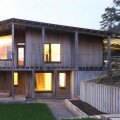 Dundon Passivhaus by Prewett Bizley Architects<h3>Dundon Passivhaus by Prewett Bizley Architects</h3> <a href="http://www.prewettbizley.com/" target="_blank">Prewett Bizley Architects’</a> Dundon Passivhaus is a low-energy home nestled at the bottom of a hillside in Somerset. Built to <a href="http://inhabitat.com/tag/passivhaus" target="_blank">Passivhaus</a> standards, the timber-framed structure features airtight and high-quality insulation that helps maintain steady temperate indoor temperatures year-round. A mechanical heat recovery ventilation system supplies the interior with fresh air in the colder months.7
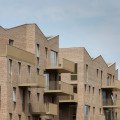 Brentford Lock West by Duggan Morris<h3>Brentford Lock West by Duggan Morris</h3> <a href="http://www.dugganmorrisarchitects.com" target="_blank">Duggan Morris’</a> Brentford Lock West is a new residential development on the banks of the Grand Union Canal. Developed for the ISIS Waterside Regeneration project, the 45 energy-efficient residential units are clad in brick and sculpted with jagged rooflines in reference to the area’s industrial character. The project won a biodiversity award for its landscape design—irrigated by harvested rainwater—that not only increases the site’s ecological value, but also remediates the <a href="http://inhabitat.com/tag/brownfield" target="_blank">brownfield</a> soil. Solar energy powers the buildings, which are heated from communal gas boilers and retain the heat using high performance insulation and windows.8
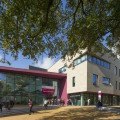 Sheffield Hallam University's Heart of the Campus<h3>Sheffield Hallam University's Heart of the Campus by HLM Architects</h3> <a href="http://www.shu.ac.uk/eventservices/venues/heart-campus" target="_blank">Sheffield Hallam University's Heart of the Campus</a> is a three-story tall energy-efficient building designed by <a href="www.hlmarchitects.com/" target="_blank">HLM Architects</a> in Yorkshire. Filled with natural light, the building was designed to ‘bring the outdoors in’ and, in the process, reduces its need for artificial lighting, heating, and cooling. The building is heated entirely by ground source heat pumps, powered by solar energy, and equipped with rainwater harvesting systems.9
