


Start Slideshow


 Toilet Paper Packaging the FutureMoms and experienced travelers carry <a href="http://inhabitat.com/eco-art-yuken-teruya-everyday-objects/">toilet paper</a> in their bags 'just in case' -- probably because it's one of those things that we literally can't imagine living without. And yet toilet paper in its present form has only been available for commercial distribution and common use for about a hundred years. Since we use about 24 rolls per person per year (Americans use about double what Europeans do), it seems inconceivable that anything else existed. What DID people do before? While the answer is great dinner-party convo, the more important question is - what about its impact? As the New York Times reported,<a href="http://www.nytimes.com/2009/02/26/science/earth/26charmin.html?em"> TP is tough on forests</a> and in the US, only about 2% of the stuff is made from recycled materials. This is definitely a product that's ripe for redesign and rethinking from the ground up.1
 Toilet Paper Packaging the FutureIn the past, (and commonly today, in developing nations) people used their hands and water after they did their 1's and 2's - and in fact some still regard TP as less clean than a good post-loo wash (hence, bidets). But people have used <a href="http://encyclopedia.toiletpaperworld.com/toilet-paper-history/history-of-toilet-paper">all kinds of methods</a> to keep clean: ancient Romans used a sponge on a stick that was kept in salt water near the privy, and Inuits used moss in the warmer seasons and snow when it blanketed the ground. Brits used discarded sheep's wool and native Hawaiians used coconut shells. Most famously, in the United States, the Sears & Roebuck catalog and corn cobs took the place of the TP we now use. The first purposeful manufacture of toilet paper was in China. According to <em>Science and Civilization in China: Volume 5, Chemistry and Chemical Technology, Part 1, Paper and Printing </em> by Joseph Needham, "During the early 14th century (Yuan Dynasty) it was recorded that in modern-day Zhejiang province alone there was an annual manufacturing of toilet paper amounting in ten million packages of 1,000 to 10,000 sheets of toilet paper each."2
 Toilet Paper Packaging the FutureThe first toilet paper in the US was made from off-white hemp paper and began selling much later in human history - <a href="http://wordinfo.info/unit/3949/ip:6/il:T">not until 1857</a>: "Geyetty's Medicated Paper—a perfectly pure article for the toilet and for the prevention of piles" was a Victorian-era upper class staple. Later, as costs went down and a process was developed for processing tissue (following on the heels of more efficient manufacture of newsprint - insert journalism joke here), toilet paper became available to everyone at an affordable price.3
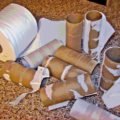 Toilet Paper Packaging the FutureModern toilet paper is incredibly wasteful from all aspects, because old-growth trees are used to make the soft stuff, because the interior rolls usually aren't recycled, because very short lengths of paper are packaged in rolls to make TP manufacturers more money, and because it is usually packaged in plastic that can't be recycled. If you buy the 1,000-sheet, recycled rolls that are wrapped in paper (I do, it's cheaper and you have to change it less often) you are in the minority.4
 Old Growth TreeThe biggest beef with TP is the sourcing for the soft stuff. Apparently, you just can't get the supercushy TP that most Americans like via recycled materials. "...it is the fiber taken from standing trees that help give it that plush feel, and most large manufacturers rely on them. Customers “demand soft and comfortable,” said James Malone, a spokesman for Georgia Pacific, the maker of Quilted Northern. “Recycled fiber cannot do it," reports the<a href="http://www.nytimes.com/2009/02/26/science/earth/26charmin.html?em"> New York Times. </a> <br> <br> Kimberly-Clark, the maker of pretty much all the softest TP we've heard of, has been targeted for years by the NRDC regarding its wood pulp sourcing for a throw-away product that is used for just seconds. About 12-15% of fluffy TP comes from old-growth trees in Canada, and healthy standing forest ecosystems in the southern US. These are active ecosystems that are home to a complex web of species that are cut down so we can wipe our butts. Sure, many of them are replanted after the companies have devastated the area, but have you ever seen a forest before and after clear-cutting? It's ugly and depressing.5
 Toilet Paper Packaging the FutureAnd then there are those wasteful interior cardboard tubes; one solution might be to eliminate them altogether. Kimberly-Clark, the same company that destroys forests for TP, has made and tested <a href="http://inhabitat.com/is-new-tubeless-toilet-paper-just-a-green-tease/">TP sans center roll</a> in an effort to save resources (and of course money on production and transportation of toilet tissue). What would be saved is, "160 million pounds of waste from the 17 billion toilet paper tubes produced annually," according to Greenbiz.com. So eliminating the center rolls - only about 1/2 of which are recycled - would put a dent in the landfills (but might break some crafty kids' hearts). Of course, plenty of rolls would be saved if companies put 1,000 sheets on every roll of TP - but it turns out you can't fit that much of the fluffy stuff on one roll. And so, four-packs of soft TP are sold in a package covered in plastic wrap, with four cardboard inner tubes, when a single roll of recycled TP would do the job - and cost a lot less too.6
 Toilet PaperBesides cutting down ecologically important trees, making toilet paper from a tree requires much more water than making it from already-existent paper fiber that comes from recycling. Water-polluting chlorine is used to bleach the wood pulp to make it white, leading to even more water use, and polluted water to boot. "In addition, tissue made from recycled paper produces less waste tonnage — almost equaling its weight — that would otherwise go to a landfill." <br> <br> While most of us aren't willing to give up the toilet paper, the best option is definitely recycled versions. You can find current listings <a href="http://www.nrdc.org/land/forests/gtissue.asp">here from the NRDC</a> and <a href="http://www.greenpeace.org/usa/en/campaigns/forests/tissue-guide/">Greenpeace also has a great list</a> with more brands on it. For those of us who might not have access to large supermarkets with 20 different varieties of TP, note that all of Marcal's paper products are made from recycled materials and are pretty easy to find in smaller stores. Avoid Cottonelle, Charmin and Scott, which are made with a healthy portion of old-growth forest wood pulp. <br> <br> One Japanese company thinks that next-gen dunny paper could be made by recycling office paper - right in the office; they've developed a <a href="http://inhabitat.com/new-machine-recycles-office-paper-into-toilet-paper-on-site/">large, 1,300 pound machine that retails for $95,000</a> and promises to turn 1,800 sheets of discarded paper into two rolls of TP in about an hour. It seems like overkill, when you can just choose recycled on your next trip to the store anyway, but maybe one day we'll come to the place where a community paper recycler will take our boxes, paper and magazines, and shoot out TP - no trees needed. There's got to be a better solution to the current wasteful system.7

