


Start Slideshow


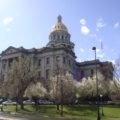 Colorado LEED State Capital photo by Richard McDonald<p>On <a href="http://inhabitat.com/2010/04/22/what-are-you-doing-for-earth-day-2010/">Earth Day</a>, Inhabitat took a tour exploring the bones of the <a href="http://www.colorado.gov/dpa/doit/archives/cap/contents.htm">Colorado State Capitol building</a> in Denver. It is the first and only LEED certified capital building in the country, and the first ever to receive a LEED Existing Buildings Operations and Maintenance certification or <a href="http://www.usgbc.org/DisplayPage.aspx?CMSPageID=221">LEED EB O&M</a>. Come with us as we take a look at the "power brokering" that goes on behind the scenes.1
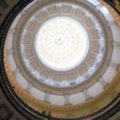 Dome from below photo by Richard McDonaldThe Capitol is the equivalent to an eighteen story building in height. Stained glass window portraits of the state leaders, starting with <a href="http://en.wikipedia.org/wiki/Chief_Ouray">Chief Ouray</a>, line the dome.2
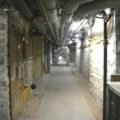 Old coal train tunnel photo by Richard McDonaldOn our first stop, we explored a basement tunnel system three blocks long and a block wide, revealing layers of <a href="http://inhabitat.com/green-gadgets/">technology</a> and design through the last 125 years. We followed the old coal car tracks to a steam heating distribution system and chiller. The tunnels have full access to the entire complex of state buildings and can be used in emergencies to move VIPs.3
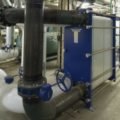 Cooling transfer plate image courtesy of Chevron USABecause of the richly historic nature of the building, the energy upgrades cannot disturb its character. This means that the HVAC systems are a mixture of new boilers and chillers, old radiators and ducts, and <a href="http://www.facilitiesnet.com/energyefficiency/article/Retrocommissioning--4126">retrocommissioning</a>. One example of energy savings is how, by taking advantage of the thermal mass, engineers can flush excess heat that the building gained throughout the day out at night.4
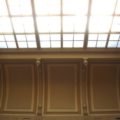 Capitol skylight photo by Richard McDonaldOur next stop was the attic of the Capitol where an elegant series of skylights flood the two main halls. From below an etched glass ceiling hides a second glass roof protecting the first.5
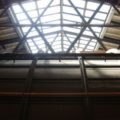 Outer skylight photo by Richard McDonaldThe outside skylight can be viewed from the attic and observation windows within an interpretative center. This was a clever solution when <a href="http://inhabitat.com/interiors/lighting/">lighting</a> such a large space was difficult back in the 1880’s.6
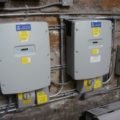 SMA Solar Power Inverters photo by Richard McDonaldFrom the top level of the gold-leafed dome, you can just make out the 10Kw <a href="http://www.inhabitat.com/solar-power">solar panel array</a> on the roof below. These SMA Solar Power Inverters convert that energy to the building's electrical grid. This is a relatively small array but is as symbolic as it is practical.7
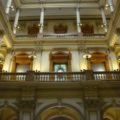 Daylighting the interior photo by Richard McDonaldElectrical lighting upgrades took a great deal of research to find just the right <a href="http://inhabitat.com/2006/08/16/green-building-101-environmentally-friendly-lighting/">CFL lightbulbs</a> to replace the incandescent bulbs while still maintaining the historic ambiance. Nothing is taken for granted when preserving the building's character.8
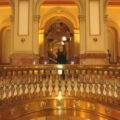 North entrance galley photo by Richard McDonaldOrnate brass elements lace the interior, and are cleaned with a non solvent based <a href="http://www.inhabitat.com/index.php?s=green+cleaning">green cleaning</a> product required for LEED certification. In the end the cleaner cost no more than what they'd been using before.9
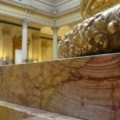 Colorado Rose Onyx marble photo by Richard McDonaldThe exquisite Colorado Rose Onyx marble that defines the halls was from a local quarry near Beulah, Colorado, and the capitol consumed the entire source. In one pattern, it is said you can see a portrait of the "unsinkable" <a href="http://www.mollybrown.org/">Molly Brown</a> - a Colorado native famous for surviving the sinking of the Titanic.10
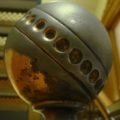 Cannonball handrail photo by Richard McDonaldIn the stairwells, the handrails sport authentic cannon balls as decoration. Now that is reuse!11
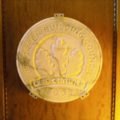 First LEED EB O&M PlaqueThe Colorado State Capitol is the first and only LEED certified capitol in the country, and the first building ever to get the LEED EB O&M certification. It earned 41 points out of the 44 that were submitted. Pretty impressive indeed!12
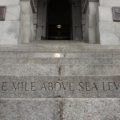 One mile altitude markerThe entrance steps to the Capitol have a plaque indicating the exact point that is one mile above sea level.13
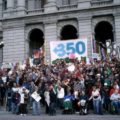 Hear the PeopleThe Capitol is also the perfect place to <a href="http://inhabitat.com/index.php?s=politics">advocate</a> sustainability! We hope this post inspires you to visit your own state capital building and check out its eco-conscious features.14
