


Start Slideshow


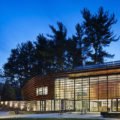 Baird Sampson Neuert Architects Cornell Plantation Welcome CenterCornell University’s woodsy site provides the perfect setting for students to serenely immerse themselves in their studies. Surrounded by tall trees and set under a wide and untouched sky, the Plantations Welcome Center draws upon the beauty of its site to create a stunning space that invites visitors into the school's horticultural study area. Designed by <a href="http://www.bsnarchitects.com/" target="_blank">Baird Sampson Neuert Architects</a>, the sustainable structure helps foster the school’s environmental stewardship. Currently, the complex is on the fast track to achieve <a href="http://inhabitat.com/sacramentos-new-leed-seeking-international-airport-opens-for-business/" target="_blank">LEED Silver certification,</a> with hopes of obtaining Platinum in the future.1
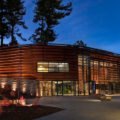 Baird Sampson Neuert Architects Cornell Plantation Welcome CenterSituated on a plateau next to the garden knoll, the welcome center was constructed where several garden pathways meet. Built flush with the hillside, the center’s first floor has a <a href="http://inhabitat.com/liyuan-librarys-wood-facade-filters-the-sun-while-harmonizing-with-the-surrounding-landscape/" target="_blank">terrace that meets the land</a>, acting as a natural entranceway for incoming visitors.2
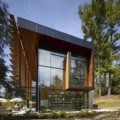 Baird Sampson Neuert Architects Cornell Plantation Welcome CenterOutside of this entrance, a bio-swale was installed, which filters storm water from the adjacent parking lot from the upper campus. The <a href="http://en.wikipedia.org/wiki/Bioswale" target="_blank">bio-swale</a>, which occupies a historic glacier path, also helps protect the gardens from excessive storm water.3
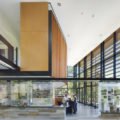 Baird Sampson Neuert Architects Cornell Plantation Welcome CenterThe first floor also employs passive cooling, siphoning the cool air that gathers in the knoll, and distributing it throughout the interior. Motorized vents and <a href="http://inhabitat.com/naturally-daylit-guangzhou-south-railway-station-is-a-critical-stop-in-chinas-high-speed-network/" target="_blank">skylights</a> help to circulate the natural cool air around both floors of the center. Largely made from <a href="http://inhabitat.com/londons-deptford-cafe-transforms-an-old-train-carriage-into-an-eco-eatery/" target="_blank">recycled and local materials</a>, the emphasis on efficiency can be seen throughout.4
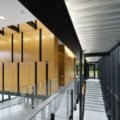 Baird Sampson Neuert Architects Cornell Plantation Welcome CenterThe second floor of the center is used for events, classes and lectures, and includes a flexible multipurpose space. The exterior is covered with a <a href="http://inhabitat.com/mad-architects-complete-passive-solar-ordos-museum-inspired-by-the-gobi-desert/" target="_blank">wooden louver system</a>, which helps control solar gain, while blocking direct sunlight from the interior.5
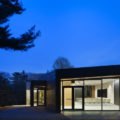 Baird Sampson Neuert Architects Cornell Plantation Welcome CenterOn the roof, <a href="http://inhabitat.com/cascading-creek-house-harvests-rainwater-and-solar-energy-in-central-texas/" target="_blank">solar thermal panels </a>gather enough heat to satisfy 80% of its needs.6
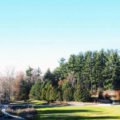 Baird Sampson Neuert Architects Cornell Plantation Welcome CenterHigh efficiency water fixtures, recycling programs and natural lighting and cooling help make this garden welcome center congruent with the program’s teachings, as well as <a href="http://inhabitat.com/habitat-for-humanity-kent-county-uses-leed-standards/" target="_blank">LEED certified</a>.7
