


Start Slideshow


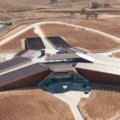 Faustino WineryWe wrote about <a href="http://inhabitat.com/index.php?s=foster+and+partners">Foster + Partners</a>' design for a new <a href="http://inhabitat.com/2007/05/29/foster-partners-spanish-winery/">green winery in Spain back in 2007</a> and now we're pleased to say that the project has finally come to <em>fruition</em> (get it?). The modern facility, called Bodegas Portia, was built for the Faustino Group in one of Spain’s most famous wine-producing regions, the Ribera del Duero. The low profile design of the winery not only helps it blend beautifully into the surrounding landscape, it actually takes advantage of the sloping terrain and uses gravity (instead of electric mechanisms) to move grapes around the structure. The building is also equipped with <a href="http://inhabitat.com/solar-power">solar panels</a> on the roof and passive strategies that allow it to minimize energy usage.1
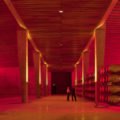 Faustino WineryBodegas Portia is a 12,500 square-metre facility capable of producing one million bottles of wine per year.2
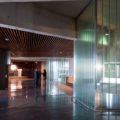 Faustino WinerySince the site that it sits on has extremely cold winters and hot summers heating and cooling <a href="http://www.inhabitat.com/energy">energy </a>expenditure was a key consideration when designing the building.3
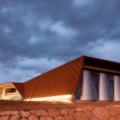 Faustino Winery<a href="http://inhabitat.com/2007/04/10/sustainable-motor-city-foster-partners/">Foster + Partners</a> incorporated a deep overhang on the roof to shade and the building and keep it cool during hot days.4
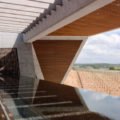 Faustino WineryThe building is also partially embedded right into the landscape, which helps regulate internal temperatures. In addition, there are PV panels on the roof to collect solar power.5
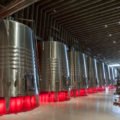 Faustino WineryAnother interesting feature of the <a href="http://inhabitat.com/index.php?s=winery">winery</a> is that it actually uses the slope of the land that it sits on to aid in the wine-making process. A road rises to the roof of the building where the harvested grapes are delivered straight into the hopper.6
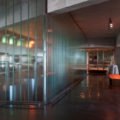 Faustino WinerySince gravity is doing the work, less electricity is needed and damage to the grapes is also minimized.7
