


Start Slideshow







 Tom Kundig Lead V1Seattle-based <a href="http://www.olsonkundigarchitects.com/" target="_blank" rel="nofollow noopener">Olson Kundig Architects</a> is one of our favorite architectural firms, championing the fight for sustainable design. Founded in the late 1960s, the firm has created a collection of structures that rise from the ground as natural extensions of their sites, acting as bridges between nature, culture, and people. We sat down with principal architect <a href="https://inhabitat.com/architect-tom-kundig-to-be-featured-at-toto-gallery-ma-in-tokyo/">Tom Kundig</a> who shares his thoughts on his design process, what it's like to be a Seattle-based firm, where he finds his inspiration and more. Read on for our exclusive interview with Tom, as well as a look at some <a href="https://inhabitat.com/the-pierre-a-breathtaking-hideaway-tucked-in-a-cluster-of-rock/">featured projects</a> that are as green as they are gorgeous!1
 chicken point cabin<h3>Inhabitat: Many well-known architects make it a point to establish offices in large cities, but even with your success Olson + Kundig remains in the (arguably) more remote Pacific Northwest. What impact do you think being a Seattle-based firm has had on your work?</h3> <p><strong><big>Tom Kundig:</big></strong> Not entirely sure. I’m sure there are impacts that we are not aware of - are we ‘mysterious’ because we are remote, or are we ‘removed from the action’? My guess is that it might be both, but the most important consideration is how we do our work. In a large landscape like the Pacific Northwest - and in a relatively large city like Seattle that is connected internationally - we might have the best of both worlds. Irregardless, our work is context based - cultural, environmental, craft, tectonics, and so forth - and we are in an ideal location where all these elements converge.2
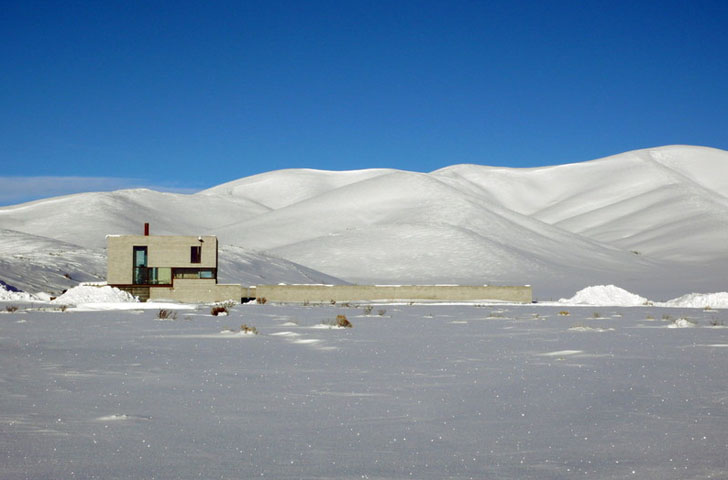
 delta shelter<h3>Inhabitat: Are you concerned about environmental and social sustainability in your buildings? If so, what role does green building play into your work?</h3></p> <strong><big>Tom Kundig:</big> </strong>I am absolutely concerned about it. And I'm not speaking strictly of the environmental, because the process of building and what's required to maintain a building consumes not only a significant amount of natural resources, but also has a huge influence on cultural and social sustainability. Ultimately architecture is cultural and social - it is shelter at its most basic human level, and within the spirit of that notion, it is a deeply humanistic endeavor.3
 The Pierre<h3>Inhabitat: What do you feel is the greatest challenge when it comes to designing for environmental sustainability?</h3> <p><strong><big>Tom Kundig:</big></strong> The greatest challenge is designing to an authenticity that recognizes the true issues of sustainability, not just treating it as a check list of items or simplifying it to accomodate to score keeping. Sustainability takes on a true, holistic understanding of all the implications of a design.4
 The Pierre<h3>Inhabitat: You're the sole N. American representative in Toto Gallery MA’s “Global Ends – Towards the Beginning” an exhibit that hopes to inspire architects to break away from the architectural uniformity resulting from past movements. Modernism has clearly been the most dominant and continues to permeate design - what are your thoughts on its value today?</h3> <p><strong><big>Tom Kundig: </big></strong>Modernism at its core is a humanistic value. It is about shelter, about culture, and about equality, safety, and nurturing for a better future for EVERYBODY. Unfortunately today, many of these values have been lost in stylistic fashion. I am hopeful that the next movement will be about a meaningful search for a humanistic architecture. This is an idea that will never go out of style.5
 rolling huts1<h3>Inhabitat: Why do you think sustainability remains largely outside of theoretical discussions of architecture? Sustainability can be clever, innovative, it can justify designs, but by in large it is not a realm of theoretical review. Themes such as space, aesthetics, and cities are constant avenues for debate, speculation and experiment, but sustainability still seems thin. Thoughts?</h3> <p><strong><big>Tom Kundig:</big></strong> Sustainability has been relegated to the ‘science’ side of practice, both by the practitioners and in academia. Architecture at its core is the <em>intersection</em> of the rational and the poetic. If architecture, academics and practitioners can embrace that idea and respect the two realms of the practice, this question would not have to be asked. Unfortunately the question is a good one.6
 Art Stable<h3>Inhabitat: Can you tell us about the house you grew up in?</h3> <p><strong><big>Tom Kundig</big></strong>: It was a 1918 classic two-story bungalow with a porch facing the street. However, it was its location near a large city port that had more affect on my childhood than the house itself. Spending my formative years in and around the lake cabin of the areas, probably had the most impact on my career.7
 1111 E. Pike Street<h3>Inhabitat: Who inspires you?</h3> <p><strong><big>Tom Kundig:</big></strong> So many architects, both living and dead, inspire me. It’s difficult to list. But certainly individuals within the architectural, art and music realm are the most inspirational. And when I speak of artists, what I'm focusing in on are those willing to truly put their souls on the line for their art. They are working ‘out there’, many times without a net, vulnerable to the second guessing of polite society, bureaucrats, academics, and mainstream media - it’s a lonely place to be.8
 Outpost<h3>Inhabitat: What is your ultimate goal when it comes to your work? What do you want to be remembered for?</h3> <p><strong><big>Tom Kundig: </big></strong>I hope that my work is meaningful and it that it resonates in people’s lives - architecture at its core.9
 1111 E. Pike StreetA 38,179-square-foot mixed-use urban infill project, with 27 condominiums spread over five stories, ground-level retail space, two underground parking levels, and a rooftop garden.10
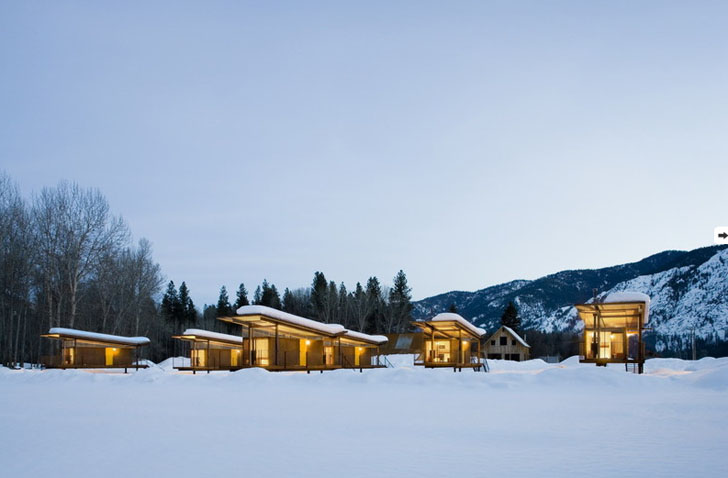
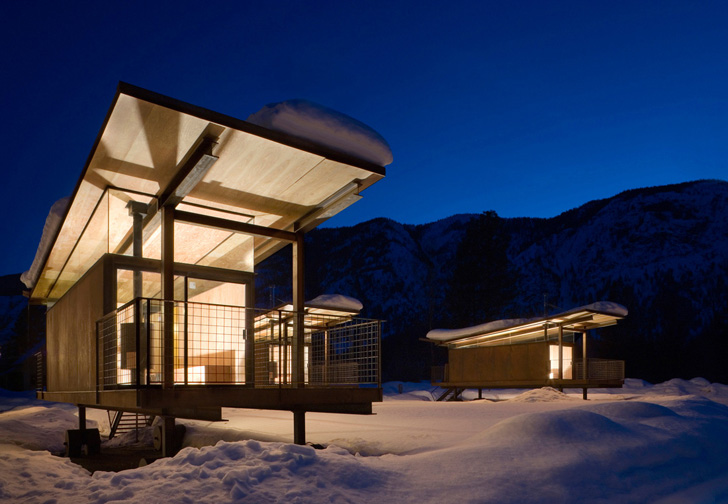
 rolling hutsResponding to the owner’s need for space to house visitors, the Rolling Huts are several steps above camping, while remaining low-tech and low-impact in their design. The huts sit lightly on the site, a flood plain meadow in an alpine river valley. The owner purchased the site, formerly a RV campground, with the aim of allowing the landscape return to its natural state. The wheels lift the structures above the meadow, providing an unobstructed view into nature and the prospect of the surrounding mountains. <p> The huts are grouped as a herd: while each is sited towards a view of the mountains (and away from the other structures), their proximity unites them. They evoke Thoreau’s simple cabin in the woods; the structures take second place to nature.11
 shadowboxShadowboxx responds to a desire to facilitate an intimate understanding of this special place and explores of the tradition of gathering around a fire. Tucked between a thicket of trees and a rising bank, the house sits in a natural clearing created by the strong winds that force back the trees from the rocky bank. The building purposely confuses the traditional boundaries between a built structure and its surroundings.12
 slaughterhouse beach houseLocated close to a well-known surfing spot, Slaughterhouse Beach House expands the concept of a traditional surfing hut with three connected huts. The structure’s walls are constructed from rammed earth. In this process, different local earth-based mixtures are packed together, and the resulting striated layers are visible both inside and outside the building. The walls blend in with the surroundings, are low maintenance, virtually fireproof, and a strong barrier to sound.13
 Montecito ResidenceThe Montecito Residence is a single-family home set in the fire-prone Toro Canyon. The owners wanted a house that minimized its use of scarce natural resources and recognized the challenging environmental conditions of the area. The design solution is a structure that functions as an umbrella to shield the house from the sun and allows cool offshore breezes to move through the space.14
 Tom Kundig interviewSeattle-based <a href="http://www.olsonkundigarchitects.com/" target="_blank" rel="nofollow noopener">Olson Kundig Architects</a> is one of our favorite architectural firms, championing the fight for sustainable design. Founded in the late 1960s, the firm has created a collection of structures that rise from the ground as natural extensions of their sites, acting as bridges between nature, culture, and people. We sat down with principal architect <a href="https://inhabitat.com/architect-tom-kundig-to-be-featured-at-toto-gallery-ma-in-tokyo/">Tom Kundig</a> who shares his thoughts on his design process, what it's like to be a Seattle-based firm, where he finds his inspiration and more. Read on for our exclusive interview with Tom, as well as a look at some <a href="https://inhabitat.com/the-pierre-a-breathtaking-hideaway-tucked-in-a-cluster-of-rock/">featured projects</a> that are as green as they are gorgeous!15


