


Start Slideshow


 Inhabitat Interview with James DysonEvery year, roughly 14 billion tons of waste are swept out to our <a href="http://inhabitat.com/tag/ocean-pollution/">oceans</a> via rivers and canals - an environmental catastrophe, since much of this pollution is made up of petroleum-based plastics. Such accumulations also present a great opportunity, however, to not only restore the health of our waterways, but also to unlock some of the latent energy that lies within all that waste! James Dyson, Founder and Chief Engineer of the renowned vacuum cleaner company of the same name, has sketched a design for <a href="http://inhabitat.com/james-dyson-wants-to-use-his-famous-vacuum-technology-to-clean-rivers/">a river barge</a> that can harvest some of the waste that our rivers carry. The M.V. Recyclone would be equipped with a massive net that would collect the debris, and then it would sort the waste into different grades using the same cyclone technology found in the company's vacuum cleaners. Once harvested, the materials could be transported to recycling facilities and repurposed in any number of ways. Inhabitat interviewed Dyson about the genesis of his fascinating barge concept—read on to learn more.1
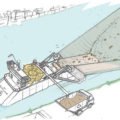 James Dyson MV Recyclone Barge<h3>1. James, can you tell us about the genesis of your MV Recyclone barge concept?</h3> To an engineer, there’s a certain thrill in solving problems, and this was absolutely an interesting one. The concept actually started as a grid which skimmed rivers, attached to a power plant placed at strategic locations along a river. But this was slow and immobile, and hardly scalable. So I began thinking about how to make it better, faster, more efficient. And eventually the barge idea emerged.2
 Brooklyn Bridge<h3>2. Can you briefly describe how this giant water vacuum might work?</h3> At its core, it is a filtration system. Large skim nets unfurl from the rollers at the barge’s stern and are anchored on either side of a river, with hydraulic winches that can wind the rollers in and out. The nets skim the surface of the river for floating debris and collect them on board. From there, the plastic waste is shredded and different grades of plastic are separated via a large cyclone – much like the cyclonic system in our vacuums – and stored until they can be discarded appropriately.3
 River Pollution<h3>3. Would the technology be appropriate for oceans or just rivers?</h3> As the concept currently stands, it is designed for rivers – the idea being that the technology would rid rivers of a major source of pollution before it can even reach the ocean.4
 Ocean Pollution<h3>4. Would the Recyclone be able to capture smaller plastic beads or only larger pieces of waste?</h3> Therein lies the biggest challenge. To capture debris of different sizes, one would need a series of separation stages. Separate out the largest pieces first, then smaller, and so on – much like how our vacuums operate. With enough prototyping and testing, these additional stages could theoretically be added to the design.5
 Green River Gorge<h3>5. Does the technology used in your vacuum cleaners inform this design?</h3> Absolutely. The key to this design is cyclonic separation – spinning out debris from the air. That is the foundation of my first vacuum, and every Dyson vacuum we’ve made to date.6
 Dyson Cyclone Technology<h3>6. Once the waste has been captured, what would you do with it?</h3> I’m an engineer, so I’ll leave it to the environmental experts to decide. But in theory, plastic collected could be transported to a nearby recycling facility, where it could be turned into new products, rather than waste away in our oceans.7
 James Dyson MV Recyclone 2Every year, roughly 14 billion tons of waste are swept out to our oceans via rivers and canals - an environmental catastrophe, since much of this pollution is made up of petroleum-based plastics. Such accumulations also present a great opportunity, however, to not only restore the health of our waterways, but also to unlock some of the latent energy that lies within all that waste! James Dyson, Founder and Chief Engineer of the renowned vacuum cleaner company of the same name, has sketched a design for a river barge that can harvest some of the waste that our rivers carry....<br><br><a href='https://inhabitat.com/interview-james-dyson-on-using-his-famous-vacuum-technology-to-suck-garbage-from-rivers/'>READ ARTICLE</a>8
 Inhabitat Interview with James DysonEvery year, roughly 14 billion tons of waste are swept out to our oceans via rivers and canals - an environmental catastrophe, since much of this pollution is made up of petroleum-based plastics. Such accumulations also present a great opportunity, however, to not only restore the health of our waterways, but also to unlock some of the latent energy that lies within all that waste! James Dyson, Founder and Chief Engineer of the renowned vacuum cleaner company of the same name, has sketched a design for a river barge that can harvest some of the waste that our rivers carry....<br><br><a href='https://inhabitat.com/interview-james-dyson-on-using-his-famous-vacuum-technology-to-suck-garbage-from-rivers/'>READ ARTICLE</a>9

