


Start Slideshow


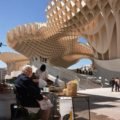
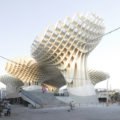
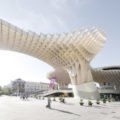
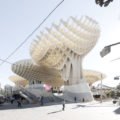
 Metropol Parasol architect, Juergen Meyer HThe Metropol Parasol was arguably the most important structure to open last year, and it has without doubt come to be one of the most photographed new architectural works of the decade. Designed by German architect Juergen Mayer, the beautiful and monumental work isthe world's largest wooden structure, and has quickly become a new focal point for the city of Seville, Spain. Throwing back to the city's marketplace tradition, and paving the way for a new era of design innovation, the Metropol Parasol is a signal moment in architectural culture....<br><br><a href='https://inhabitat.com/video-inhabitat-interviews-metropol-parasol-architect-juergen-mayer-h/'>READ ARTICLE</a>1
 Inhabitat Interviews Metropol Parasol Architect Juergen Mayer H.<em>This interview was originally published July 2011</em> <p> The <a href="http://inhabitat.com/metropol-parasol-the-worlds-largest-wooden-structure-opens-in-seville/">Metropol Parasol</a> was arguably the most important structure to open last year, and it has without doubt come to be one of the most photographed new architectural works of the decade. Designed by German architect <a href="http://www.jmayerh.de/">Juergen Mayer</a>, the beautiful and monumental work is<a href="http://inhabitat.com/new-photos-of-sevilles-gorgeous-metropol-parasol/"> the world's largest wooden structure</a>, and has quickly become a new focal point for the city of Seville, Spain. Throwing back to the city's marketplace tradition, and paving the way for a new era of design innovation, the Metropol Parasol is a signal moment in architectural culture. Recently, our very own Editor-in-Chief, <a href="http://www.inhabitat.com/jill">Jill Fehrenbacher</a>, sat down with Mayer in <a href="http://www.inhabitat.com/nyc">New York City</a> to talk about his inspiration for the design. Mayer also talks about the impact of digital technology on the architectural world, and what sustainability means for design. Hit jump to see a <strong>VIDEO </strong>of the interview, or click through our gallery above for all of Mayer's insight!2
 Inhabitat Interviews Metropol Parasol Architect Juergen Mayer H.<h3><big>Inhabitat: How did you get your start in architecture?</big></h3> <p> <big><strong>Jurgen Mayer:</strong></big> I found a book, which had the picture of <a href="http://en.wikipedia.org/wiki/Erich_Mendelsohn">Erich Mendelsohn</a>’s <a href="http://en.wikipedia.org/wiki/Schocken_Department_Store,_Stuttgart">department store</a>, Schocken, in Stuttgart. It was such a beautiful building that was dealing with light, and a very sculptural expression of<a href="http://www.inhabitat.com/architecture"> modern architecture</a> in the city. It kind of opened my eyes to our built environment, and this building in particular was took on an artistic approach to its form. At the time I was interested in sculptures that you could walk around, but it felt easier to work on a larger scale in my studies. I then expanded the discipline towards art, designing, communication, and of course, architecture.3
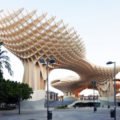 Inhabitat Interviews Metropol Parasol Architect Juergen Mayer H.<h3><big>Inhabitat: Let’s talk about the Metropol Parasol. This is the world’s largest wooden structure and it just opened in Seville, Spain. Can you tell us a little bit about how you got involved in that project and what inspired you to design this in wood?</big></h3> <p> <big><strong>Jurgen Mayer:</strong></big> It was a <a href="http://www.inhabitat.com/designcompetitions">competition</a> that we won in 2004, which was about creating a new, iconic piece for Seville that could also create a new idea for an urban space in the 21st century. What we proposed was a structure that sits on the Roman ruins, which is an archeology <a href="http://inhabitat.com/fantastical-new-salvador-dali-museum-in-florida-is-also-hurricaine-resistant/">museum </a>now. The <a href="http://inhabitat.com/new-photos-of-sevilles-gorgeous-metropol-parasol/">Metropol Parasol</a> brings back the food market, which was there before, and it also provides visitors with a mode to be elevated up above the horizon line of the buildings.4
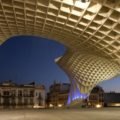 Inhabitat Interviews Metropol Parasol Architect Juergen Mayer H.<big><strong>Jurgen Mayer:</strong></big> Besides being the largest <a href="http://inhabitat.com/incredible-bangkok-guesthouse-made-from-salvaged-wood/">wood </a>or timber construction in the world, it might also be the largest one that has a glued, bonding technology. All of the joints are actually held together by a special glue that was developed about two or three years ago. While there are some nails, the steel connections are actually glued into the wood with like long fork-like steel rods. This is a very new technology, and to transfer the forces from one element to the other was actually the most innovative part in the structure of the building.5
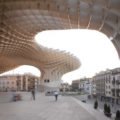
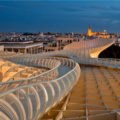 Inhabitat Interviews Metropol Parasol Architect Juergen Mayer H.<h3><big>Inhabitat: Can you walk on top of it?</big></h3> <p> <big><strong>Jurgen Mayer: </strong></big> Yes, it has a panoramic platform and there’s a <a href="http://inhabitat.com/stunning-tang-palace-restaurant-is-wrapped-in-a-geometric-bamboo-skin/">restaurant</a> on top. It has a very kind of seducing atmosphere up there, it's like being on a cloud above the city.6
 Inhabitat Interviews Metropol Parasol Architect Juergen Mayer H.<h3><big>Inhabitat: What’s been the response you’ve had so far?</big></h3> <p> <big><strong>Jurgen Mayer:</strong></big> Since it opened people are really excited about it. There was some doubt before because it was such a different and new <a href="http://www.inhabitat.com/architecture">architectural language</a>, but since it opened and became accessible, it’s been extremely busy. People like it -- they hang out there at night, they go up -- I think they have 1,700 people a day visiting the top right now, so it’s really becoming part of the city.7
 Inhabitat Interviews Metropol Parasol Architect Juergen Mayer H.<h3><big>Inhabitat: Was there an element of drawing upon nature for inspiration in this design?</big></h3> <p> <big><strong>Jurgen Mayer:</strong></big> We had some references from the city. One was big trees on a neighboring plaza, so we are doing the same in a built version. There are also references to the <a href="http://en.wikipedia.org/wiki/Seville_Cathedral">Seville Cathedral</a>, which has this beautiful, unrelated stone roof. The structure inside of the Cathedral also kind of defines the space. We sometimes call our project an urban, democratic, open Cathedral that actually is held together by the people and the life in the center of the city.8
 Inhabitat Interviews Metropol Parasol Architect Juergen Mayer H.<h3><big>Inhabitat: There also appears to be an organic and mathematical pattern to the structure.</big></h3> <p> <big><strong>Jurgen Mayer:</strong></big> The digital world, of course, comes into the mathology, and this is how we design things and how we understand our built environment. For this project, using <a href="http://inhabitat.com/building-information-modeling/">contemporary software </a>was part of the production process, not just the design process -- it is a really guiding force. However, what we are really interested in is what does this information and <a href="http://www.inhabitat.com/technololgy">technology </a>do to our built environments?9
 Inhabitat Interviews Metropol Parasol Architect Juergen Mayer H.<big><strong>Jurgen Mayer:</strong></big> I have this obsession with the data protection patterns you find on the inside of envelopes, for example. This is exactly the way we control access to personal information, or camouflage or blur personal information from a public; a neutral face. These forms of control and access, of enveloping space, enveloping a certain kind of environment, that is valuable for us.10
 Inhabitat Interviews Metropol Parasol Architect Juergen Mayer H.<h3><big>Inhabitat: Are you concerned with sustainability in your designs?</big></h3> <p> <big><strong>Jurgen Mayer:</strong></big> Sustainability is one of important issues in <a href="http://www.inhabitat.com/architecture">architecture</a>; it has to work on a functional level, it has to work on a sustainable level. It also has to work on an aesthetic level, so I think it is one of the parameters that helps us define our environment. It comes with a much more complex definition than what we usually would use to describe it.11
 Inhabitat Interviews Metropol Parasol Architect Juergen Mayer H.The interesting part of sustainability, besides it tries to be good for us, is that it moves the attention or the argument of architecture again back to the future. <a href="http://en.wikipedia.org/wiki/Postmodernism">Post-modernism</a> and <a href="http://en.wikipedia.org/wiki/Deconstructivism">Deconstructivism</a> was always concerned with an argument as a reference to the past, or anchoring a building in kind of a tradition. Sustainability flips it back to the future and creates a certain hope or a certain idea of a better future. <a href="http://www.inhabitat.com/architecture">Architecture</a> is always about a better future, otherwise nobody would invest or do anything, right?12
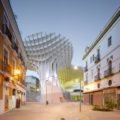
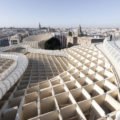
 Inhabitat Interviews Metropol Parasol Architect Juergen Mayer H.Located at Plaza de la Encarnacion, the beautiful series of undulating parasols comprise the world's largest wooden structure. The interlocking honeycomb of wooden panels rise from concrete bases, which are positioned to form canopies and walkways below the parasols.13
 Inhabitat Interviews Metropol Parasol Architect Juergen Mayer H.Aerial view of the structure.14
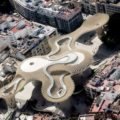 Inhabitat Interviews Metropol Parasol Architect Juergen Mayer H.Aerial view of the structure.15
 Inhabitat Interviews Metropol Parasol Architect Juergen Mayer H.The Mestia Airport building was completed in the medieval mountain town of Mestia, Georgia.16
 Inhabitat Interviews Metropol Parasol Architect Juergen Mayer H.The building comprises two branches that curve up towards the sky and serves the local ski resort.17
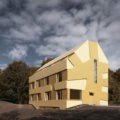 Inhabitat Interviews Metropol Parasol Architect Juergen Mayer H.Home.Haus is a design for a children’s home near a forest in Germany.18
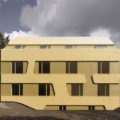 Inhabitat Interviews Metropol Parasol Architect Juergen Mayer H.The construction is based on two colors of relief greeted the appearance of the small size of the house. Central staircase and corridors provide an opportunity to develop a strict division of labor between the floors to create a public space instead.19
 Inhabitat Interviews Metropol Parasol Architect Juergen Mayer H.The Dupli Casa, a private residence by the Neckar river, near the old town of Marbach in south-western Germany.20
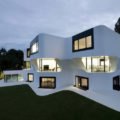 Inhabitat Interviews Metropol Parasol Architect Juergen Mayer H.The geometry of the building is based on the footprint of the house that was originally built in 1984. Since then there have been many extensions and modifications, and the new building designed by Mayer echoes the “family archaeology” by duplication and rotation.21
 Inhabitat Interviews Metropol Parasol Architect Juergen Mayer H.The An der Alster 1 is situated at the intersection between the Hamburg’s lively downtown and a lush landscape of water and. The horizontal striped facade with its floating ‘eyes’ celebrates the view onto this unique context.22

