As far as green roof designers go, you can’t get much more committed or accomplished than the team at Rana Creek. While their name often gets partially eclipsed by the names of their starchitect collaborators, such as William McDonough and Renzo Piano, it’s Rana Creek’s genius that yields such massive marvels as the rooftops of the Gap corporate headquarters and the California Academy of Sciences.
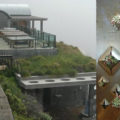
I discovered Rana Creek at CA Boom, the West Coast annual design show. Across a huge exhibition floor, I was drawn to Rana Creek’s living wall display, which they’d custom designed for the occasion as an example of a climate-appropriate botanical rain catchment system. Of course, the technical functions of the wall weren’t the main attractor; rather, it was the incredible artistry of the sculptural bent metal, through which succulents were penetrating by what seems like the sheer force of a plant’s irrepressible will to thrive.
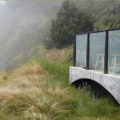
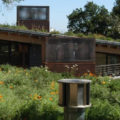
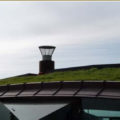
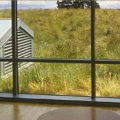
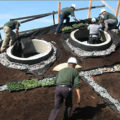
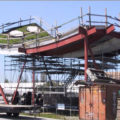

It’s a metaphor for the whole organism that is Rana Creek Habitat Restoration and Living Architecture, a California-based firm with a committment to sustainable innovation matched by a tremendously impressive project portfolio. When I met the two team representatives, Freya Bardell and Brent Bucknum, both were adamant that I speak with with their Exective Director, Paul Kephart, who they made to sound like an ecological prophet with a vision for the future that must be heard.
As it turns out, their zeal was not unfounded. A few weeks later, I had a chance to interview Paul, and gain a broader understanding of the mission and philosophy underlying Rana Creek’s tenacious green pursuits. Beginning as a painter on the Big Sur coast with a passion for natural habitats, Paul is now a leading restoration ecologist and resource planner. It was a delight to have a conversation with such a deeply knowledgeable, wholeheartedly committed, and genuinely optimistic innovator.
The interview to follow us the first part of two – you can check out our second interview here.

Sarah: So tell me how you’ve seen the interest level in green roofs evolve since you began.
Paul: Well, there is a great interest today, that’s for sure! When I first started, there was less. A lot of these great ideas started with some art and science integration, and all of the tenets and houses that support psychological and natural processes. When I did the project with Bill McDonough at the Gap [Headquarters in San Bruno, California], it was a little far out – a green roof in a Mediterranean climate. But now things are happening, and I think people are beginning to understand what is sustainable and what isn’t. People are beginning to recognize the importance of sustainable design and planning and construction. And they are starting to see the economic benefits, as well. I am pretty encouraged. Having spent 20 years doing this and now seeing it as both “main street” and “mainstream” is really a rewarding and fulfilling experience.

Sarah: It seems like you are doing some incredible projects. The way I learned about you was through researching the California Academy of Sciences*.
Paul: That‘s a spectacular project. Working with the design team of Renzo Piano and Gordon Chong, and SWA. What an absolute beautiful group of people to work with — talented, artistic, disciplined; and that vision that Renzo had was quite elegant.
From my perspective, the project addresses how to restore and encourage biodiversity in the urban sectors; what a great message, what a great venue. You know the Academy has a long tradition of exploring and explaining the natural world, and they have thousands of living organisms in collections and have been classified under the roof. Now the opportunity is to take that kind of experimentation in science and apply it in the built environment and as part of structure.
And that’s really where I’m going with my work; I want to define a new vernacular and a design style that don’t just look at green roofs and don’t just look at bioswales and grey water and passive solar, but to start to integrate all of these in a design process that really makes it a part of structure, not an amenity to or an apperturant feature of the design. That’s really on the cutting edge; that’s where a lot of our design work is going.

Sarah: So how far off is the California Academy of Sciences roof?
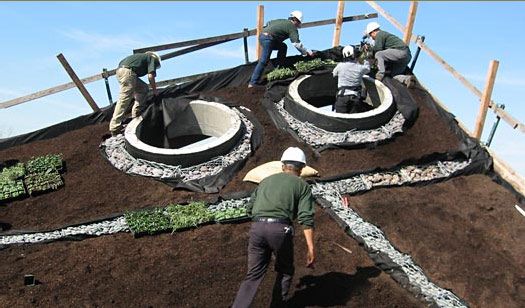
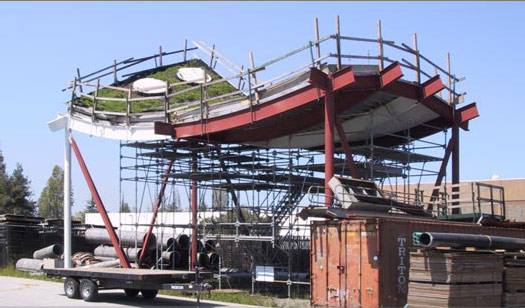
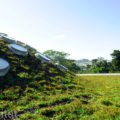
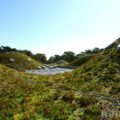
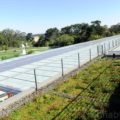
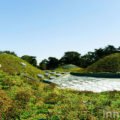
Paul:We are going to plant the roof most likely in 2007. It will be a spectacular project; it’s almost a two acre footprint and about an acre of planted roof on seven undulating domes. Two of the domes are almost 60 degree slopes. So, from an ecological standpoint, it simulates the slope, height, aspect and orientation of some of the hills that we have here in California. So the plant material we selected is kind of adapted to those micro climates on the roof.
Sarah: Is the California Academy roof going to be accessible to visitors?
Paul: It will be. We’re going to invite school children to participate and we hope to have studies on pollinators. We’ll have studies on invasive plants versus volunteers. There will be a school curriculum associated with sustainable architecture and urban ecology. We can study food webs and we are working to incorporate a study on the complexity of biodiversity and how interrelated species are within a food web.
There are so many opportunities that the California Academy roof will have for public information and interpretation about ecology, about sustainable architecture. And there is a viewing platform that will access the roof by guided tour, with information about the roof. It’s actually considered to be one of the exhibits.
[*Editor’s note: this interview was originally conducted in 2006 and the California Academy of Sciences officially opened in 2008]

Paul: We have a number of large scale projects now that are starting to look at integrated designs where we use grey water, and we use the roof as a biofilter for the grey water system; a closed-loop system where the water is then reprocessed and used in the ground plain or it can be used for other applications, water being the most precious resource.
I have been talking about green architecture and ecology and design for a number of years, but it is time to start thinking in the design community about catastrophic episodes and preparedness. How do we design food production within our cities? How do we generate energy, self-sufficiency, and how do we create an environment where people are a lot safer than they are today? It’s not only about ecology, but part of ecology is having a safe place that has stable food and energy and water supplies. That’s going to be key.
And I think our designers – after some of these large-scale events like Katrina and such – are starting to get it. I think it starts with ecology, because it’s a whole systems approach, so it looks at all the different parts of the design process and the natural process. What’s neat is that you can take ecological principles and apply them to architecture. When you think about the program of a structure or building, what about thinking about its natural processes?

Sarah: Are the food preparedness and energy issues things that you are already integrating into your current projects, or something you’re thinking towards?
Paul: You know what I’m doing is I’m beginning to articulate it. And through that articulation, I’m beginning to understand it; and now I’m beginning to see where the connections are and where we have opportunities. This actually came out yesterday in this design process for an urban application of a police station in San Jose. Here I was promoting the use of indigenous species, specific species from that site that benefit specific invertebrates and organisms — so an actual reverence for the place and the little things that inhabit it. And then I zoomed out and I said, But what about the people? That particular part of the world once had great agricultural production of fruit trees. So why can’t we retain a part of that as a part of our landscape and not just create ornamental landscape? You know, ornamental, in the true sense of the word, is without function or purpose other than adornment and amenity.
So I threw that on the table [in our meeting] and I said, “Wouldn’t it be nice to have a small grove of fruit trees?” And the answer was that the participants and the people there probably wouldn’t understand it, or they would be afraid of it. That’s how far removed we are from our food production and from natural processes. When I said, ”Well, it could be for the birds,” they said “Oh no, we don’t want birds! Then there would be birds droppings everywhere!”

Another project I’m working on is the LEAF standards. You’ve heard of LEED…now this exercise is to develop “Leadership in Ecological Applications and Functions,” where we really start to look at ecology and natural process and psychological functions in urban ecology as a part of the built environment and reward people for having an understanding of their particular site capacity to support biodiversity. What a concept! It’s called LEAF, and you don’t get a silver or gold or platinum award, you get an oak leaf, maple leaf, sycamore leaf and willow leaf award.
LEED is sometimes inadequate to really address particular species of rare plants or animals; so this would provide incentives for those kinds of developments within the built area. I keep throwing the idea out there and most people kind of look at me like I’m a little bit deranged; but that’s probably a good thing! I must be on the right track.
It’s time to get real. It’s too late to continue protesting and saying the word “saving.” That era is over. We need to be proactive and incorporate this in our design with a clear understanding that the population is going to nearly double in California in the next 40 years. That’s going to put pressure on the natural resources. And since we are going to do so much redevelopment and we’re going to create such a broad-based economic revival based on ecology, let’s celebrate it. I’m very optimistic!
+ Rana Creek
*You’ll find Part II of this interview here.