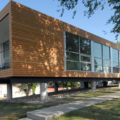
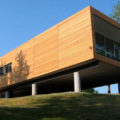
Since the last time we touted Studio 804′s design/build prefab projects, the University of Kansas studio group has completed construction and landed the prestigious Home Of The Year Award, given annually by Architecture magazine. Their prefab Modular 3 home, which was conceptualized, designed, and built all within a twenty-week long semester, earned the award with its modular framework, environmentally-friendly materials, and gorgeously modern aesthetic.
Related Posts
-
For over 10 years, Studio 804 at the University of Kansas School of Architecture & Urban Design has been churning out real projects through their
-
pieceHomes premiered at Dwell on Design last month with seven modern prefab designs that take full green advantage of factory-built construction. Created by LA-based Davis
-
We just caught wind of a beautiful new prefab that takes an innovative approach towards its own structural life-cycle. The Canada based Énóvo House
17 Responses to “PREFAB FRIDAY: Studio 804 Wins Home Of The Year”
-
Featured Author
-
Read Inhabitat
-
Search Categories
-
Recent Posts
-
Recent Comments
-
Browse by Keyword
follow inhabitat on:
popular today
all time
most commented
more popular stories >
© Inhabitat.com 2012 | About Inhabitat | Contact Us | Advertising with Inhabitat | Terms Of Use | Privacy Policy | Inhabitat, LLC


As good as this house sounds – and looks! – I would be interested to know how much it cost … as both a one-off and, potentially, if put into production. Reason for asking: during the small amount of research I’ve done, prefab appears to be drift towards the upper end of the market; thus having little practical application. [I'd be happy to find out I'm wrong in my perception
.]
the house sold for roughly 160k. I dont know how much the house would cost if mass produced, however (less, of course, but how much less…don’t know). -arjun
It looks like the antithesis of Universal Design.
Those steps leading up to it and even the other entrance, are enough to give me nightmares.
at first glance it looks like a semi-truck trailer without the cab–at second glance it looks like a hip mobile home park—and finally at thrid glance looks like good architecture—thomas gathman
I constantly hear about materials such as bamboo being green. On some level I suppose that they are, but how green is it to transport a product from asia to use in the floor of a home in north america? Is it sustainable to continue to build buildings such as this, or are we better off takeing lessons from the past? In other parts of the world, there are homes that have been occupied for centuries. That is green or sustainable to me. I love great architecture. I would like to see buildings designed to last for 300 years. I know that our consumer society doesn’t appriciate that type of thing much anymore. Perhaps eventually we will look at things differently, but I think we will be forced into it.
Hi Brad-
Bamboo can be grown anywhere and is often grown in North America – its not exclusive to Asia. That said, I know a lot of bamboo flooring comes from in China – and of course, the shipping of material across the Pacific isn’t very sustainable…….but it is still a lot better than using tropical hardwoods or even chopping down North American forest to make flooring. Bamboo grows SO fast that is really is much more renewable and thus more sustainable than any type of hard wood.
That said, your point about consumer culture is spot on. One of the biggest problems facing sustainability today is getting people to get over the idea that they have to keep purchasing “new” things all the time. Well made and well designed things can last for hundreds of years and that is TRUE sustainability.
Brad is right about shipping bamboo. difficult to speculate on where the designers of this house got their bamboo. on the other hand, their website specifically states that the external cladding was intentionally sourced locally to avoid the pollution, etc related with shipping wood from one place to another. at a minimum, the designers are cognizant of the issue that Brad raised and tried to solve the problem in at least one aspect of the house.
“It looks like the antithesis of Universal Design.”
Who said it was universal design? The design thesis was sustainable prefab, not handicapped accessibility.
Looks great to me. It’s sits well in it’s surroundings and looks like fun to live in. If i had the money i would definately look into something like this. i love how modern it looks.
Brad & Jill, yes, yes – green build is fast becoming a marketing tool by the home building industry and enough is never enough for them. Long life; it’s one of the most over looked aspects of building green. As I much as like this house, one would have to view it in its intended setting – a development – land use also being an issue! Critisism may then lean towards trailer like if the box is repeated.
is the floor plan published somewhere?
great job- love to see more interior images
ad
Check out The PBS six part series “design-e2″ http://www.designe2.com
We live in KC and have 120 acres where we want to build a small weekend cottage that is entirely off the grid. Can you recommend someone for us to work with in the area, who is well-versed in this type of design? Regards, Anne Brewer
A previous Studio 804 project was designed for a family where one member had mobility issues. There was an open house for that particular project and the place was a model of universal design.
great work , but it’s possible to see the diffrent plan and interior design .
Nice design. The idea has some promise. This design does seem very short on storge however. In the late 60′s a company in Whicita Kansas worked on a similar idea, I think it was funded by Jack DeVore. There seemed to be some economic issues. In that era getting building code approvals was a major roadblock. Today it seams some of these obsticals have been overcome, but local communities tradesmen will still make the effort difficult.
I would like to see the university do a cost study that would define the costs of this project in a manufactured enviornment.
Seeing things which are so simple yet invoke emotions from within are what makes architecture dynamic. Would it be applicable in a tropical environment(like my country Nigeria)in terms of cost effectiveness if mass produced though?